

Are Plastic Car Ramps Safe, or Should You Buy Steel?

Plastic car ramps are often suitable for many home cars and light trucks if the pair’s rating exceeds the axle weight by about 25%; steel is often preferred for frequent use, low-clearance angles, or heavier vehicles. Pick the wrong material and you risk flex, slipping, or a ramp that is too steep for your bumper or splitter. This guide shows how to compare weight ratings, slope, traction, and use frequency so you can choose the safer buy.
Choosing the right ramp material and capacity
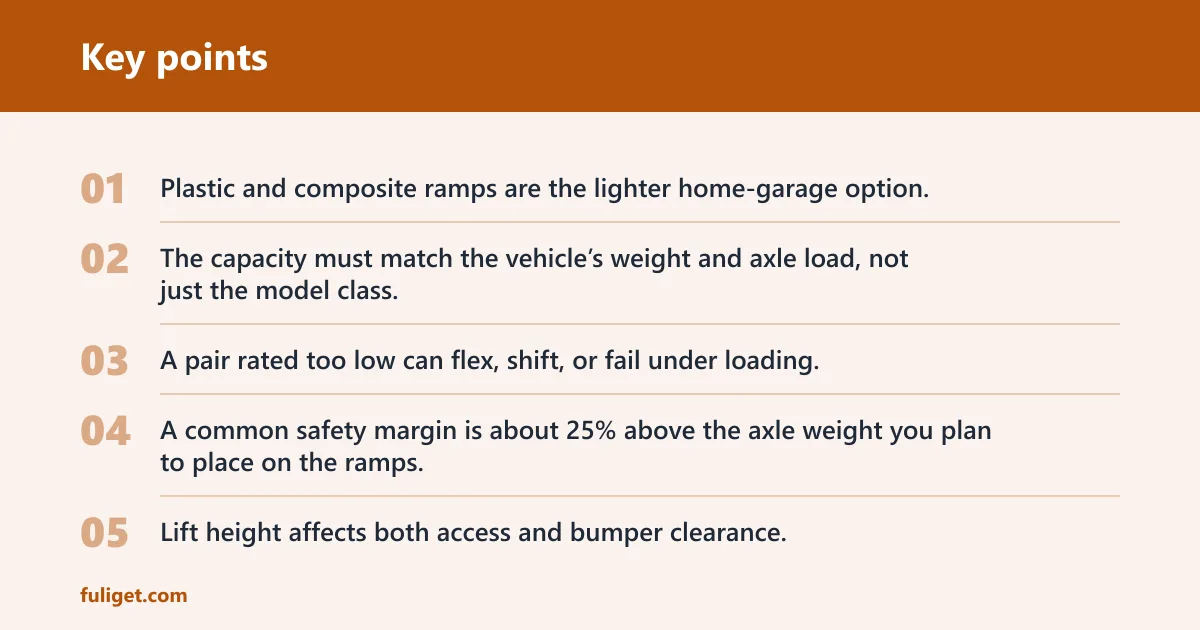
Plastic and composite ramps are the lighter home-garage option. Steel ramps are heavier-duty, more durable, and better for repeated loading or heavier vehicles, but they are harder to move and store. The right pick depends less on material alone and more on capacity, entry angle, tire traction, and the surface under the ramp.
| Comparison point | Plastic/composite ramps | Steel ramps |
|---|---|---|
| Best use | Routine home maintenance, especially on sedans, crossovers, and light trucks | Heavier vehicles, frequent use, and demanding garage work |
| Typical home fit | Commonly used for home garages | Often chosen for trucks, SUVs, and commercial vehicles |
| Lift height | Standard ramps usually raise the vehicle about 6 to 10 inches | Can vary by design; heavy-duty models may provide more access |
| Handling and storage | Lightweight construction makes them easier to carry and stack | Heavier to move and store |
| Capacity range seen on competitor pages | Examples include 6,500 pounds per pair, 12,000 pounds per pair, and 16,000 pounds per pair | Heavy-duty steel ramps can exceed 20,000 pounds capacity |
| Traction | Depends on a textured, ridged, cross-hatch, or non-skid surface | Also benefits from traction features and stable feet |
Weight capacity and load rating
Capacity is the first filter. Many ramp labels list a pair capacity, while others list per-ramp capacity, so you need to read the label carefully before buying. The capacity must match the vehicle’s weight and axle load, not just the model class. A pair rated too low can flex, shift, or fail under loading.
A common safety margin is about 25% above the axle weight you plan to place on the ramps. That matters because an even weight split is not guaranteed, especially when the engine, transmission, or cargo bias the front or rear axle. Capacity is not a place to guess.
Lift height and entry angle
Lift height affects both access and bumper clearance. Standard ramps often lift about 6 to 10 inches, which works well for many routine maintenance jobs. Low-profile ramps have a gentler entry and lower lift, which helps cars with little front clearance, but the lower angle can also reduce working room under the vehicle.
Entry angle matters as much as total height. A steep ramp can scrape a low splitter, bumper lip, or front valance before the tire even reaches the flat top. A gentler approach, such as roughly a 17-degree or 20-degree style, can reduce that risk on lower vehicles and may also lower the chance of wheel spin during loading.
Traction surface and stability
A ramp needs grip where the tire meets the ramp and where the base meets the floor. Ridged, cross-hatch, or non-skid tread helps prevent tire slip during loading, especially on wet concrete or smooth garage floors. Some designs also use rubber feet or stops to reduce movement on hard surfaces.
Stability depends on a hard, level support surface. Garage floors and paved driveways are commonly used choices. Uneven pavement, gravel, grass, or softened asphalt can let a ramp creep as the tire climbs, which is exactly when the vehicle is most vulnerable to slipping off line.
Portability and storage
Plastic/composite ramps are generally easier to move, carry, and stack. That matters in a small garage where you may not want to lift heavy steel gear every time you change oil or inspect brakes. Steel is the better fit when weight and storage space are less important than durability and repeated use.
For a one-car household that uses ramps a few times a year, lighter weight is a real advantage. For a busy garage that sees repeated service on heavier vehicles, the extra mass of steel is easier to justify.
Are plastic car ramps safe?
Yes, plastic ramps are safe for routine home use when the rating fits the vehicle, the entry angle suits the clearance, and the floor is hard and level. They are commonly used in home garages for standard-height sedans, crossovers, and light trucks. Safety drops fast if the ramp is overloaded, too steep, or placed on a soft surface.
When plastic ramps are a good fit
Plastic ramps fit best when you want a light, easy-to-store tool for oil changes, underbody checks, or other short maintenance jobs. Standard plastic ramps are the most common type for home garages, and standard models are ideal for regular-height sedans, crossovers, and light trucks. Their typical lift height of about 6 to 10 inches is enough for many simple tasks.
Say your sedan weighs 3,600 pounds and the front axle carries roughly half that. A pair rated well above the front axle load gives you margin for safety, while a textured top and rubberized base help prevent movement during loading.
Where plastic ramps fall short
Plastic ramps are a weaker fit for repeated loading, heavier vehicles, and very low front ends. The main failure modes are flex under load, tire slip on a smooth surface, and a steep approach that catches the bumper or splitter before the tire climbs. If the vehicle is close to the rating, steel is the safer long-term buy.
A common first-timer mistake is assuming all ramps in the same size category are equivalent. Two ramps can look similar but differ sharply in incline, tread, and pair rating. Those differences change how likely the tire is to spin or the nose to scrape on entry.
What makes a plastic ramp safer
-
Check the rating first.
Look for pair capacity or per-ramp capacity before anything else, then match it to the axle weight with margin to spare. If the label is unclear, do not assume the number is generous enough for your vehicle.
-
Match the clearance.
For regular-height vehicles, a standard 6 to 10 inch ramp often works. For lower cars, choose a low-profile design with a gentler entry so the bumper and splitter clear the leading edge.
-
Use a hard surface.
Place the ramps on a level garage floor or driveway, not on gravel, grass, or a sloped apron. Uneven ground increases the chance of creep when the tire starts climbing.
When should you buy steel car ramps?
Buy steel when the vehicle is heavier, the ramp will see frequent use, or the car is regularly loaded in a demanding setting. Steel is the better long-term buy for trucks, SUVs, commercial vehicles, and repetitive garage use. It is heavier to store, but it can handle bigger loads and more abuse.
Heavy vehicles and repeated use
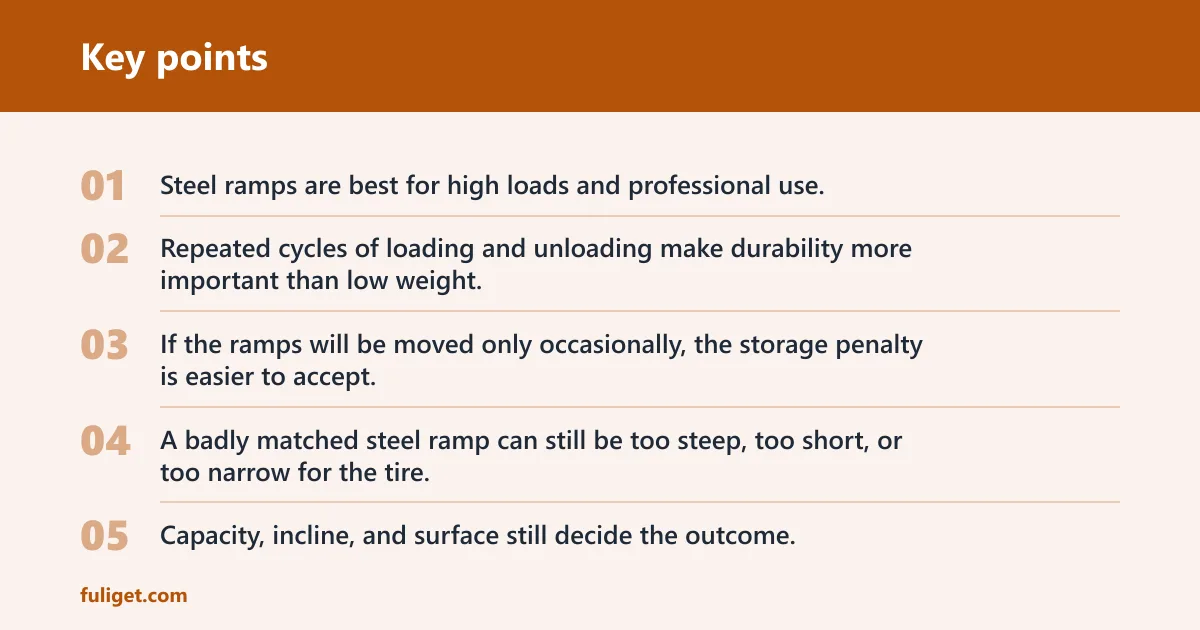
Steel ramps are best for high loads and professional use. Heavy-duty steel ramps can reach very high capacities, which puts them in a different class from many home-use plastic options. That extra margin matters for full-size trucks, larger SUVs, and work vehicles that are loaded often.
They are also the stronger choice when ramps stay in use frequently. Repeated cycles of loading and unloading make durability more important than low weight. If the ramps will be moved only occasionally, the storage penalty is easier to accept.
Why steel can be the better long-term buy
Steel usually wins on toughness. It resists wear from repeated tire contact and repeated handling better than lightweight plastic designs. For a garage that serves one truck every week, or multiple vehicles every month, the extra durability can justify the added cost and mass.
That does not mean steel is automatically safer. A badly matched steel ramp can still be too steep, too short, or too narrow for the tire. Capacity, incline, and surface still decide the outcome.
Tradeoffs in weight and storage
The price of steel is physical convenience. Heavier ramps are harder to carry, move into position, and store on a wall or shelf. If you need to set them out and put them away often, that extra weight becomes part of the real cost.
Choose steel when the vehicle and the usage pattern justify it. Choose plastic when the lighter handling matters more and the load rating still leaves useful margin.
Car ramps decision matrix
This matrix gives a direct buyer rule. Use vehicle type, ground clearance, and maintenance frequency together, because no single factor tells the whole story.
| Decision factor | Plastic/composite is the better fit | Steel is the better fit |
|---|---|---|
| Vehicle type | Sedans, crossovers, regular-height light trucks | Trucks, SUVs, commercial vehicles, heavy work rigs |
| Ground clearance | Normal clearance with room for a standard 6 to 10 inch lift | Higher load needs or vehicles that need a stronger structure more than a lighter shell |
| Maintenance frequency | Occasional oil changes and inspections | Frequent loading, repeated garage use, or fleet-style maintenance |
| Recommended ramp material | Plastic/composite if the rating and angle fit the car | Steel if capacity, durability, and repeated use matter more |
Which ramp material fits your vehicle?
The right material changes with vehicle class. Sedans and crossovers usually fit standard plastic ramps if the rating and approach angle are correct. SUVs and light trucks may still fit plastic, but steel becomes more attractive as weight and frequency go up. Lowered sports cars need the gentlest entry angle, not just a higher rating.
Sedans and crossovers
For regular-height sedans and crossovers, plastic is often the smarter home-garage choice. Standard plastic ramps are described as ideal for these vehicles, and the typical 6 to 10 inch lift is enough for many oil changes and inspections. A textured tread and stable base matter more than raw mass here.
SUVs and light trucks
Are plastic ramps okay for trucks and SUVs? Sometimes, yes. They can be fine if the pair rating clearly exceeds the axle load and the entry angle is not steep. But steel becomes more attractive as the vehicle gets heavier or the ramps see repeated use, because it gives more durability and often more capacity headroom.
Lowered sports cars
Can low-profile cars use plastic ramps safely? Yes, if the ramp is truly low-profile and the entry angle is gentle. Low-profile ramps can have an entry point as low as 1 to 2 inches, and some low-profile options offer a 2.6-inch lift for low-chassis vehicles. A steep plastic ramp can scrape before the tire fully climbs.
Choose plastic if… / Choose steel if…
Choose plastic if you want a lighter home-garage ramp for routine maintenance and your vehicle stays well inside the listed rating. Choose steel if you need higher capacity, more repeated use, or better support for trucks and SUVs. The safer choice is the one that matches weight, clearance, and how often you will load it.
Choose plastic if you want lighter home-garage use
Plastic is the better choice when you need easy storage, lighter carrying weight, and a ramp for occasional oil changes or inspections. It also makes sense when your vehicle is a sedan, crossover, or light truck with enough front clearance for a standard ramp and a textured tread for grip.
Choose steel if you need higher capacity or frequent loading
Steel is the better choice when the vehicle is heavier, the work is frequent, or the ramp must tolerate repeated use without feeling marginal. It is also the safer direction when you want the extra capacity buffer that many heavy-duty steel designs provide.
-
Measure the vehicle weight.
Use the vehicle’s listed weight and think in axle terms, not just curb weight. The ramp rating should leave a clear margin above what one axle will place on the ramps.
-
Check the approach angle.
Match the ramp to the vehicle’s clearance. A lower car needs a gentler entry, while a standard-height sedan can usually accept a standard ramp angle.
-
Match the usage pattern.
Use plastic for occasional home work. Move to steel when loading becomes frequent or when the vehicle’s mass and duty cycle make durability more important than portability.
Frequently asked questions
Are plastic car ramps safe for an oil change?
Yes, if the ramps are rated above the axle load, sit on a hard level surface, and have enough traction to keep the tires from slipping. Plastic ramps are commonly used for oil changes because they are light, easy to store, and usually raise the vehicle enough for drain access.
Should I buy steel car ramps instead of plastic?
Buy steel if the vehicle is heavy, the ramps will be used often, or you want more durability for long-term garage work. If your car is a normal sedan or crossover and you only need ramps a few times a year, plastic is often the more practical choice.
How much weight capacity do car ramps need for my vehicle?
Check the vehicle’s axle load and choose ramps that exceed it by a comfortable margin. Many buyers use a 25% buffer as a practical safety target. Also check whether the listed number is for a pair or for one ramp, because the label format changes the calculation.
Are plastic ramps okay for trucks and SUVs?
Sometimes, yes. Plastic ramps can work for trucks and SUVs if the rating is high enough and the entry angle is manageable. But as vehicle weight and use frequency rise, steel becomes the safer long-term fit because it offers more durability and often more capacity headroom.
Can low-profile cars use plastic ramps safely?
Yes, but only with a low-profile design and a gentle entry angle. Low-profile ramps can have an entry point as low as 1 to 2 inches, which helps avoid bumper scrape. A standard steep ramp can be a bad fit for lowered cars, even if the capacity is high.
What surface should car ramps sit on to stay stable?
Use a hard, level surface such as a garage floor or a paved driveway. Soft ground, gravel, and uneven concrete increase the chance of ramp movement. Good traction at the tire and a stable base on the floor both matter, especially during the first few inches of loading.