
Jump Starter: How to Choose the Right One

Choose a jump starter by matching your vehicle’s largest engine and battery type to the unit’s peak amps: about 800–1,000A for most gas cars and SUVs, and around 1,200A or more for trucks or diesels, with lithium for compact storage and AGM-safe electronics. Buy too small, and it may fail with a flat battery, push you into features you will never use, or simply be wrong for sensitive electrical systems. This guide matches jump-starter specs to sedans, SUVs, trucks, diesels, hybrids, storage space, standby life, and budget.
Choose by vehicle first
Start with the engine you need to crank, then check battery type, where the unit will live, and how often it may sit unused. That sequence works better than shopping by brand, because the wrong size, cable length, or battery support can rule out a unit before any extra feature matters.
Small gas cars and compact SUVs
For most four-cylinder and smaller V6 gas vehicles, the useful starting point is the compact lithium class around 800A to 1,000A peak. That usually keeps weight low enough for glovebox, console, or under-seat storage while still covering ordinary commuter use.
The Noco Boost Plus GB40 is rated at 1000A peak, and Car and Driver says it can start most gasoline engines up to about 6.0 liters. That makes it a useful reference point for a typical sedan or compact crossover buyer: enough for many gas vehicles without moving into the bulky heavy-duty class. (Caranddriver)
V6 and V8 family vehicles
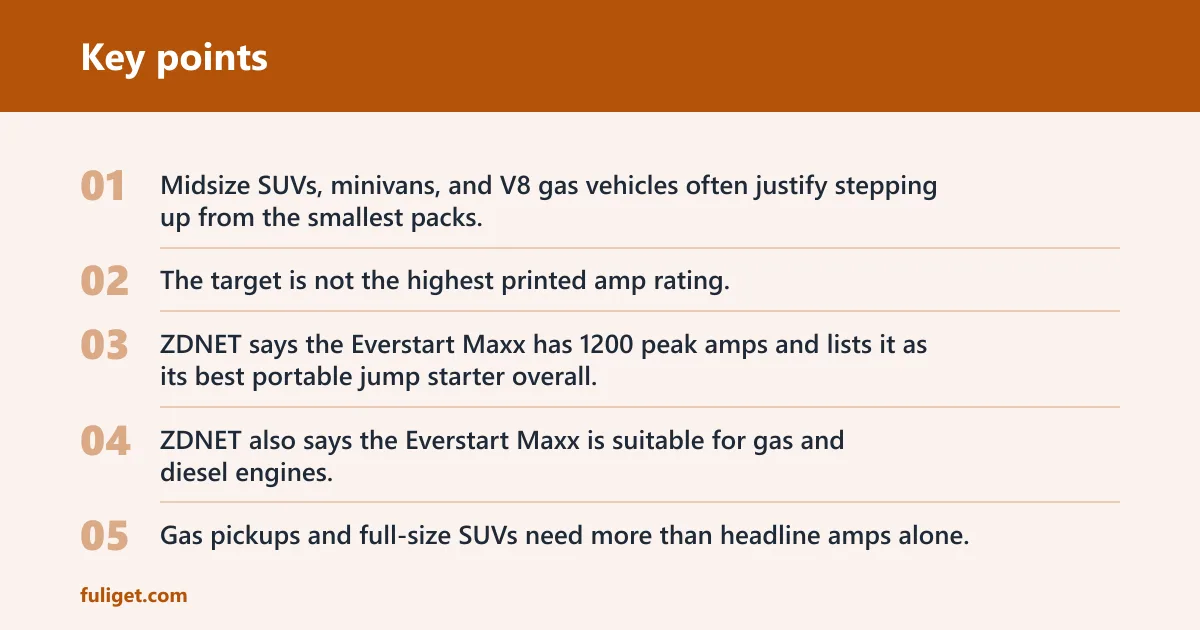
Midsize SUVs, minivans, and V8 gas vehicles often justify stepping up from the smallest packs. The target is not the highest printed amp rating. It is enough reserve for cold weather, a weakened battery, and clamp contact that is good, not perfect.
ZDNET says the Everstart Maxx has 1200 peak amps and lists it as its best portable jump starter overall. ZDNET also says the Everstart Maxx is suitable for gas and diesel engines. That makes the 1,200A tier a practical reference for families with one larger gas SUV and another smaller vehicle in the driveway.
Half-ton trucks and larger SUVs
Gas pickups and full-size SUVs need more than headline amps alone. Larger engines often benefit from thicker cables, stronger clamps, and a case large enough to hold cells that do not sag badly under load.
If the truck lives in a trunk kit and only sees occasional emergency duty, a solid midrange unit may be enough. If it sees towing, repeated starts, or winter use, move up in size early.
Diesel pickups and heavy-duty use
Diesel usually pushes buyers into a larger class because compression demands are higher and cold starts punish weak packs. Here, manufacturer engine-size limits matter more than marketing language.
Car and Driver says the Gooloo GT6000 has 6000 A peak amperage and is rated for gas and diesel engines up to 12.0 liters. That does not mean every diesel owner needs 6000A, but it shows where heavy-duty packs sit when the job moves beyond passenger-car duty. (Caranddriver)
Suppose a diesel pickup has to be parked outside through winter and the battery may not be fresh. That is a case for buying above the minimum listed engine match, because low temperature and battery age can erase the safety margin fast.
How much peak amps do you need?
Peak amps are a quick sorting tool, not proof that a unit will start your vehicle every time.
What peak amps actually tell you
Peak amperage is the maximum burst a jump starter claims it can deliver. It is useful because it narrows the field quickly by vehicle type. It is imperfect because test conditions, battery state, temperature, and cable quality vary widely across brands.
Use peak amps to narrow the shelf fast, then check the unit’s stated engine support, such as a gas-liter or diesel-liter limit. A clear engine-size rating tells you more than an oversized amp claim with no vehicle match behind it.
Useful starting ranges by engine size
A common rule of thumb is simple:
- Small gas cars and many compact SUVs: around 800A to 1,000A peak
- Larger V6 and V8 gas vehicles: around 1,000A to 1,200A or more
- Half-ton trucks and diesel vehicles: usually 1,200A and up, with more reserve preferred
- Large diesel or repeated commercial use: heavy-duty packs with explicit diesel support
Those ranges are buying filters, not promises. A worn battery, freezing weather, or poor clamp placement can still beat an otherwise adequate unit.
Why diesel ratings need extra margin
Diesel labels deserve closer reading because “diesel compatible” can mean very different things. One model may support a light-duty diesel. Another may be rated up to 12.0 liters. That gap is huge in real use.
Diesel buyers should look for three things together: a stated diesel limit, substantial clamps, and a larger pack that is realistic to store in the truck rather than forgotten in a garage cabinet.
Why clamps and cables matter too
A jump starter can have a strong cell pack and still disappoint if the clamps bite poorly or the leads are too short for awkward battery placement. Car and Driver says the Clore Jump-N-Carry JNC325 includes a 24.0-inch lead length, which matters on trucks and engine bays where the battery posts are not easy to reach.
Picture a full-size SUV with a plastic cover, a recessed positive terminal, and a ground point off to the side. A compact unit with stubby leads may force a strained connection, which can matter more than a few hundred extra advertised amps.
Will a jump starter work on a dead battery?
A jump starter often works on a discharged battery, but not every dead-battery situation is recoverable. It may fail if the battery has internal damage, voltage is too low for auto-detection, the clamps are not making clean contact, or the battery is frozen in severe cold.
When a low battery is still jump-startable
If the battery is simply discharged from lights left on, short-trip driving, or sitting too long, a suitable jump starter usually has a fair chance. This is the best-case scenario for portable units.
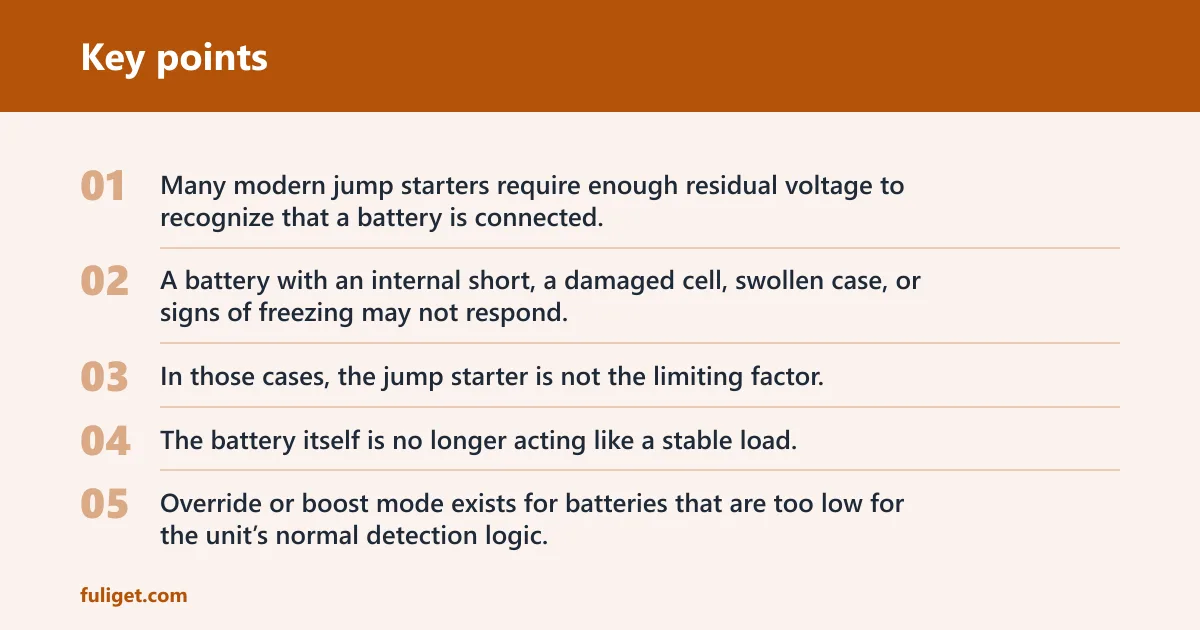
Many modern jump starters require enough residual voltage to recognize that a battery is connected. That safety logic helps prevent misuse, but it also explains why some “dead” batteries do not trigger an automatic start mode.
When the battery is too far gone
A battery with an internal short, a damaged cell, swollen case, or signs of freezing may not respond. In those cases, the jump starter is not the limiting factor. The battery itself is no longer acting like a stable load.
A common first-timer mistake is assuming a no-start always means “buy more amps.” Sometimes the battery is physically finished, and the right next step is diagnosis or replacement, not a larger pack.
What override or boost mode
Override or boost mode exists for batteries that are too low for the unit’s normal detection logic. It forces the jump starter to deliver output anyway. Because that can bypass part of the protection system, it should be used only when the manual allows it and the clamps are confirmed correct.
This feature matters most for occasional deep-discharge situations. It is not a substitute for a healthy battery.
Cold-weather and low-voltage failure cases
Cold thickens engine oil and reduces battery performance at the same time. That is why a unit that looks sufficient on paper can struggle on a winter morning, especially on a larger gas engine or diesel.
Buyers in cold climates should leave more headroom above the minimum engine rating and be stricter about recharge discipline after each use.
Which battery types and vehicles are compatible?
A jump starter should match the vehicle’s 12V starting system first. Standard flooded lead-acid and AGM batteries are the common target, some units also support lithium starter batteries when stated by the maker, and hybrids or EVs use these packs only for the 12V auxiliary battery, never the traction battery.
Standard 12V lead-acid and AGM batteries
Most passenger vehicles still use a 12-volt lead-acid starting battery, either flooded or AGM. AGM compatibility matters because many newer vehicles use AGM for stop-start systems and higher accessory loads.
Check the product page or manual for direct wording on AGM support. Do not assume every unit treats every 12V battery chemistry the same way.
Lithium starter batteries and manufacturer limits
Some specialty or performance vehicles use 12V lithium starter batteries. A portable jump starter may work, but only if the manufacturer states support. This is a compatibility check, not a place for guesswork.
Lithium jump starters themselves are popular because they store compactly. That says nothing by itself about whether they are approved to boost every lithium vehicle battery type.
Gas versus diesel compatibility labels
Gas compatibility alone is not enough for truck buyers. Read the label for a diesel statement and, ideally, a listed engine-size ceiling. The same source says the Everstart Maxx is suitable for gas and diesel engines, while Car and Driver says the Gooloo GT6000 is rated up to 12.0 liters. Those are not interchangeable claims.
Hybrids and EVs with 12V auxiliary batteries
Many hybrids and EVs still depend on a 12V auxiliary battery to wake control systems, close relays, or power accessories. A jump starter can often help that 12V system if the manual permits it.
It does not charge or start the high-voltage traction battery. Keep those two systems separate when shopping and when reading compatibility labels.
What safety features matter most?
Safety protections should outrank convenience extras. Reverse polarity protection, spark prevention, short-circuit protection, overcurrent protection, and temperature protection reduce the odds of damage or misuse, while manual override is valuable only for rare low-voltage cases and should stay a backup feature, not the reason to buy.
Reverse polarity and spark protection
These are the baseline protections worth insisting on. Reverse polarity protection warns or blocks output if the clamps are on the wrong terminals. Spark protection reduces ignition risk during connection.
For most buyers, these features matter more than a brighter flashlight or another USB port.
Short-circuit, overcurrent, and temperature protection
These protections help if clamps touch accidentally, the load spikes, or the pack gets too hot. They are especially relevant on compact lithium units, where thermal control is part of safe high-current discharge.
Look for them in the manual or spec sheet, not only on front-of-box marketing claims.
Manual override and its limits
Override mode can be useful, but it is also the feature most likely to be misunderstood. It exists for very low-voltage batteries that normal auto-sensing rejects. It should never be treated as a routine mode.
Clamp design and connection security
Big, well-sprung clamps with solid jaw contact are easier to trust than tiny decorative-looking ones. This is one reason larger-engine units often weigh more: the supporting hardware is bigger too.
Jump starter matrix
| Buyer profile | Recommended peak amps | Must-have features | Acceptable weight range | What to skip |
|---|---|---|---|---|
| Sedan | 800A to 1,000A peak | 12V lead-acid and AGM support, reverse polarity protection, spark protection, compact case | About 1.5 to 3 pounds | Built-in inverter, oversized diesel claims, very bulky compressor combos |
| SUV | 1,000A to 1,200A peak | AGM support, stronger clamps, usable cable length, override mode for low-voltage cases | About 2 to 5 pounds | Ultra-mini units with short leads, AC outlet add-ons that increase bulk |
| Truck or diesel | 1,200A or more, with explicit diesel rating | Diesel compatibility label, heavier clamps, longer leads, temperature protection, trunk or cab case | About 4 to 10+ pounds | Glovebox-size packs chosen only by peak-amp sticker |
| Emergency-only kit | Match vehicle minimum, then favor standby life and simple controls | Long hold-charge claim, easy recharge method, basic USB output, clear status indicators | Under 3 pounds if space is tight | Air compressor if space is limited, premium work-truck hardware, extra ports rarely used |
Safe jump-start steps and failure checks
If you already have the right jump starter, the next priority is using it in the correct order so you do not spark the battery or damage the car’s electronics. The supporting guide explains the safest setup for a 12V vehicle, where to place the red and black clamps, when the ready light matters, and why you should stop after one or two failed starts instead of forcing repeated attempts.
It also covers the common mistakes that turn a simple emergency fix into a bigger problem, including poor grounding, reversed connections, and ignoring a weak battery or faulty clamps. For a clear step-by-step sequence, see jump starter safety.
How portable should your jump starter be?
Portability should match both the vehicle and the storage spot. A compact unit is easier to keep in the car, but larger engines often need a bigger pack, longer leads, and heavier clamps, so the right portable jump starter is the smallest unit that still fits your actual engine and battery needs.
Glovebox-size units
Small lithium packs make sense for sedans and compact crossovers where every inch matters. Car and Driver says the Strauto is the lightest unit in its test at under 1.5 pounds, which gives a useful benchmark for the ultra-light end of the category.
That size works best when the vehicle is modestly powered and the owner will accept shorter cables and fewer extras.
Trunk-ready mid-size units
For family vehicles, a slightly larger case often buys better clamps, more battery reserve, and easier charging. This is the sweet spot for many buyers.
If the unit lives in a trunk organizer, a few extra pounds usually matter less than reliable reach to the terminals.
Heavy-duty packs for trucks and fleets
Repeated-use vehicles, work trucks, and severe-cold duty justify larger packs that would feel excessive in a commuter sedan. The storage question changes too: glovebox convenience matters less than keeping the unit charged, protected, and easy to grab with gloves on.
Cable length, case shape, and storage fit
Measure your storage space before buying. A thick rectangular pack may fit under a rear seat but not in a console. A slim pack may store nicely but fail to reach a remote grounding point.
Car and Driver says the Clore JNC325 has a 24.0-inch lead length. That is a useful reminder that cable reach is part of portability, not separate from it.
Which extra features are worth paying for?
Safety features matter first, USB charging is useful for many people, and an air compressor or inverter is worth the extra bulk only when you will realistically use it. For most buyers, emergency starting performance and storage readiness should beat feature-heavy combo designs.
USB and USB-C charging
USB output is practical because the jump starter already lives in the vehicle. Car and Driver says the Clore JNC325 includes USB-C input and USB-A outputs, a sensible combination because USB-C can simplify recharging while USB-A still covers common cables.
Useful? Yes. A buying priority over engine match? No.
LED lights and SOS modes
An LED light is fine as a convenience, especially for nighttime clamp placement. It should stay near the bottom of the checklist. Most phones already cover basic light duty.
Built-in air compressor tradeoffs
A compressor earns its space if the vehicle often travels far from help, carries family gear, or regularly sees slow leaks. It adds bulk, heat, and another failure point, so it is less attractive when the jump starter must fit in a glovebox.
Say your compact sedan already has a spare storage bin that barely fits a 1,000A pack. In that case, a separate small inflator often makes more sense than a single oversized combo unit that gets left at home.
When an inverter or AC outlet makes sense
Inverters are niche features for camping, jobsite use, or powering small AC devices briefly. They rarely belong on a sedan-focused jump starter bought for emergency starts. Buyers who truly need AC output often do better with a separate power station.
How long does a jump starter hold a charge?
Hold-charge claims vary, so treat them as a storage guide rather than a promise. Some units claim standby measured in months, but real readiness depends on self-discharge, climate, and whether you recharge after use; seasonal checks are the safe habit for any jump starter stored long-term.
Standby claims versus real storage life
Long standby life matters most for emergency-only buyers who may go months without touching the unit. The same source says the Hulkman Alpha85 can hold a charge for up to 18 months. That is useful as an upper-end example, not permission to forget the unit indefinitely.
Recharge intervals by chemistry and climate
Most manufacturers list a recharge interval in the manual. Follow that, because heat and cold both chip away at readiness. Recharge sooner after any use, even a successful one-start event.
Seasonal check routines
- Check charge status. Look at the unit’s indicator at the start of each season. If the display is low or not full, recharge it before it goes back into the vehicle, because long storage at partial charge increases the odds of a no-start surprise.
- Recharge after use. Top it up as soon as practical after any jump-start or USB charging session. The pack may still show power left, but emergency gear is most useful when returned to full before the next event.
- Inspect clamps and leads. Wipe off corrosion, confirm the cable jacket is intact, and make sure the jaws still move freely. Connection quality can decide whether the unit works at all.
- Review the storage spot. Keep the case where it will not be crushed, soaked, or buried under cargo. Fast access matters when weather is bad and battery posts are hard to reach.
What storage readiness looks like
A ready jump starter is charged, reachable, and still paired with its clamp harness and charge cable. A powerful pack left half-charged in a garage drawer is less useful than a modest one kept maintained in the car.
How much should you spend?
Spend according to engine size, diesel needs, storage space, and how often failure would be costly. Under $100 can cover many small gas vehicles, midrange buys more margin and better hardware, and premium heavy-duty pricing makes sense mainly for trucks, diesels, repeated use, or severe-cold duty.
What under $100 usually gets you
This tier is strongest for sedans, hatchbacks, and smaller SUVs. Expect compact lithium designs, basic safety protections, and USB charging. Be careful with aggressive amp claims on very small cases.
Skip compressor combos here unless storage space is generous and reviews confirm the tool is actually usable.
What improves in the midrange
Midrange models usually buy better clamps, clearer status displays, faster charging, more reserve, and stronger support for larger gas vehicles. This is also where feature choices start to matter more sensibly than at the entry level.
When premium heavy-duty pricing is justified
Premium pricing is easiest to justify for diesel pickups, large trucks, fleet use, cold-weather operation, and buyers who need explicit high-displacement support. The Gooloo GT6000 example shows how far the category extends when the target includes diesel engines up to 12.0 liters.
Features to skip at each budget tier
Small-car buyers should skip inverter-heavy and compressor-heavy bundles first. SUV buyers can usually skip AC outlets. Truck and diesel buyers should skip ultra-light units that look convenient but sacrifice cable reach and clamp quality for compactness.
Frequently asked questions
How do I choose a jump starter for my car?
Match the unit to your largest engine, confirm support for your 12V battery type, then check storage size and standby habits. For many gas cars, around 800A to 1,000A peak is a sensible starting filter, while larger gas vehicles and diesel models usually need more reserve.
How do I choose a portable jump starter?
Choose the smallest unit that still fits your engine size, cable-reach needs, and battery chemistry. Portability is not only weight. It also includes whether the case fits your glovebox or trunk kit, whether the leads reach the battery cleanly, and whether you will actually keep it charged.
What is a good jump starter for a car?
A good jump starter for a car is one with a realistic engine match, strong safety protections, clear charge indicators, and storage-friendly size.
What jump starter do I need for trucks or larger engines?
For trucks or larger engines, start around the 1,200A class and move up when diesel, cold weather, towing duty, or repeated use enter the picture. Look for explicit diesel wording, heavier clamps, and longer leads, because larger vehicles punish weak connections more than smaller cars do.
Can I use a jump starter for a hybrid or electric car’s 12V battery?
Often yes, if the vehicle manual and the jump starter maker both permit it. The jump starter is for the hybrid or EV’s 12V auxiliary battery only. It does not charge, power, or revive the high-voltage traction battery, which is a different system entirely.