
Low-Profile Drain Pan: Do You Need One for a Low Car?

A low-profile drain pan helps when it can slide under the car and still catch the oil stream. If your crossmember or bumper blocks the path, a flatter pan may not solve the job. Miss the stream and you can coat the subframe, lose access to the drain plug, or lift the car more than planned. This guide shows how to judge height, angle, and spout placement so you can tell whether the pan will fit your car.
What to look for in pan size and features
A low-profile drain pan is shorter overall, usually with a shallow rim, a wide catch area, and often a pour spout or handle. The point is fit, not appearance. It is built to clear tight space while still catching the oil stream without forcing the pan too far from the drain plug.
Height, rim depth, and catch area
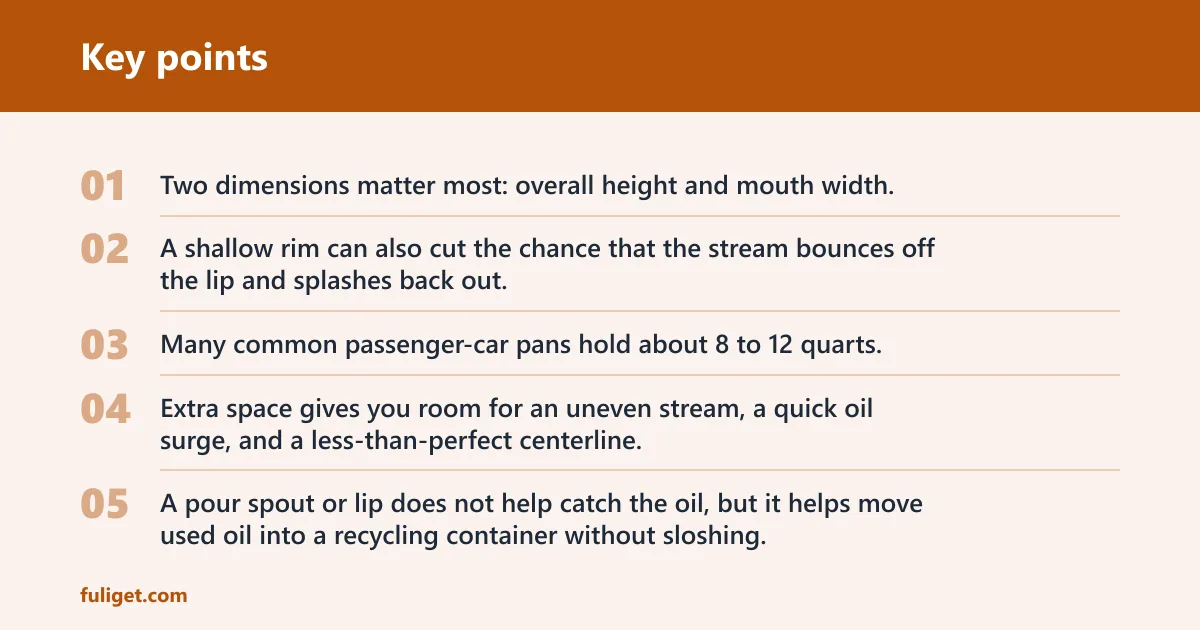
Two dimensions matter most: overall height and mouth width. A lower body helps it fit under a low car, and a wider opening can matter just as much when the drain plug sends oil at an angle. A shallow rim can also cut the chance that the stream bounces off the lip and splashes back out.
Many common passenger-car pans hold about 8 to 12 quarts. That range matters because the pan should exceed the engine oil capacity with headroom, not match it exactly. Extra space gives you room for an uneven stream, a quick oil surge, and a less-than-perfect centerline.
Why spouts and handles matter after draining
A pour spout or lip does not help catch the oil, but it helps move used oil into a recycling container without sloshing. That matters more when the pan must sit farther from the vehicle, because you may be carrying a full pan with less room to move it. A handle helps too, especially when the pan is full and slippery.
Why low cars make oil changes harder
A low car has less ground clearance, so the oil pan, crossmember, or front bumper can limit where you place the drain pan. Angle is the other problem. If the drain plug points down and slightly rearward, the stream may travel farther than it looks from the side, and a standard pan can sit outside that path.
Ground clearance and access to the drain plug
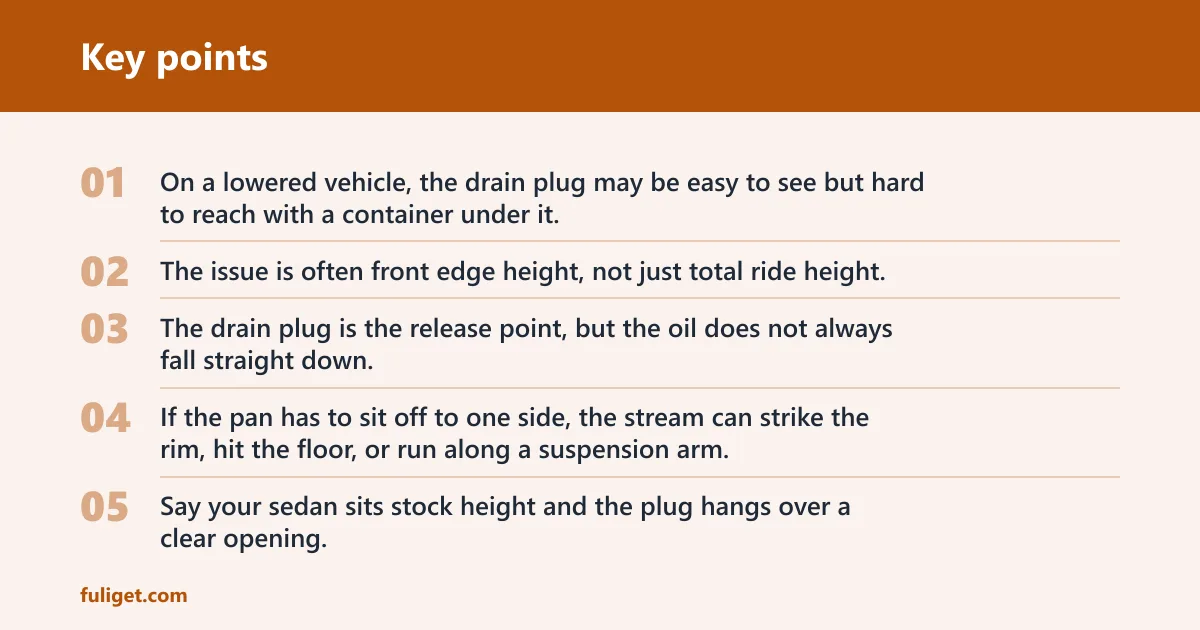
On a lowered vehicle, the drain plug may be easy to see but hard to reach with a container under it. The issue is often front edge height, not just total ride height. Some cars, including many sports cars and some EVs, also have undertrays or aero panels that reduce the open path to the plug.
Why stream angle can miss a standard pan
The drain plug is the release point, but the oil does not always fall straight down. If the pan has to sit off to one side, the stream can strike the rim, hit the floor, or run along a suspension arm. That is the clearance-and-trajectory problem in plain terms: the pan may be low enough, yet still be in the wrong place.
Say your sedan sits stock height and the plug hangs over a clear opening. A regular pan usually works if you can center it. Suppose the same pan is used on a lowered hatchback where the plug is closer to a brace. The oil can hit the lip first, then splash outward instead of dropping cleanly.
Do you need one for your car?
You need a low-profile drain pan only when clearance and stream angle leave too little room for a regular pan. If the car can be raised safely and the pan can still sit centered under the plug, a standard pan may be enough. The vehicle segment matters, because the same pan can work on one car and fail on another.
Stock sedan
A stock sedan often does not need a special pan if you can reach the plug with the car on level ground or with modest lift. A regular oil drain pan is usually fine when there is room to center the opening under the stream. The main risk is not height, but placing the pan too far forward or too far back.
Lowered sports car
A lowered sports car is where a low-profile drain pan starts to matter. Reduced ride height can limit both front clearance and side access, so the pan may need a shorter body and a wider opening to catch the oil before it overshoots. In this segment, ramps or jack stands are often part of the plan, not an afterthought.
Very low car
A very low car may need more than a low-profile pan. If the crossmember, splitter, or undertray blocks the approach, you may need ramps, jack stands, or another access method before any pan will fit. A flex-spout container can help after collection, but it does not solve a blocked drain path by itself.
Can a regular drain pan still work?
Yes, a regular drain pan can still work on a low car if the vehicle is safely raised and there is enough room to place the opening directly under the stream. The pan does not have to be low-profile if the clearance problem is solved another way. A wider pan can also be enough when the stream is easy to center.
When you can raise the car safely
If ramps or jack stands are used at the proper load rating and on firm ground, they may create enough room for a normal pan. That said, the support method must match the vehicle and the service point. Raising the car changes the drain angle, so you may need to re-check where the oil will fall before you open the plug.
When a wider pan is enough
A wider catch area helps when the issue is not height but drift. If the stream leaves the plug at an angle, a broad mouth can tolerate a small miss. This is one place where “low-profile” can be misleading: a shorter pan with a tiny opening may fit, yet still catch less well than a standard pan with a wider basin.
When the pan sits too far from the stream
If the pan cannot get close enough to the drain plug, the stream can jump the opening, strike the rim, or break into spray. In that case, a low-profile body helps only if it lets the pan move closer. If it does not, a different access method is usually the better fix.
Drain pan decision matrix
This matrix uses the minimum clearance needed for the pan body to fit under the vehicle, not the whole car’s ride height. The common failure mode matters because the wrong pan can fit physically and still miss the oil stream.
| Vehicle segment | Minimum pan clearance | Recommended pan style | When ramps or jack stands are needed | Common failure mode |
|---|---|---|---|---|
| Stock sedan | About 3 to 4 inches under the pan body | Regular pan, or low-profile if the plug sits low | Often only if access to the plug is blocked by a cover | Pan is centered too far back, so the stream misses the mouth |
| Lowered sports car | About 2 to 3 inches under the pan body | Low-profile pan with a wide catch area and pour lip | Frequently needed for safe access and placement | Rim is too shallow or the opening is too narrow for the stream angle |
| Very low car | Under 2 inches, depending on front clearance and undertray shape | Low-profile pan or a low catch tray, sometimes with a flex-spout container after collection | Usually needed before the pan will fit or before the plug can be reached | Underbody blocks the approach, so the pan cannot get under the plug at all |
How to choose pan size and shape
Choose by capacity first, then by opening size and body height. A pan that is too small overflows easily, while a pan that is too tall may not fit. The best fit balances low height, a wide mouth, and enough headroom for the oil volume in your engine.
Capacity versus headroom
For passenger vehicles, 8 to 12 quarts is the common size range, but the oil capacity of the engine should still guide the choice. Leave room above the expected fill level so the stream does not start splashing back when the pan is partly full. More headroom is especially useful if the drain plug releases oil in a strong early surge.
Wide mouth versus shallow body
A wide mouth helps catch a stream that arrives at an angle. A shallow body helps the pan fit under a low chassis. The better choice depends on the car’s underbody shape and where the plug points. A pan can be short but still miss the job if the opening is too small for the stream path.
Flex-spout container tradeoffs
Flexible-spout drain pans and containers can help when you need better pour control after collection. They are useful if the pan must sit farther from the vehicle and you want to transfer oil with less spill risk. They are less useful if the real problem is fit under the car, because the spout does nothing for initial clearance.
-
Check plug access. Look at the drain plug location, the undertray shape, and the path from the plug to the floor. If a brace or bumper blocks that path, the pan choice matters less than the access plan.
-
Measure the low point. Compare the pan’s overall height with the clearance available under the vehicle at the drain area. Leave room for the pan to move a little while you position it.
-
Match the opening to the stream. Pick a wider catch area if the plug points at an angle or the pan must sit slightly off center. This reduces overshoot and splash-back.
-
Reserve headroom. Choose a capacity above the engine’s oil volume. A little extra space helps if the flow starts fast or the pan is not perfectly level.
What else helps with tight clearance?
Ramps or jack stands can solve the access problem when a low-profile pan alone cannot. They must be used according to load rating and safe support practices. Once the car is high enough, centering the pan and using a pour lip or spout after draining are the details that keep the job clean.
Ramps or jack stands
Use ramps or jack stands when the pan cannot slide under the car, the plug cannot be reached, or the angle is too cramped to center the opening. Support equipment changes the drain angle, so it can improve access or worsen splash if you do not re-check placement after lifting. Safety comes first; the wrong support setup is not a workaround.
Centering the pan under the plug
Center the mouth under the oil stream before the plug comes all the way out. If the pan is even a few inches off, the first surge can miss the opening and run along the underbody. A wide catch area gives you a little margin, but it does not replace careful placement.
Using a pour lip or spout
A pour lip or spout matters after the oil is already in the pan. It reduces drips when you move the used oil into a sealed container for recycling. That is helpful on a low car because the pan often has to sit in a less convenient position, which leaves less room for a clean transfer later.
A common first-timer mistake is buying the shortest pan available and assuming it will solve every fit issue. If the opening is narrow and the stream lands near the edge, the oil still splashes out. A low body only helps when it also lets the mouth sit where the stream actually falls.
Frequently asked questions
Do I need a low-profile drain pan for a lowered car?
Not always. A lowered car often needs better access planning, but a low-profile drain pan is only necessary if the pan has to sit very close to the ground or close to the drain plug. If ramps or jack stands create enough room, a regular pan may still work well.
What drain pan height works under a low car?
There is no single number that fits every car, because underbody shape matters as much as ride height. As a rough guide, a regular pan often needs about 3 to 4 inches of clearance, while a lowered car may need 2 to 3 inches or less. Measure the actual path under the drain area.
Can I use a regular oil drain pan on a low car?
Yes, if the car can be raised safely and the pan can be centered under the stream. A regular pan often works when there is enough room to place it directly below the plug. If the pan has to sit too far away, a wider or lower pan is the better fit.
What makes a drain pan low-profile?
A low-profile drain pan has a shorter overall height, usually a shallow rim, and often a wide catch area. Many also include a pour spout or handle. Those features help it fit under limited clearance and control the oil after collection, but the low body is the part that solves fit.
How do I stop oil from splashing when clearance is tight?
Use a pan with a wide opening, keep the mouth centered under the drain plug, and leave headroom in the pan. If the stream comes in at an angle, move the pan closer only if there is safe clearance. A shallow, narrow mouth is more likely to splash or overshoot.
Should I use ramps, jack stands, or a low-profile pan?
Use whichever tool solves the actual problem. If the issue is access, ramps or jack stands may be needed first. If the issue is fit under the car after it is safely supported, a low-profile pan helps more. In many low-car jobs, you need both: access support and a better-shaped pan.