How Accurate Are Tire Pressure Gauges?

Most tire pressure gauges are accurate enough if they stay within about ±1 psi; cheap ones can be off by 2–4 psi, which is enough to change handling and tire wear. Wrong readings can leave you underinflated, overinflated, or chasing the wrong fix. This guide explains normal error, what causes bad readings, and which gauge type is accurate enough for each use case.
Typical gauge error ranges and why readings vary
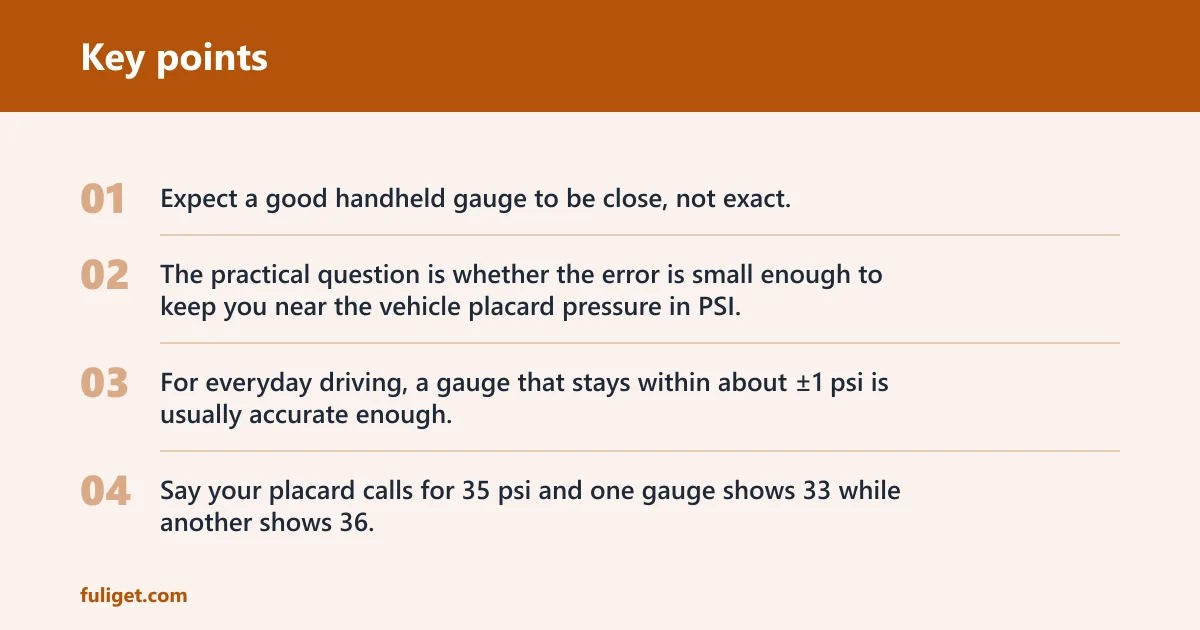
Expect a good handheld gauge to be close, not exact. A small spread between readings is normal, especially if you compare two different gauges, check a warm tire, or press the chuck on unevenly. The practical question is whether the error is small enough to keep you near the vehicle placard pressure in PSI.
What a normal error range looks like
For everyday driving, a gauge that stays within about ±1 psi is usually accurate enough. A cheaper gauge that can wander by about 2–4 psi may mislead you enough to matter, especially on low-profile tires, towing setups, or vehicles with a narrow recommended pressure window.
Say your placard calls for 35 psi and one gauge shows 33 while another shows 36. That spread is larger than you want to trust blindly, so you should recheck with a second gauge on a cold tire before you add or release air.
Why the same tire can read differently twice
Small differences come from how the valve core seals, how firmly the chuck seats on the stem, and whether the tire has warmed up. Gauge design matters too. A digital gauge may round to the nearest increment, while an analog needle can shift slightly as you remove it or reread the dial from a different angle.
What the numbers on a gauge mean
PSI is the unit most drivers use, and the vehicle placard usually lists the recommended pressure on the door jamb or in the owner’s manual. Some gauges also display bar, kPa, or kg/cm2. A quick conversion guide helps: 1 bar is about 14.5 psi, 100 kPa is about 14.5 psi, and 1 kg/cm2 is about 14.2 psi.
Resolution, tolerance, and display rounding
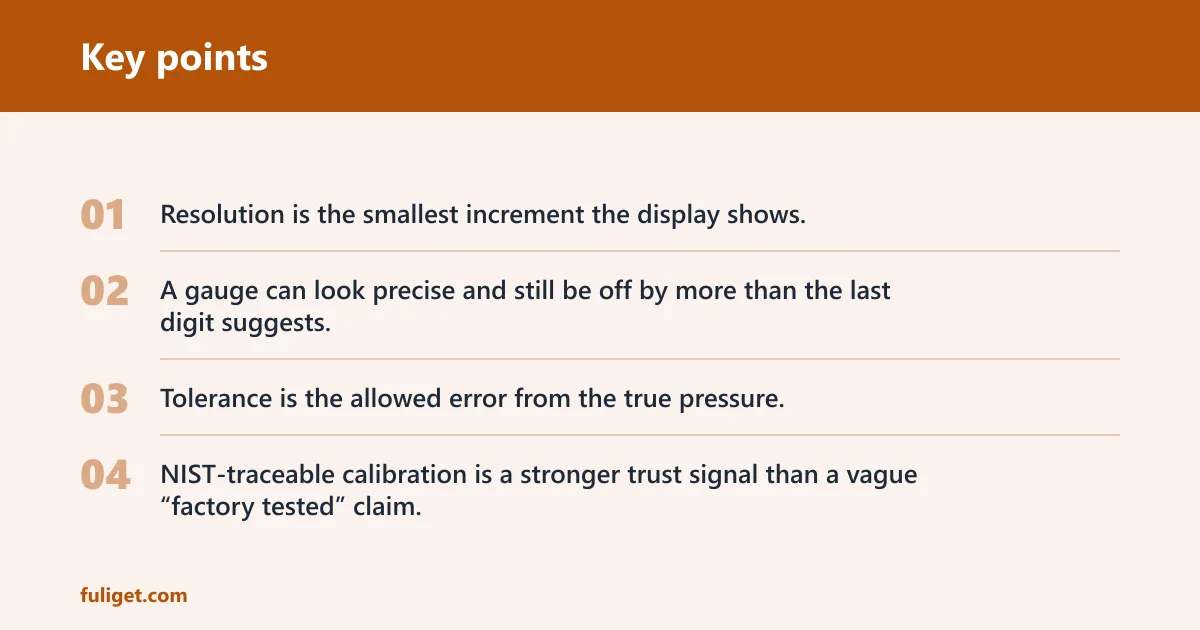
Resolution is the smallest increment the display shows. A gauge with 0.1 psi increments can display smaller changes than one that rounds in 0.5 psi or 1 psi steps, but finer display steps do not automatically mean tighter accuracy. A gauge can look precise and still be off by more than the last digit suggests.
Tolerance is the allowed error from the true pressure. If a gauge is accurate to ±1 psi, that means the true pressure can be one psi higher or lower than the reading, depending on the manufacturer’s spec and test conditions. Do not confuse that with display resolution.
ANSI B40.1 and NIST-traceable calibration
ANSI B40.1 is a reference point for pressure gauge performance, but it is not a blanket statement that every consumer tire gauge meets the same class. When a maker references grade A or grade B, it is pointing to an accuracy tolerance class and test conditions, not a promise that every reading will be exact in every setting.
NIST-traceable calibration is a stronger trust signal than a vague “factory tested” claim. It means the calibration chain can be linked to standards maintained by NIST through a traceable lab process, often with ISO/IEC 17025 lab calibration behind it. That matters most when you need repeatable readings and documentation, not just a ballpark number.
Which gauge type is accurate enough?
The right answer depends on how close you need to be, how easy the gauge is to read, and how often you use it. Digital gauges are usually easiest to read. Analog dials can be sturdy and quick. Pencil gauges are compact and cheap, but they are the easiest to misread and the most likely to drift out of trust for careful work.
Digital tire pressure gauge
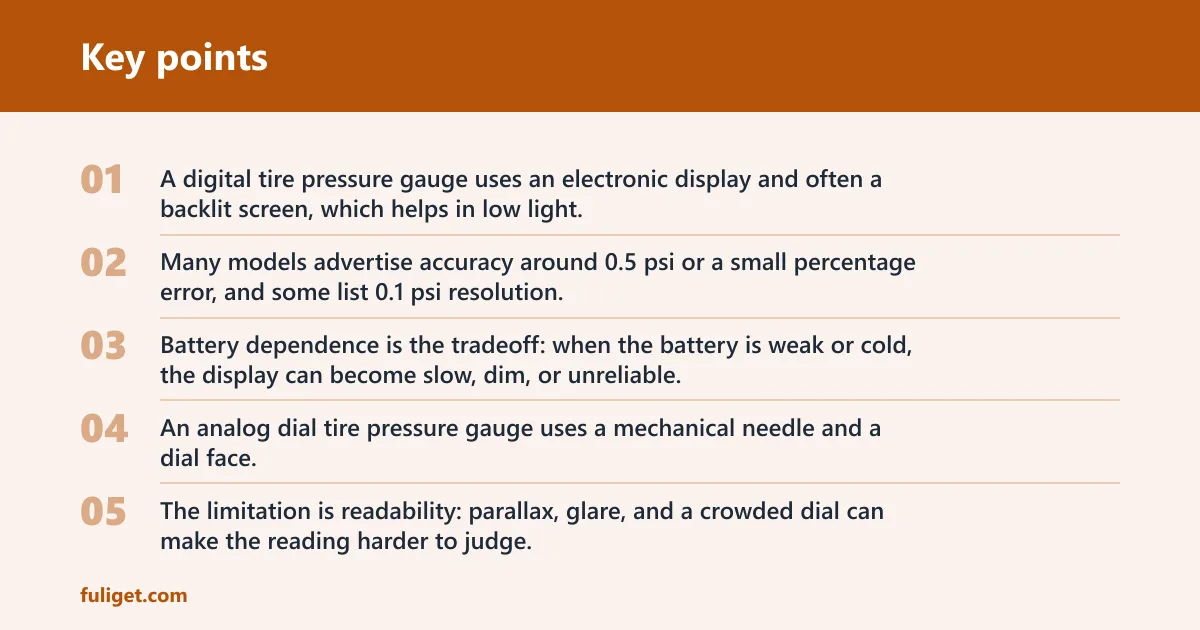
A digital tire pressure gauge uses an electronic display and often a backlit screen, which helps in low light. Many models advertise accuracy around 0.5 psi or a small percentage error, and some list 0.1 psi resolution. Battery dependence is the tradeoff: when the battery is weak or cold, the display can become slow, dim, or unreliable.
For daily driving, a good digital gauge is often accurate enough if the listing states a clear tolerance and the unit has a solid seal on the valve stem. For track use, towing, or RV setups, choose a model with a tighter stated tolerance and a resolution that lets you see small changes without guessing.
Analog dial tire pressure gauge
An analog dial tire pressure gauge uses a mechanical needle and a dial face. These gauges are often valued for durability and the lack of a battery, and some include a bleeder valve so you can release air in small amounts. The limitation is readability: parallax, glare, and a crowded dial can make the reading harder to judge.
Analog gauges can be accurate enough for street use when the manufacturer gives a clear tolerance and the dial is easy to read. They are also a sensible choice if you want a tool that does not depend on batteries. For precision work, make sure the needle settles fully before you trust the number.
Pencil tire pressure gauge
A pencil tire pressure gauge uses a sliding scale design in a compact form factor. It is easy to store in a glove box and costs less than many dial or digital options. Its lower accuracy reputation comes from simple construction, narrow markings, and the fact that the reading can be easier to misread at a glance.
That does not make every pencil gauge useless. It means the better use case is budget checking, not fine tuning. If you only need to confirm that a tire is roughly near spec, a decent pencil gauge can be enough. If you need repeatable numbers, choose digital or a well-made dial gauge instead.
Tire gauge accuracy table
| Gauge type | Typical tolerance | Resolution | Cold-weather sensitivity | Battery dependence | Reading ease | Best use scenario |
|---|---|---|---|---|---|---|
| Digital | Often around ±0.5 psi to ±1 psi, depending on model | Commonly 0.1 psi or 0.5 psi | Moderate; electronics and batteries can drift in cold conditions | Yes | Easy; backlit screen helps | Daily driving, towing, repeatable checks |
| Analog dial | Commonly around ±1 psi on better models; check the listing | Depends on dial markings | Low to moderate; mechanical parts avoid battery issues | No | Moderate; harder to read at a glance | General use, durable kit, battery-free storage |
| Pencil | Often looser than digital or good dial gauges | Coarser sliding marks | Moderate; seal and reading method matter more than electronics | No | Harder; small scale is easy to misread | Budget use, quick rough checks |
Specific product specs can put those general rules in context. The Accutire MS-4021 Digital is accurate to 0.5 PSI and has a 5 to 150 PSI range. A tire pressure gauge may be certified to ANSI standards at about ±1.5% and use 1 PSI increments, and a digital model may have a smaller error margin and finer resolution. The Milton 555E measures from 5 to 220 PSI, the ARB601A accuracy is plus or minus 1 psi between 25 and 200 psi, the Jaco FlowPro Digital Tire Inflator with Pressure Gauge measures 5 to 200 psi and is calibrated to ANSI 1A standards, and the Etenwolf G200 has a 0 to 75-psi range with one percent accuracy claimed.
How accurate are tire pressure sensors?
Tire pressure sensors are useful for monitoring, but they are not the same thing as a handheld gauge. Direct TPMS systems can display per-tire pressure values, while indirect systems usually estimate a problem by wheel speed changes and may only warn you that something is wrong. In both cases, the dashboard is for monitoring, not final verification.
Direct TPMS and per-tire pressure displays
Direct TPMS uses sensors inside the wheel and may show individual tire pressures on the dashboard. That is helpful, but sensor readings can still be affected by calibration drift, sensor aging, temperature changes, or sensor failure. A dashboard value that looks plausible is not proof that a handheld gauge is wrong.
Indirect TPMS and warning-only systems
Indirect systems do not measure pressure directly. They infer a change from wheel speed data and usually warn only after a tire drops enough to alter the system’s interpretation. That means the display is even less useful for setting exact pressure.
Why TPMS does not replace a handheld gauge
TPMS can catch a slow leak or tell you which tire needs attention. It cannot reliably confirm exact fill pressure in every situation. Use it as a monitoring layer, then confirm with a handheld gauge when you air up, rotate tires, or notice a pressure alert.
What makes a gauge read wrong?
Bad readings usually come from conditions, wear, or weak parts rather than from a mysterious brand problem. Cold weather changes pressure. A leaky valve stem or poor seal can waste air. A dropped gauge can lose calibration. A weak battery can make a digital display misleading or incomplete.
Cold weather and temperature shifts
Check tires when they are cold, before driving or after about three hours parked. Pressure changes with temperature, so a tire that was driven on can read higher than it will after sitting. The tire itself can also warm unevenly, which adds noise to the reading.
Suppose a tire reads 36 psi right after a highway exit and then 34 psi the next morning on the same gauge. That difference may be normal temperature change, not a leak. Always compare to the cold placard pressure before adjusting air.
Valve seal issues and air leaks
A poor seal at the valve stem can let air escape during the check or leave you with a low reading after repeated tries. A damaged valve core, cracked stem, or slow leak can make the gauge look unreliable when the real problem is the tire. If the number keeps falling, look for the leak.
Shock damage, wear, and battery problems
Dropping a gauge can shift the internal mechanism or damage the display. On analog gauges, that can bend the needle or affect spring tension. On digital gauges, a weak battery can cause slow updates, dim output, or erratic readings, especially in cold weather.
How to spot a bad reading
Do not trust one odd number until you have checked it against the tire’s cold baseline. A reading that is far from the placard target, or far from another gauge, deserves a second look. The goal is not perfect agreement. The goal is to avoid acting on a bad number.
-
Check a cold tire first.
Measure before driving or after about three hours parked. That limits temperature error and gives you a number you can compare against the door-jamb placard. -
Repeat the reading once.
Remove and reseat the gauge on the same valve stem. If the second result is notably different, the issue may be seal fit, valve condition, or a gauge problem. -
Compare with another gauge.
Use a second handheld gauge if the reading seems off by more than about 1 psi. If both agree closely, trust the result more than a single outlier.
Frequently asked questions
How accurate are tire pressure gauges?
Good tire pressure gauges are usually accurate enough for normal driving if they stay within about ±1 psi. That is close enough to match a vehicle placard without meaningful risk of overthinking tiny differences. Cheap gauges can drift by several psi, which can be enough to distort your adjustment.
How accurate are tyre pressure gauges?
Tyre pressure gauges are only as accurate as their tolerance, seal quality, and condition. The spelling changes, but the physics do not. Look for a stated tolerance, check against a cold tire, and compare the number with a second gauge if the result seems suspicious.
Are digital tire pressure gauges more accurate?
Often, yes, but only when the listed tolerance is tighter than the alternatives and the battery is healthy. Digital gauges are easier to read and may show 0.1 psi or 0.5 psi increments, but display resolution is not the same as true accuracy. Read the spec carefully.
How accurate are pencil tire pressure gauges?
Pencil gauges are usually less accurate than better digital or dial gauges, especially when the markings are small or the seal on the valve stem is inconsistent. They are useful for quick, rough checks and a compact emergency kit, but they are not the first choice for exact setup.
Are cheap tire pressure gauges accurate?
Some cheap gauges are accurate enough, but many are not stable enough to trust for precise work. The main risks are poor seal fit, rough internal parts, shock damage, and weak batteries in digital units. If the reading matters, compare it against a known good gauge first.
How accurate are tire pressure sensors in cars?
Car tire pressure sensors can be useful and often quite close, especially in direct TPMS systems that show per-tire pressure. Even then, they are monitoring devices, not final setting tools. Use the dashboard to notice a problem, then confirm pressure with a handheld gauge before changing air.