

Drain Pan with Lid vs Open Pan: Which Is Better?

Choose an open pan if you need the lowest profile for tight under-car access; choose a lidded drain pan if you need to move, store, or contain used fluid after draining. Pick the wrong one and you end up with spills, awkward transfers, or a pan that will not fit under the car. This guide compares clearance, handling, storage, and cleanup for oil and coolant jobs.
Open or lidded: the core trade-off
| Decision factor | Drain pan with lid | open pan | Winner |
|---|---|---|---|
| Under-car clearance | Usually taller, so it can be harder to fit under low vehicles or between jack stands and suspension parts. | Shallow tray design gives you the lowest profile for tight access. | open pan |
| Transport and storage | Built for portable waste-oil storage, with a sealed or screw-on lid, gasketed cap, or O-ring seal. | Poor for transport or storage; often needs a separate sealed container after the drain. | Drain pan with lid |
| Immediate emptying | Can work, but the lid is extra hardware if you only need a quick catch-and-dump setup. | Best for immediate emptying into a recycling jug or drain bucket. | open pan |
| Spill control away from the bench | Better at containing slosh during carrying and vehicle transport. | Open top leaves oil exposed, so movement raises spill risk. | Drain pan with lid |
| Workflow simplicity | More parts to manage, but fewer transfer steps if the pan doubles as storage. | Simple under-car catcher, but you still need a sealed container later. | tie |
Under-car clearance
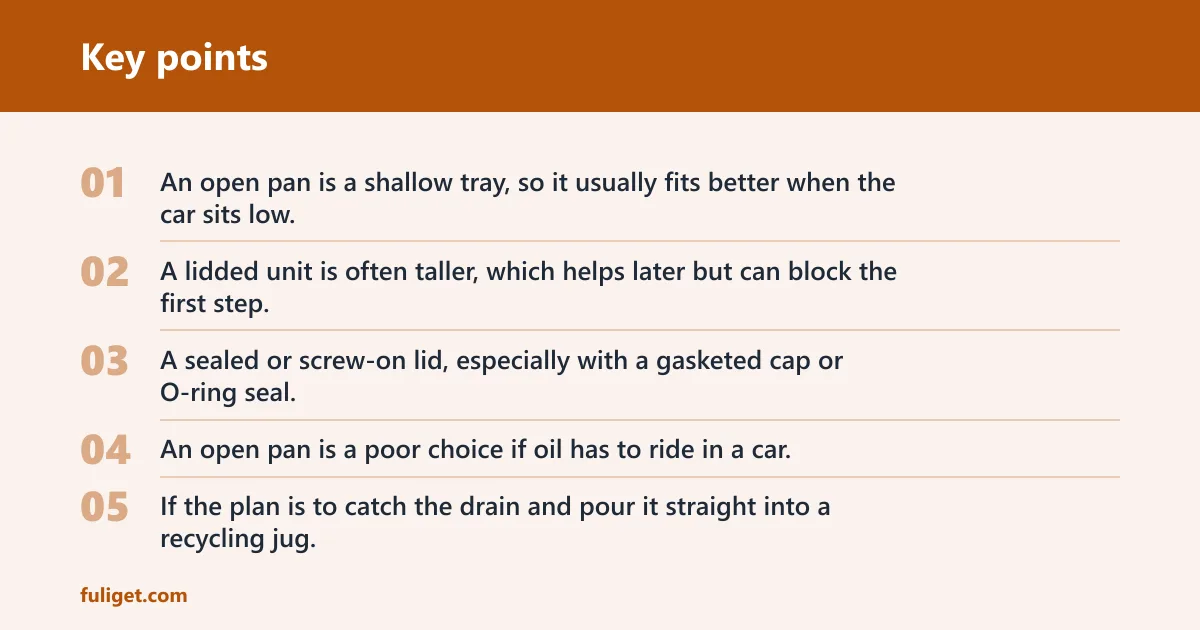
The height is the key difference. An open pan is a shallow tray, so it usually fits better when the car sits low, the jack stands crowd the drain point, or ramps leave little vertical room. A lidded unit is often taller, which helps later but can block the first step.
Transport and storage
This is where the lid earns its keep. A sealed or screw-on lid, especially with a gasketed cap or O-ring seal, helps keep used oil in one container while it rides to a recycling point or sits in a garage corner. An open pan is a poor choice if oil has to ride in a car.
Immediate emptying
If the plan is to catch the drain and pour it straight into a recycling jug, the open pan has the advantage. The shallow profile makes it easy to slide under the drain point and then empty right away. That is the cleanest path when disposal is close and you do not need to store the fluid for long.
Spill control away from the bench
Transport changes the math. A lidded pan reduces slosh and gives you a closed top when the container is full, which matters in a trunk, in a shared garage, or across a yard. Open pans do fine at the vehicle, but they are the weaker choice once the oil is no longer sitting still.
Drain opening and catch features
Drain opening size matters more than many buyers expect. A wider opening catches arcing streams better and helps with fast hot drains, while a catch screen keeps the drain plug out of the oil and can hold a filter to drip dry. That screen is especially useful on a sealed container because it keeps debris out before the lid goes on.
Drain pan decision table
| Workspace | Vehicle clearance | Disposal distance | Best pan style | Yes / no | Exact tradeoff |
|---|---|---|---|---|---|
| Home garage with low sedan | Tight under jack stands | Recycle jug beside the bay | open pan | Yes | Lowest profile wins, but you still need a separate sealed container after draining. |
| Driveway on ramps | Limited side clearance | Short carry to storage shelf | open pan | Yes | Fast catch and empty is easier; the open top is a liability if you want to carry the fluid far. |
| Apartment parking area | Moderate clearance | Long carry to recycling site | Drain pan with lid | Yes | Spill control beats low profile because the fluid has to travel after the drain. |
| Field work on equipment | Mixed, often higher access | Transport back to shop | Drain pan with lid | Yes | Sealing and handling matter more than the lowest height. |
| Open workshop with tractor or mower | Good clearance | Nearby dump point | Drain pan with lid | Yes | A wheeled drain pan can reduce lifting strain, and the lid helps once the container rolls away. |
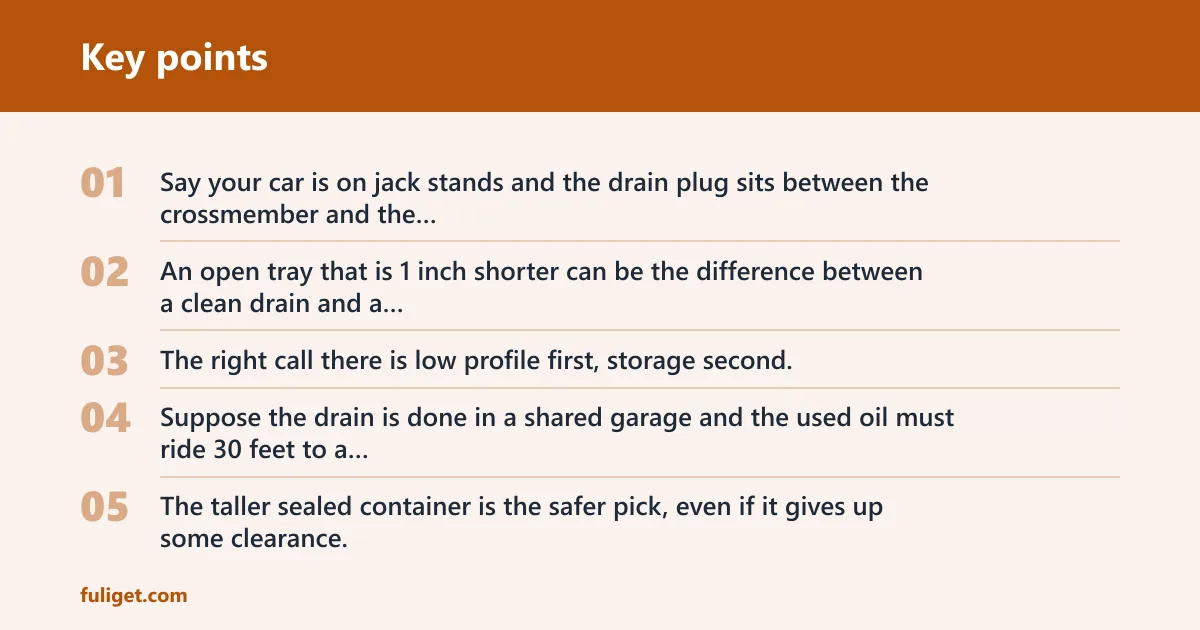
Say your car is on jack stands and the drain plug sits between the crossmember and the pan rail. An open tray that is 1 inch shorter can be the difference between a clean drain and a pan that will not slide in. The right call there is low profile first, storage second.
Suppose the drain is done in a shared garage and the used oil must ride 30 feet to a recycling jug. The taller sealed container is the safer pick, even if it gives up some clearance. The risk shifts from under-car fit to slosh and cap security.
Which one fits under your car?
Check overall height first. That means the external top-to-bottom measurement of the pan, not its rated capacity. Compare that height against the actual clearance under the car, including jack stands or ramps, because those supports often block the exact path the pan needs to take.
How to check overall height
Measure the space from the ground to the lowest point near the drain path, then compare that number to the pan’s listed height. If the pan is taller than the available space, it is a no-go even if the capacity is large enough. This is a common return reason because capacity and height are easy to confuse.
Why shallow trays matter on low vehicles
Open pans are often lower because the tray is shallow and there is no lid stack on top. That lower profile matters most on cars with little ground clearance, especially when the drain point sits close to the subframe. If the pan cannot enter cleanly, the better capacity number is irrelevant.
When a taller sealed pan still works
A taller sealed pan can still fit under trucks, tractors, and higher-clearance vehicles. It can also work on a low car if the drain point is accessed from a side opening with enough room to place the pan before the fluid starts flowing. The key is to match the container shape to the route under the car, not just the engine size.
Can you store used oil in an open pan?
Short answer: no, not as the final container. An open pan is for collection, not storage, since exposed fluid can slosh, pick up debris, and spill if the pan is bumped. If the oil has to sit overnight or travel anywhere, move it into a sealed jug or lidded drain pan.
Why open pans are poor storage containers
Open pans expose the surface and leave the contents vulnerable to tipping or contamination. That is manageable for a quick catch under the drain plug, but it is the wrong setup for a garage shelf, a trunk, or a long walk to a disposal site. A lid changes the use case more than the shape does.
How lids, caps, and O-rings change spill risk
A screw-on lid with a gasketed cap or O-ring seal reduces the chance of leaks during transport. That does not make the container leak-proof forever. Cap-thread wear, a damaged seal, or a cap that does not seat cleanly can all bring the spill risk back, so the closing parts need to be checked before moving fluid.
When to move fluid into a jug
If disposal is not immediate, move the fluid into a closed container as soon as the draining stops. That applies to garage storage, apartment work, and any job where the pan has to travel farther than a few steps. A sealed container also makes it easier to label the contents if the same workflow handles oil and coolant.
What features matter most?
Capacity, height, and how the pan empties are the features that matter most. A stated capacity should exceed the engine’s drain amount, but it is not the same as fill capacity and should leave room for the filter and splash margin. For a typical oil change, a 16 quart container gives more room than a small 5 quart pan, and a 15 quart sealed drain pan can still be useful if the job size fits.
Capacity and splash margin
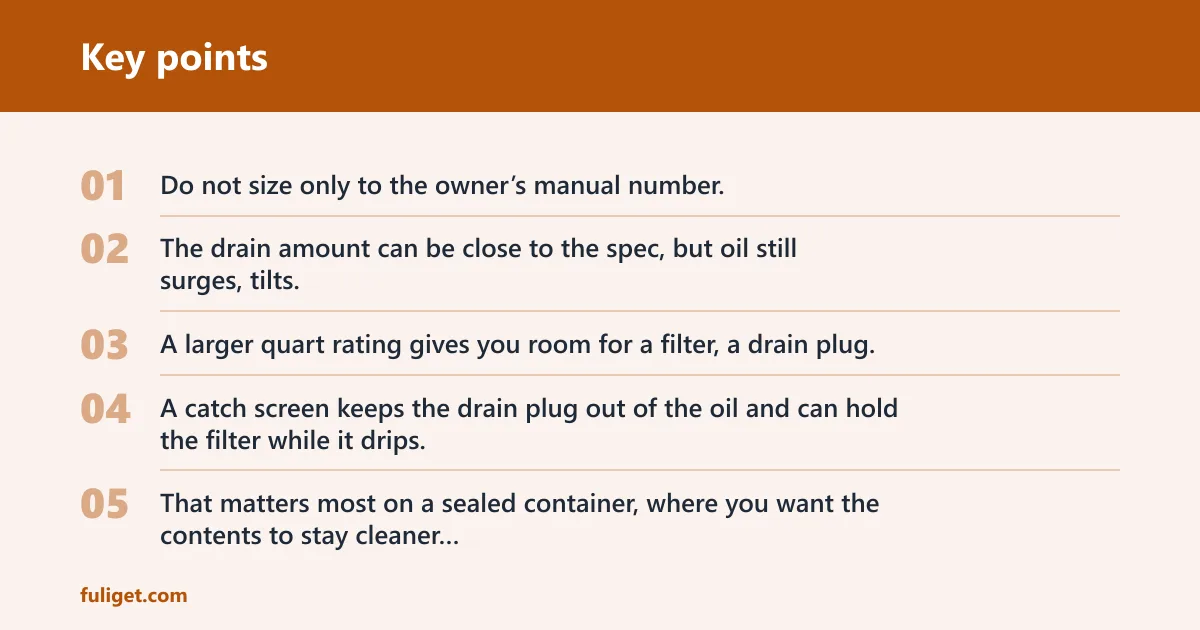
Do not size only to the owner’s manual number. The drain amount can be close to the spec, but oil still surges, tilts, and foams a bit on the way into the pan. A larger quart rating gives you room for a filter, a drain plug, and a safe margin against overflow.
Catch screens and drain plug control
A catch screen keeps the drain plug out of the oil and can hold the filter while it drips. That matters most on a sealed container, where you want the contents to stay cleaner before the lid goes on. The screen is less critical on a quick dump tray, but still useful when you want fewer hands in the oil.
Pour spouts, handles, and tethered caps
A pour spout or drain spout controls emptying into a jug. Recessed or capped spouts are better because they are easier to seal and less likely to drip while moving the container. A tethered cap is worth seeking out because it is harder to misplace when the pan is full and greasy.
Plastic material and wall thickness
Polyethylene and polypropylene are common because they resist oil and antifreeze well enough for shop use. Wall thickness matters because a thin shell can flex when full, especially if the pan is lifted by one handle or bounced in transit. The material choice is only half the story; the wall and seam quality finish the job.
Choose Drain pan with lid if… / Choose open pan if…
Choose Drain pan with lid if the used fluid has to travel, sit in storage, or ride in a vehicle after draining. Choose open pan if the job is a quick catch under a low car and the fluid can be emptied right away into a sealed jug.
- Choose Drain pan with lid if disposal is farther than a few steps.
- Choose Drain pan with lid if you work in an apartment, shared garage, or field setting.
- Choose Drain pan with lid if you want portable waste-oil storage with lower slosh risk.
- Choose open pan if clearance under the car is the tightest constraint.
- Choose open pan if you plan to empty the pan immediately after the drain.
- Choose open pan if you already have a separate sealed container for transfer.
A wheeled drain pan belongs with larger equipment and open workshop spaces. It reduces lifting strain, but it does not change the basic rule: if the fluid is going to move far, a lid matters more than an open tray.
Frequently asked questions
Is a drain pan with lid better than an open drain pan?
It is better only when the fluid has to move, store, or stay contained after draining. For the lowest under-car profile, an open pan is usually the better tool. The right answer depends on whether the job ends at the drain plug or at the recycling jug.
Can I store used oil in an open drain pan?
No. An open pan is a collection tool, not a storage container. Used oil should go into a sealed container if it will sit, ride in a car, or wait for disposal, because exposure and slosh raise the spill risk.
Which drain pan is lower profile for a car on jack stands?
Open pans are often lower profile because they use a shallow tray design with no lid stack. That lower height is often the deciding factor on jack stands, where every inch counts. Always compare the pan’s overall height with the actual clearance under the car before buying.
Do lidded drain pans leak less during transport?
Usually, yes, because a sealed or screw-on lid with a gasketed cap or O-ring keeps fluid enclosed. The seal still depends on condition and fit. Worn threads, a damaged O-ring, or an improperly seated cap can reduce the benefit fast.
What size drain pan do I need for a typical oil change?
Pick a stated capacity larger than the engine’s oil drain amount, and leave room for the filter and splash margin. A common rule of thumb is that a 16 quart container is a practical size for many passenger-car oil changes, while a 15 quart sealed drain pan can also work when the job size fits.
How do I know if a drain pan will clear my car?
Measure the overall height of the pan, then compare it to the space under the car with the jack stands or ramps in place. If the pan is taller than the available space under the car, it will not clear. This check matters more than the quart rating, which only tells you volume.
