
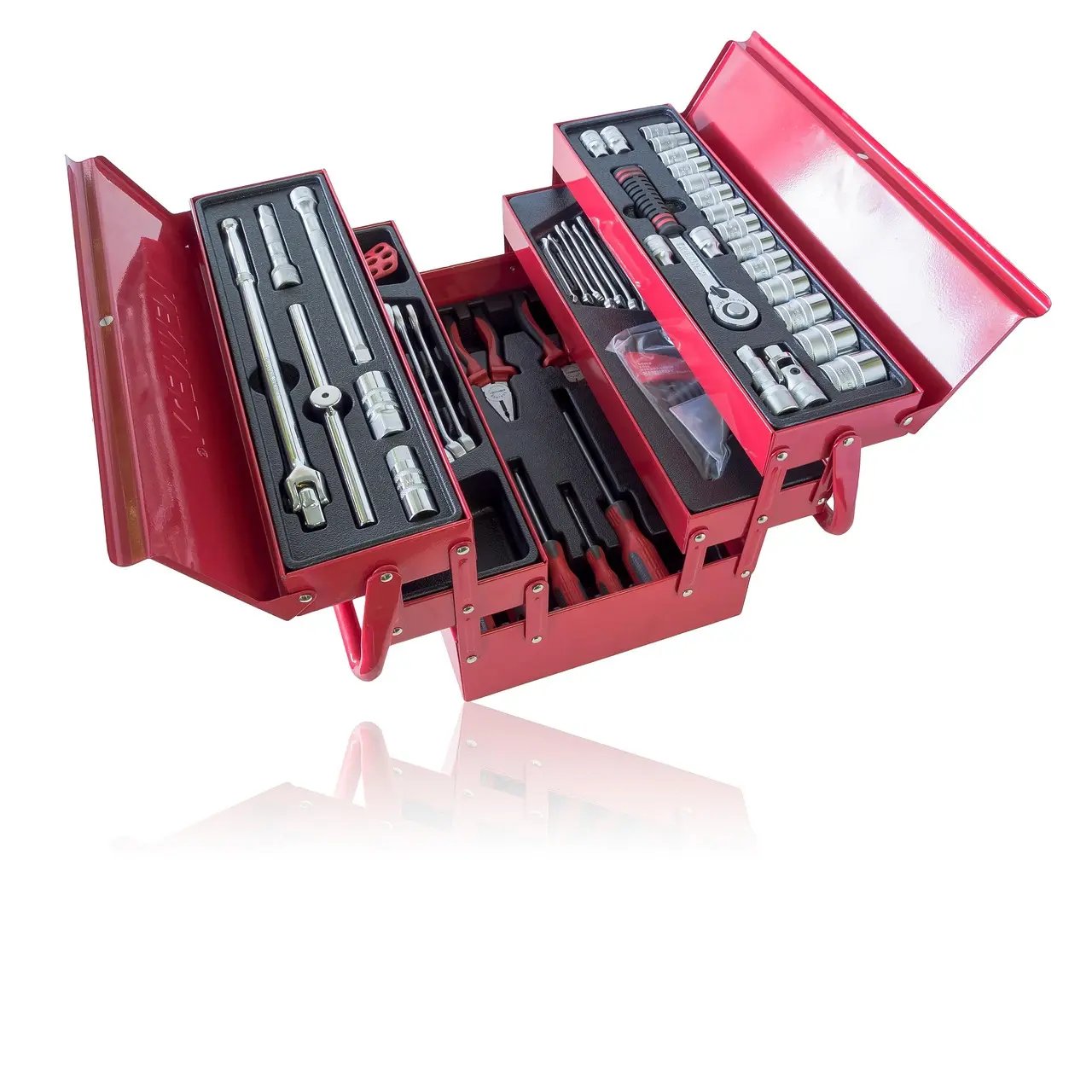
Mechanics Tool Kit With Case: What Size Do You Need?

For most DIY drivers, a 16–18 inch mechanics tool kit with case is a common size to start with. Go smaller for trunk-only use, larger only if the kit will live in a home garage and cover more jobs. Pick the wrong size and the case wastes space, leaves out key tools, or will not close cleanly. This guide sizes the case by the jobs you will actually do, then matches the tool stack to that space.
What size case do you need?
The right case size follows the work, not the piece count. Start with the smallest useful stack: a 1/4-inch drive for light work, a 3/8-inch drive for most fasteners, and only add 1/2-inch drive if your jobs regularly need larger sockets or more breakaway force. Then choose the smallest case that holds that stack without forcing in duplicates, spare bits, and dead weight.
Mechanics tool kit matrix
| Case format | Best use | Approximate storage need | What fits well | What becomes filler | Minimum useful stack | Fit risks |
|---|---|---|---|---|---|---|
| Glovebox or trunk carry case | Roadside repair, emergency fixes, borrowed-tool backup | Flat, short case that closes easily in a vehicle compartment | 1/4-inch drive ratchet, small metric socket range, a few bits, one short extension | Extra screwdrivers, duplicate bits, bulky specialty sockets, full wrench rolls | 1/4-inch drive, a small metric socket set, a few Phillips, flat, hex, and Torx bits | Too shallow for deep sockets; lid pressure can crush loose accessories |
| Compact molded case | Beginner car maintenance, basic home repairs, one-car households | Medium carry case with molded tool nests and a secure handle | 1/4-inch and 3/8-inch drive tools, metric sockets, shallow and a few deep sockets, combination wrenches | Duplicate drivers, extra bit rows, low-value adapters you will rarely use | 1/4-inch and 3/8-inch drives, metric sockets, a short-to-medium extension set, a basic wrench range | Can fill up fast if the set includes too many duplicate bits or specialty pieces |
| 3-drawer box | Garage bench, shelf storage, more complete home kit | Drawer-based case with enough depth for organized separation | 1/4-inch, 3/8-inch, and often 1/2-inch drive tools, deeper socket coverage, more wrench sizes, better accessory separation | Redundant screwdriver handles, repeated bit packs, extra packaging inserts | 1/4-inch, 3/8-inch, and 1/2-inch drives, metric and SAE sockets, short and medium extensions, universal joints | Drawer height must clear deep sockets; shallow drawer boxes crowd tall pieces |
| Rolling chest | Full garage set, frequent work, mobile cart-style storage | Largest footprint, highest storage capacity, best for a dedicated space | Large mixed socket families, full wrench sets, more specialty bits, spark plug sockets, spare trays | Almost nothing if the kit is well planned; filler still appears in very high piece-count sets | All three drive sizes, broad metric and SAE coverage, deep sockets, spark plug sockets, extensions, adapters, bit sets | Too bulky for vehicle carry; can become a parking-space problem if you do not have a fixed spot |
Use the matrix as a storage filter. If you need trunk portability, do not buy a case that needs a shelf. If you need a garage kit, do not accept a tiny molded case that forces you to dump loose sockets into a drawer later.
What tools need to fit first?
The first tools to size around are the drive sizes and the sockets they carry. For most beginners, 1/4-inch drive is the smallest useful core, 3/8-inch drive is the main all-around size, and 1/2-inch drive is the point where case space usually starts to grow quickly. Build around those before you count bit packs or extra adapters.
Drive sizes, sockets, and access tools
Socket coverage should follow the work you expect. Metric-only makes sense if you are focusing on modern cars and basic home tasks, but many DIY drivers still need some SAE coverage for older fasteners, accessories, or mixed hardware around the house. Shallow sockets save space; deep sockets solve recessed nuts and threaded studs, but they also demand more drawer height or a deeper molded tray.
Ratchets matter too. A 1/4-inch ratchet belongs in the smallest kit. A 3/8-inch ratchet is the everyday workhorse. A 1/2-inch ratchet, especially with quick-release or flex-head features, helps with access and stubborn fasteners, but it pushes the case toward a larger format. Tooth count affects how much swing room you need, so low-clearance jobs benefit from finer indexing.
Extensions and adapters deserve a separate slot, not a loose corner. Short and medium extensions cover most basic work. Long extensions, universal joints, and adapters are useful when the fastener sits behind brackets, but too many extras quickly become filler if the kit is meant for carry use.
Wrenches round out the stack. Combination wrenches should start around 8 mm in metric sets, with SAE added when your hardware mix requires it. Ratcheting wrenches save time, but they also consume more storage than a basic wrench row. Spark plug sockets are worth including if you plan ignition or tune-up work; one common size is 5/8-inch, and many drivers only need one or two spark plug socket sizes, not a full family.
Bit sets are where many large kits lose usefulness. Phillips, flat, hex, and Torx bits are practical. Duplicate screwdrivers are not. A compact bit driver often replaces several bulky screwdrivers and keeps the case cleaner.
How many pieces is enough?
Enough pieces means enough coverage, not the highest count on the box. A practical kit can fall in roughly the 125 to 247-piece range and still be useful if the pieces are organized around real jobs. Once you move into 497 pieces or more, the extra count often comes from duplicate bits, repeated accessories, and specialty parts you may not touch often.
Piece count versus useful storage
Piece count only helps when the set uses its space well. The Amazon Basics set is a 201-piece mechanic’s tool set with case, which is the kind of number many buyers see as a midrange benchmark. The problem is that a 201-piece label does not tell you how much of the case is taken by bits, filler trays, or repeated accessories.
Some large sets are built for breadth. Husky’s master set includes 815 pieces, along with 177 standard sockets, 141 deep sockets, 117 specialty sockets, and 145 wrenches. That is broad coverage, but the storage plan matters just as much as the count. A big set is only helpful if you have the drawer depth and shelf space to keep it organized.
A common first-timer mistake is buying the biggest count available and then discovering that the case is full of small accessories while the sockets you actually use are squeezed into one crowded layer. A 200-piece case can be better than a 400-piece case if the smaller one carries the right socket sizes, the right drives, and a cleaner layout.
Picture a trunk kit with a 3/8-inch ratchet, a small socket run, a few bits, and a wrench strip. That setup can be more useful than a much larger molded case that leaves no room for a spare tire well, a jump pack, or the cargo you actually carry.
Which case format fits your space?
Choose the format from the space you actually have. A carry case works for the vehicle. A drawer box works for a shelf or bench. A rolling chest makes sense when the kit stays in one place and needs room for deeper sockets, more wrenches, and a broader mix of drives.
Vehicle storage, garage storage, and retention
For vehicle storage, measure the flat area first. You need enough length for the case to lie or stand without blocking other cargo, enough width for the handle and latches, and enough thickness that the lid closes without pressuring the sockets. Under-seat storage is usually the tightest; trunk and cargo-area storage are more forgiving.
For garage storage, check shelf depth and drawer clearance. A 3-drawer box can fit neatly on a bench or shelf if the drawers open fully and the lid or top layer does not hit a wall or tool chest. If deep sockets are part of the kit, drawer height matters more than overall piece count.
Durability also affects usability. An integrated handle and good latches matter on carry cases. Steel-hinged lids and drawer boxes usually hold alignment better than flimsy cases, and independent sliding drawers can make it easier to grab one group of tools without dumping the whole set. DeWalt’s kit comes in a custom-molded case with an integrated handle and double latches, while Craftsman’s set uses a 3-drawer Versastack toolbox for storage. Gearwrench’s set is stored in a 3-drawer storage box with independent sliding drawers, and the set includes quick-release ratchets. Those storage choices show the trade-off clearly: carry convenience on one side, organized access on the other.
Walmart lists a 497-piece professional mechanics tool set with a 3-drawer heavy duty tool box, while Walmart also lists a 262-piece mechanics tool set and a 145-piece mechanics tool set with 1/4, 3/8, and 1/2-inch drive. The count alone does not tell you whether the case suits a trunk, shelf, or garage cart.
What tools should be in a basic mechanic tool kit?
A basic kit should cover the fasteners you actually see most often. Start with 1/4-inch and 3/8-inch drive ratchets, metric sockets, a few SAE sockets if your hardware mix calls for them, short and medium extensions, a small adapter set, combination wrenches, and a compact bit driver with Phillips, flat, hex, and Torx bits.
How to pack the smallest useful kit
- Choose the smallest drive stack that covers your jobs: 1/4-inch for light work and 3/8-inch for most tasks.
- Add the socket sizes you touch most often first, then add deep sockets only where reach demands them.
- Include a short extension, then add medium or long pieces only if you know you need the extra reach.
- Pack one compact bit set instead of several duplicate screwdrivers.
- Keep wrenches to the range you will actually use, starting around 8 mm for metric work.
- Check the case depth before buying deep sockets, spark plug sockets, or a 1/2-inch drive group.
Say your car work is mostly battery swaps, interior trim, and small bracket hardware. A compact molded case with 1/4-inch and 3/8-inch drives, metric sockets, and a few bits is usually enough. A 1/2-inch drive set would add weight and case bulk without changing the jobs you can complete.
Suppose you need a garage kit for brake work and suspension hardware on a second vehicle. In that case, a 3-drawer box is a better fit because it can separate 1/4-inch, 3/8-inch, and 1/2-inch tools, keep deep sockets upright, and leave room for wrench sets and spark plug sockets.
Frequently asked questions
What size case do I need for a mechanic tool kit?
For most DIY drivers, a compact carry case around the 16–18 inch range is the safest starting point. Go smaller only if the kit stays in the vehicle. Go larger only if the tools will live in a garage, where drawer space or shelf depth can support deeper sockets, more wrenches, and a fuller drive stack.
How many pieces fit in a standard mechanic tool case?
There is no single standard because layout matters more than raw count. A 125- to 247-piece set can fit well in a compact case if the extras are limited. Once you get into 497 pieces or 815 pieces, the storage format usually needs drawers or a rolling chest to avoid crowding.
Is a 200-piece mechanic tool set too much for home use?
Usually no, but the layout matters. A 201-piece set can be a good home kit if the pieces are mostly sockets, ratchets, wrenches, and a compact bit selection. It becomes too much when the case is loaded with duplicate bits, repeated accessories, and filler that displaces the tools you will actually reach for.
Do I need a rolling case or a carry case for car repair tools?
Use a carry case for roadside work, trunk storage, and small home jobs. Choose a rolling chest if the set stays in a garage, needs drawer separation, or includes a larger 1/2-inch drive group with more sockets and wrenches. The rolling format is about storage capacity, not automatic superiority.
Are deep sockets worth the extra case space?
Yes, when you regularly deal with recessed fasteners, studs, or long-thread hardware. No, if you mostly service shallow fasteners and want a compact carry case. Deep sockets take more vertical space, so they are best when the job list justifies the larger drawer or deeper molded tray.
What size tool set is best for beginner car maintenance?
A compact 1/4-inch and 3/8-inch kit with metric sockets is the best starting point for most beginners. Add SAE only if your hardware mix needs it. A 145-piece or 201-piece set is often enough for early maintenance if the case is organized and not overloaded with filler.
