
Tire inflator vs air compressor: which should you buy?

Buy a tire inflator if you want portable emergency top-offs for car tires and bikes. Buy an air compressor if you need repeated inflation, higher airflow, or garage tools, especially for truck tires and frequent use. Pick the wrong one, and you get slow fills, dead batteries, or a unit that cannot keep up with your load. This guide compares speed, duty cycle, power, noise, portability, and the best fit for each use case.
| Factor | Tire inflator | air compressor | Winner |
|---|---|---|---|
| Portability | Compact, easy to store in a trunk, cargo bin, or emergency kit. | Larger, heavier, and less convenient to move or stash. | Tire inflator |
| Repeated inflation | Best for one tire or a small number of top-offs before cooldown or battery limits matter. | Better for repeated fills and larger inflation jobs. | air compressor |
| Garage versatility | Good for tires, balls, bikes, and motorcycle tires with the right adapters. | Better for broader garage use and some air tools, depending on model. | air compressor |
| Emergency use | Simple to keep on hand for roadside top-offs and low-pressure warnings. | Useful if stored at home, but less convenient to carry in a vehicle. | Tire inflator |
| Storage priority | Fits apartment living and small trunks more easily. | Takes more space and usually stays in a garage or shop. | Tire inflator |
| Airflow for larger jobs | Usually enough for passenger-car tires and light inflatables. | Higher airflow for bigger tires and repeated use. | air compressor |
How the two tools differ in everyday use
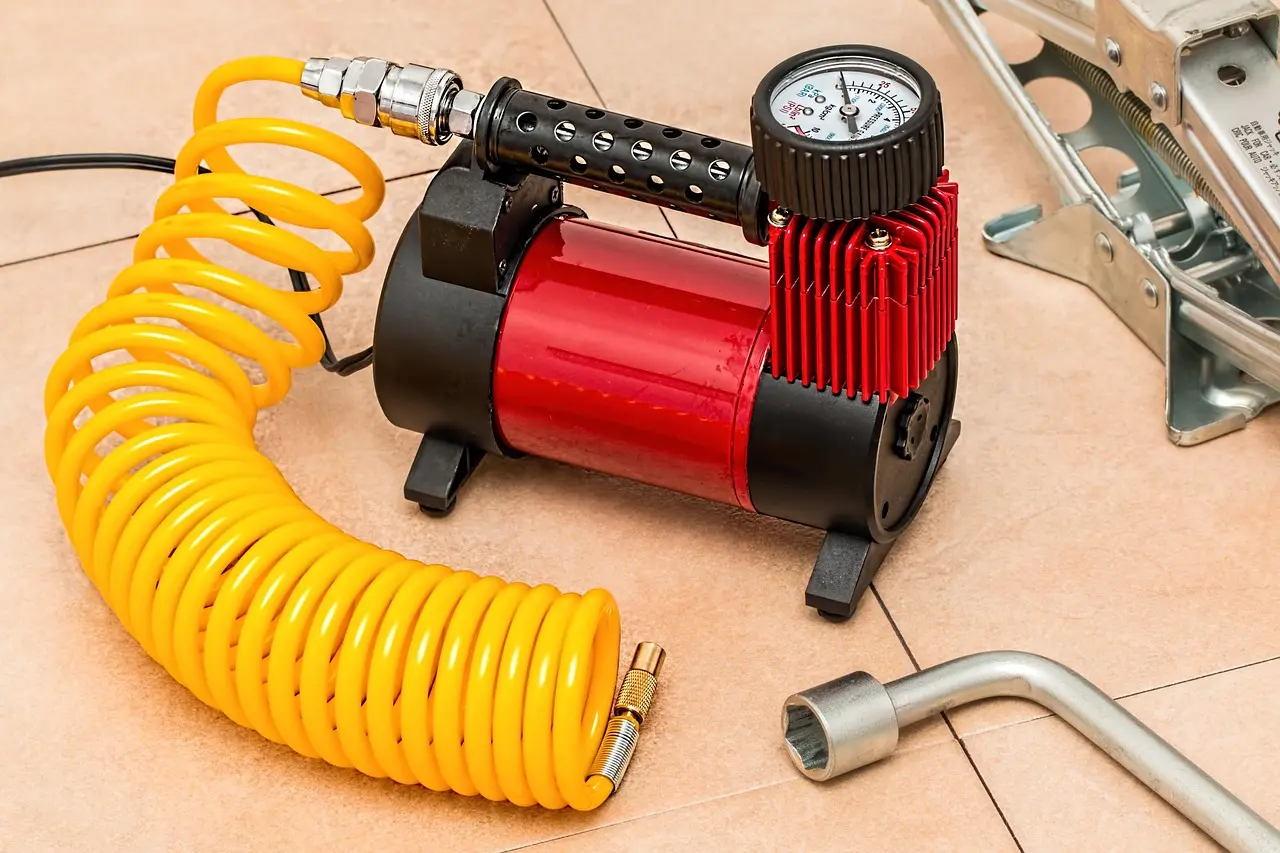
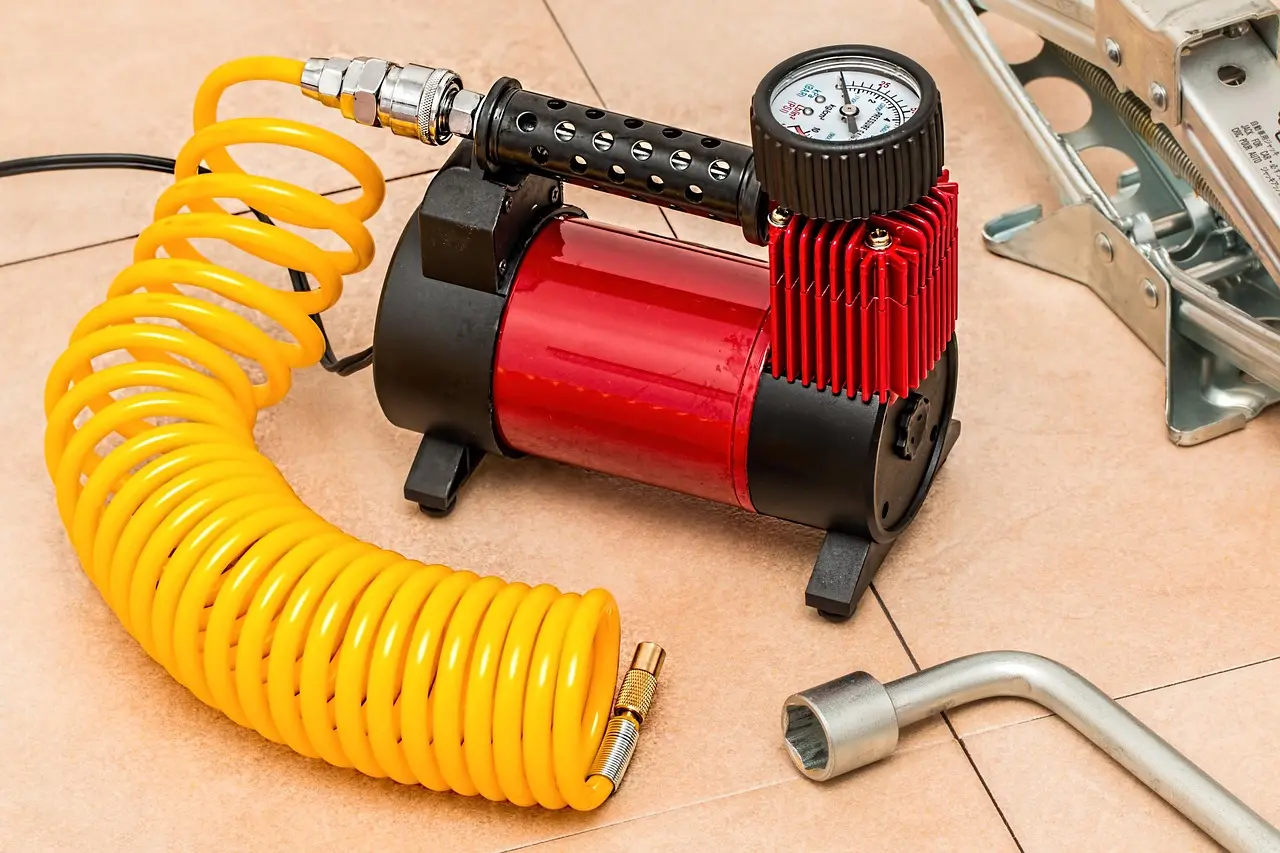
The difference is load. A portable tire inflator is made for compact, on-the-go tire top-offs, while an air compressor is a larger compressed-air source for repeated or higher-volume jobs. If your main task is keeping passenger-car tires topped up, a tire inflator is usually the better fit. If you need repeated inflation or shop use, an air compressor is the better category.
What each tool is built to do
A portable tire inflator usually refers to a compact, battery-powered or 12-volt-powered unit with a digital display and auto shut-off. That layout favors quick connection, simple operation, and easy storage. It is best for topping off passenger-car tires, bikes, and other light inflatables.
An air compressor is built around higher airflow and longer run time. That matters when you are filling larger tires, cycling through several tires in a row, or using air tools in a garage. It is less convenient to carry, but it keeps pace better when the workload rises.
Why portability and repeated use pull in different directions
Portability matters most when the job is small and urgent. Repeated use changes the equation because battery depletion, heat buildup, and cooldown time become real limits. That is where a compact inflator can feel slow or tired, while a larger compressor keeps going.
Say your sedan tire drops low on a weekday morning and needs a top-off to reach the placard pressure. A tire inflator makes sense because you can store it in the trunk and use it once or twice a month without giving up space. Now picture four 33-inch SUV tires after a trail day; that is a load where an air compressor becomes the better category.
Which tool fits your vehicle and garage use?
For daily driving, a tire inflator is usually enough if your main job is topping off passenger tires after a pressure warning or seasonal temperature drop. For SUVs, trucks, and off-road rigs, the choice shifts toward higher airflow and better cooldown behavior, especially if you often start from lower pressure or fill larger tires. Garage use pushes the decision even further toward an air compressor.
Sedan and daily-driver needs
Many sedan owners need a compact unit that stays in the car, works from a 12-volt outlet or a battery, and shuts off at a set pressure. That is exactly where a tire inflator fits best. If the tires are only a few PSI low, storage and quick access matter more than raw airflow.
SUV, truck, and off-road needs
Larger tires need more air volume, not just a higher PSI number on the box. A tire inflator can still work, but fill time stretches and duty cycle matters more. For trucks and off-road tires, choose an air compressor if you regularly refill from low pressures, air down on trails, or handle multiple tires in one session.
Garage DIY and air-tool needs
If your list includes brad nails, blowing out dust, inflating lawn gear, and repeated tire work, an air compressor is the more flexible buy. The same tool can support higher-volume inflation and, depending on the model, some air tools. A compact inflator rarely replaces that role.
Tire inflator comparison table
Use the specs that affect your actual job. PSI tells you the pressure ceiling. Inflation speed tells you how long the wait feels at the wheel. Duty cycle tells you whether the tool can keep working or needs a pause.
| Spec | Tire inflator | air compressor | What to watch |
|---|---|---|---|
| PSI rating | Commonly around 125 PSI, 150 PSI, or 160 PSI. | Varies widely by tank and model. | Pick enough margin above your tire’s recommended pressure. |
| Power source | 12-volt outlet, rechargeable battery, or dual-power options. | AC power for shop units; some portable models use other sources. | Match power to where you will actually use it. |
| Inflation speed | Often judged by time to 30 psi and time to 45 psi. | Usually faster for repeated and larger jobs. | Focus on fill time, not marketing language. |
| Duty cycle | Limited continuous run time on many compact models. | Better suited to longer sessions, depending on model. | Cool-down time matters on larger tires. |
| Portability | High | Lower | Consider trunk space and carry weight. |
What PSI, speed, and duty cycle should you look for?
Look for a PSI rating that exceeds your tire’s recommended pressure with margin, then check fill speed and duty cycle next. Maximum pressure alone does not tell you whether the tool will finish the job quickly. For larger tires or repeated fills, the real limit is usually airflow and cooldown time.
PSI rating and margin above tire pressure
Many portable inflators are listed with maximum pressure around 125 PSI, 150 PSI, or 160 PSI. That number matters less than whether the tool can comfortably exceed your vehicle’s required tire pressure. Passenger tires usually need far less than those ceilings, so the extra margin helps the tool reach target pressure without strain.
If your tire placard says 35 PSI, a unit that tops out at 125 PSI is still fine in theory because you are not using the ceiling. The question is whether the inflator can reach your target with enough headroom and without slowing down badly near the top. A higher ceiling can also help when you use the same tool for bikes or other inflatables.
Inflation speed: time to 30 psi and 45 psi
For roadside use, the useful metric is how long the tool takes to get a tire back to a safe, drivable pressure. Time to 30 psi matters for a nearly flat tire. Time to 45 psi matters for bigger tires and for understanding whether the unit is still useful after a heavier lift.
Car and Driver tested six portable tire inflators. In that test, the Slime Cordless Pro Power took 2:18 to inflate to 30 psi and 5:09 to inflate to 45 psi, while the Milwaukee M18 was the fastest inflator and hit 30 psi in just over 90 seconds and 45 psi in under three minutes. Those numbers show why speed matters when the tire starts low. (Caranddriver)
Duty cycle and cool-down time
Duty cycle is the part many buyers skip. It tells you how long the tool can run before it needs a break. On small inflators, that matters because a warm, low tire can push the unit into slowdown or heat buildup before the job is done.
That risk rises with SUV, truck, and off-road tires because the air volume is larger. A compact inflator may still finish the task, but it can need a cool-down pause or a second charge. An air compressor is the safer category when repeated inflation is routine.
Which power source is best?
The best power source is the one that matches your parking and storage habits. A 12-volt outlet model is simple and keeps going as long as the vehicle battery and wiring are available. A rechargeable battery model is more portable. AC and dual-power models are the better fit when the tool will live in a garage or when you want more than one way to power it.
12-volt outlet models
These plug into the vehicle and are a practical choice for emergency kits. They do not need a separate battery charge, so they are ready when the car is on. The trade-off is that you need access to the vehicle, which limits them outside roadside or driveway use.
Rechargeable battery models
Cordless units are worth it for apartment dwellers, commuters, and anyone who wants the easiest carry. They avoid cord management and are simple to grab from a closet or trunk. The downside is battery depletion, which becomes a real problem if you need to fill multiple low tires or start from very low pressure.
Car and Driver named the Avid Power Cordless the Best Budget model, and it includes 12-volt outlet and 20-volt battery power. That dual-power setup is useful because it gives you a backup when one source is less convenient. A cordless inflator is worth it when mobility matters more than long run time.
AC and dual-power models
AC power makes sense in a garage because it removes the battery question and suits repeated use. Dual-power models offer more flexibility, especially if you split time between home storage and vehicle carry. If you need one tool for both the garage and the road, dual-power is often the safer pick.
How easy is it to use at the valve?
Ease of use matters because a slow or awkward connection wastes time at the wheel. A clamp connector can be secure, but a simple attachment is usually faster to manage in tight spaces. A digital display and auto shut-off reduce guesswork and help prevent overinflation.
Clamp connector versus simple attachment
A clamp connector gives a firm hold on the valve stem, which can help when you want a secure seal. Simple attachment can be easier to work with, especially when you are crouched beside a curb or wheel well. The right choice depends on how often you will connect and disconnect the hose.
Digital display and auto shut-off
A digital display lets you watch pressure as it rises instead of guessing. Auto shut-off is especially useful for passenger-car tires because it stops the tool at the target pressure. That feature matters more than a flashy accessory count.
Accessories that matter
Useful accessories are the ones that match your jobs. A needle adapter helps with balls, a tapered nozzle helps with small inflatables, a carry case helps storage, and a 12V cord or charger helps with power flexibility. Do not pay extra for add-ons that you will never use.
Tire inflator decision matrix
Use this table as a segment check. The right tool changes with tire size, storage space, and how often you refill. The verdict line in each row tells you which category fits best.
| Driver type | Recommended tool type | Minimum PSI target | Power source | Expected fill-speed priority | Storage priority | Red-flag reasons not to buy | Verdict |
|---|---|---|---|---|---|---|---|
| Sedan owner | Tire inflator | At least your tire placard pressure with margin | 12-volt outlet or battery | Moderate | High | Needs only emergency top-offs, not repeated fills or air tools | Buy a tire inflator. |
| SUV owner | air compressor | Enough headroom for larger tires | AC or dual-power | High | Moderate | Regularly fills larger tires or several tires in one session | Buy an air compressor. |
| Truck owner | air compressor | Higher ceiling and better airflow margin | AC, dual-power, or vehicle-powered model | High | Low to moderate | Compact inflator may overheat or take too long on larger volume | Buy an air compressor. |
| Off-road driver | air compressor | Enough for repeated fill-up after airing down | Dual-power or vehicle-powered model | High | Moderate | Needs repeated inflation and better cooldown behavior | Buy an air compressor. |
| Apartment dweller | Tire inflator | Passenger-car tire pressure with margin | Rechargeable battery or 12-volt outlet | Moderate | Very high | Little storage space and no need for shop-level air output | Buy a tire inflator. |
| Garage DIYer | air compressor | Depends on tire and tool use | AC or larger fixed setup | High | Moderate | Wants broader garage versatility and repeated inflation | Buy an air compressor. |
Choose Tire inflator if… / Choose air compressor if…
Choose a Tire inflator if your priority is emergency top-offs, low storage footprint, and easy use in a trunk or apartment closet. It is the right buy for sedan owners, commuters, and drivers who mostly correct small pressure drops or need a tool for bikes, motorcycle tires, and balls.
Choose an air compressor if you need repeated inflation, faster refill recovery, or garage versatility. It is the better category for trucks, SUVs, off-road use, and anyone who wants a tool that can support more demanding air tasks beyond passenger-car tire top-offs.
Say your compact hatchback needs a quick refill after a cold snap and you keep the tool under the cargo floor. A tire inflator fits that job. Suppose the same household also keeps a lifted pickup and wants to refill four larger tires after a trail run; the air compressor becomes the better buy because the work is heavier and repeated.
Frequently asked questions
Do I need a tire inflator or an air compressor?
If your main job is topping off passenger-car tires, a tire inflator is usually enough and easier to store. If you need repeated inflation, larger tires, or garage work, choose an air compressor. The decision is driven by load, not by how many features are printed on the box.
What is the difference between a tire inflator and an air compressor?
A tire inflator is a compact tool made for portable tire top-offs and light inflatables. An air compressor is a larger compressed-air source with more airflow for repeated jobs and shop use. The second category is the better choice when you need endurance, not just convenience.
Can a portable tire inflator fill a flat tire?
It can often recover a low or partially flat tire, but a fully flat tire may take a long time and may run into heat or battery limits. The tool is best for emergency top-offs, not for repeated heavy inflation. If the tire is very low, expect slower progress.
Which is better for car tires, a tire inflator or air compressor?
For most passenger cars, a tire inflator is the better day-to-day choice because it is smaller, easier to store, and fast enough for top-offs. An air compressor makes more sense if you service several cars, keep larger tires, or want broader garage use. The better pick depends on frequency and volume.
How fast does a portable tire inflator inflate a tire?
Speed varies by model and tire size, so compare time to 30 psi and time to 45 psi. In Car and Driver’s test of six portable inflators, the Slime Cordless Pro Power took 2:18 to 30 psi and 5:09 to 45 psi, while the Milwaukee M18 was faster at just over 90 seconds and under three minutes.
What PSI should I look for in a tire inflator?
Look for a maximum PSI rating that exceeds your tire’s required pressure with margin. The useful question is whether the tool can comfortably reach your target pressure without strain, not whether the number is the highest on the shelf.
Is a cordless tire inflator worth it?
Yes, if you value portability, easy storage, and quick access for roadside or apartment use. It is less ideal if you regularly fill several tires or need long run time, because battery depletion becomes the limit. A dual-power model can be a smarter middle ground.
Can I use a tire inflator for bikes and motorcycle tires?
Yes, many portable tire inflators work well for bikes, motorcycle tires, and balls when you use the right adapter. A needle adapter and tapered nozzle can add value here. If your garage needs also include repeated tire fills or air tools, an air compressor is the more versatile buy.
What should I buy if I want one tool for tires and inflatables?
Choose a tire inflator with a digital display, auto shut-off, and the right adapters if your tasks stay light. Choose an air compressor if you want one tool for repeated tire work, larger tires, and broader garage use. The best single-tool answer depends on whether you mean convenience or capacity.
