Battery Charger for Cars: How to Choose the Right One

Choose a 12V car-battery charger by matching battery type first, flooded, AGM/start-stop, EFB, gel, or lithium, and then output: 4-8 amps suits most cars, while 1-3 amps is better for storage charging. Choosing the wrong charger or mode can lead to undercharging, reduce battery life, cause vehicle-electronics issues, or damage an AGM battery. This guide covers charger types, safe amperage, smart-charge features, and the specs that matter before you buy.
What matters most when choosing a battery charger?
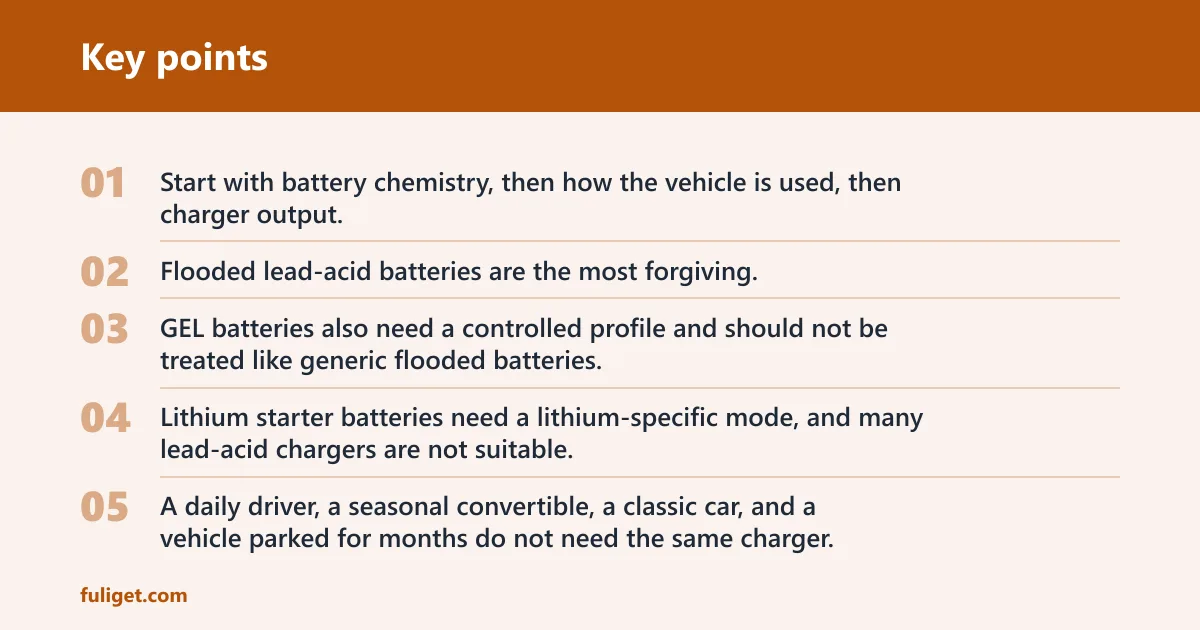
Start with battery chemistry, then how the vehicle is used, then charger output. That order matters more than chasing the highest amp number. A charger that matches flooded, AGM, GEL, or lithium chemistry and your use case is less likely to overcharge, undercharge, or upset modern vehicle electronics.
Start with battery chemistry, not amp rating
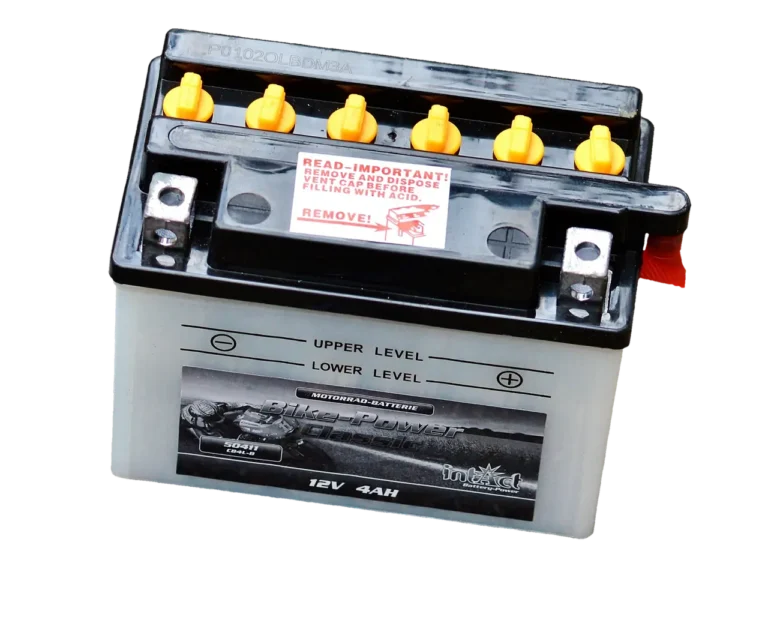
Most passenger cars, crossovers, SUVs, and light trucks use a 12V starting battery, so the charger should match that 12V system. Capacity is measured in amp hours, which is why labels such as 40Ah, 60Ah, and 80Ah are useful when estimating charging time.
Chemistry sets the charging profile. Flooded lead-acid batteries are the most forgiving. AGM batteries are more sensitive to voltage and should use an AGM-compatible mode; they are common in newer start-stop vehicles. GEL batteries also need a controlled profile and should not be treated like generic flooded batteries. Lithium starter batteries need a lithium-specific mode, and many lead-acid chargers are not suitable.
Match the charger to how the vehicle is used
A daily driver, a seasonal convertible, a classic car, and a vehicle parked for months do not need the same charger. A lower-output maintenance charger makes sense for storage. A mid-output smart charger suits routine recovery. A high-output or boost unit fits limited cases, not everyday charging.
A seasonal car with a 60Ah AGM battery that sits for about six weeks between drives can be a typical use case for a maintenance-capable charger. A 1-3A maintenance-capable charger with AGM mode fits that job better than a basic 10A manual charger, because storage care and charge control matter more than speed.
Use a safety margin for modern vehicle electronics
Late-model vehicles can be sensitive to voltage spikes, battery monitoring systems, and maker-specific charging procedures. That is one reason smart chargers are usually the safer default. If the owner’s manual specifies a charging mode, terminal point, or disconnect procedure, that guidance should override general advice.
Cold weather makes this more relevant. DEFA states that at -18°C, even a new battery can only perform at 40% capacity, and at -10°C you must drive an average of 7 kilometers before the battery even starts charging. A charger used in winter should therefore have sensible control, not only more current.
Know your battery before you buy a charger
12V car battery basics and amp-hour capacity
Most cars use a 12V battery. The charger must also be 12V. Check that first, before amp rating, battery mode, or extra features.
Amp-hour capacity tells you how much energy the battery can deliver over time. How a Car Works notes that a 48 amp hour battery can deliver 1 amp for 48 hours. The same idea explains why larger batteries usually take longer to recharge, especially once the charger tapers current near full.
Flooded, AGM, GEL, and lithium differences
Flooded lead-acid batteries are the standard type in many older or simpler vehicles. A charger for them should still be controlled, but compatibility problems are less common than with AGM or lithium.
AGM batteries need more care. They are often fitted to start-stop cars and should use an AGM mode or a charger whose specifications explicitly list AGM support. Using a generic charger with no AGM setting can leave the battery undercharged or apply the wrong voltage profile.
GEL batteries are less common in cars but do appear in some specialty applications. They should only be charged on a profile that lists GEL compatibility.
Lithium starter batteries are the least forgiving of guesswork. Confirm both the vehicle requirement and the battery label before buying a charger. If the charger does not specifically support lithium starting batteries, rule it out.
How to confirm battery type from the label or manual
Read the battery case first. Manufacturers usually print chemistry, capacity, and sometimes charge warnings on the top label. Look for terms such as AGM, EFB, GEL, lithium, LiFePO4, or plain lead-acid.
If the label is missing or unclear, check the vehicle manual. In modern cars, battery type is sometimes tied to the charging system, battery sensor, or registration procedure after replacement. That is another sign that charger choice is a system-compatibility decision, not a generic accessory purchase.
What size battery charger do you need?
For most 12V cars, a smart charger in the 4-8A range is the practical middle ground, while 1-3A is better for storage or small-battery maintenance. Size the charger by battery capacity and use pattern first, because more output cuts charge time but can raise heat and leaves less margin for the wrong charging profile, which you do not need for routine maintenance.
How 2A to 10A chargers fit different battery sizes
How a Car Works says car battery chargers commonly range from 2 to 10 amps. That range covers most owner use. Low-output chargers are slower but gentler for maintenance. Mid-range units suit everyday recovery. High-end 10A units can shorten charging time on larger batteries, provided the chemistry and charging profile are correct.
Some basic chargers use a high/low switch, typically 3 or 6 amps. That can work for straightforward flooded batteries, but it is still less flexible than a charger that adjusts automatically.
- 1-3A: storage, maintenance, motorcycles or smaller 12V batteries, and slow recovery when speed is not the priority.
- 4-6A: a strong fit for many 40Ah to 60Ah car batteries in regular owner use.
- 8-10A: larger batteries, faster recovery, or a household with several vehicles, if the charger also supports the right battery chemistry.
Charge speed versus battery stress
Higher amperage charges faster. It is also not automatically better. Faster charging can mean more heat and less margin for chemistry-specific mistakes, especially with AGM and lithium batteries.
A common first-timer mistake is shopping by the biggest number on the box, then using a basic high-output charger on a car that only needed maintenance charging. The battery gets power quickly, but the charger may be a poor fit for long-term battery health or for an electronics-heavy vehicle.
When low-amp maintenance charging makes more sense
If the car sits for weeks, preserving charge matters more than recovering from deep discharge. A proper maintenance charger monitors battery state and drops to a holding mode when needed. That is different from an old-style trickle charger that simply feeds current continuously.
The same source says winter charging may only reach 60-80% without an onboard smart charger. That matters for cars parked in cold conditions, where maintenance charging can be more useful than occasional fast charging.
Is a smart battery charger better than a manual charger?
Usually, yes. A smart charger is the better choice for most car owners because it adjusts voltage and current, charges in stages, and can switch to maintenance mode when the battery is full. A manual charger can still fit simple situations, but it needs more oversight and carries more overcharge risk.
What a smart charger does differently
POWER1986 describes smart chargers as monitoring voltage, temperature, and charging time. Those controls matter on modern batteries and in cold weather. A smart charger can also use multi-stage charging, which means it does not keep pushing the same output from empty to full.
POWER1986 also says smart chargers can quickly charge to about 80% and then switch to trickle charging. That slowing phase is why “hours to full” is always an estimate, not a promise.
Where a manual charger still fits
Manual chargers are simpler and often cheaper. On an older vehicle with an easy-to-access flooded battery, they can still do the job if the user watches charging progress and disconnects the charger at the right time.
The tradeoff is clear: fixed-output behavior, fewer protections, and more chance of overcharging if the charger is left unattended. That is a weak match for AGM batteries, storage charging, and newer vehicles with battery-management systems.
When starter or boost chargers are the wrong tool
Starter or boost chargers are for brief assistance, not normal battery care. They can be useful when a vehicle must be started immediately, but they are a poor substitute for correctly charging and evaluating the battery afterward.
Repair or desulfation modes also need context. The same source says pulse charging is widely used in repairing lead acid batteries. That can help some lead-acid batteries, but it is not a cure for physical damage, severe internal failure, or a battery that will not hold charge after proper charging.
Which charger features are worth paying for?
Battery-specific modes for AGM and lithium
If the battery is AGM, the charger should explicitly list AGM mode or AGM compatibility. If the battery is lithium, the charger should explicitly list lithium compatibility. Treat missing chemistry support as a red flag, not a minor omission.
EFB batteries are usually closer to lead-acid charging behavior than lithium, but the vehicle manual still matters, especially on start-stop cars. Where the manual specifies battery charging or battery registration procedures, follow that guidance.
Temperature compensation and multi-stage charging
Temperature compensation matters because batteries behave differently in cold and heat. A charger that senses temperature or compensates for it is less likely to undercharge in winter or apply the wrong voltage profile in warmer conditions.
Multi-stage charging is worth paying for because it changes charger behavior as the battery fills. Bulk charging restores most capacity. Later stages reduce current or adjust voltage to finish more safely. That matters more than a flashy maximum-amp claim.
Safety protections that should be standard
At minimum, look for reverse polarity protection, short-circuit protection, overcharge protection, and spark-proof connection. Those should be standard on any charger intended for ordinary owners.
Also look for clear status lights or a display that shows charging, fault, full, or maintenance mode. Chargers that tell you nothing about their state make it harder to catch a bad connection or a battery that is not accepting charge.
Charger choice matrix
Battery type and vehicle use case matrix
| Battery type | Vehicle use case | Recommended charger output range | Must-have safety features | Red flags to avoid |
|---|---|---|---|---|
| Flooded lead-acid | Daily driver, routine recovery | 4-6A smart charger | Reverse polarity, short-circuit, overcharge, spark-proof clamps | Manual fixed-output charger with no auto shutoff for unattended use |
| Flooded lead-acid | Long-term storage or infrequent use | 1-3A maintenance charger | Maintenance mode, overcharge protection, spark-proof connection | Old-style constant trickle charger with no charge control |
| AGM or EFB | Modern start-stop vehicle | 4-8A smart charger with AGM mode | AGM-compatible profile, temperature compensation, reverse polarity, overcharge protection | Any charger that does not list AGM support |
| AGM | Seasonal car or winter-stored vehicle | 1-4A maintenance-capable smart charger with AGM mode | Maintenance mode, temperature sensing, spark-proof clamps | Boost charger used as a storage charger |
| GEL | Specialty vehicle, careful maintenance | 2-4A charger that explicitly supports GEL | Battery-specific mode, overcharge protection, clear fault indication | Generic charger that lists only flooded lead-acid |
| Lithium starter battery | Performance or specialty vehicle | Battery-maker-approved lithium-compatible charger | Lithium mode, reverse polarity, short-circuit, overcharge protection | Standard lead-acid charger with no lithium setting |
| Any 12V battery | Classic car with simple electrical system | 2-6A smart charger, sized to battery capacity | Auto shutoff, reverse polarity, spark-proof clamps | Leaving a manual charger connected overnight |
| Any 12V battery | Vehicle in long-term storage | 1-3A maintenance charger matched to chemistry | Maintenance mode, overcharge protection, fault indication | Assuming trickle and maintenance charging are the same thing |
How long will charging take?
Charging time depends on battery capacity, current state of charge, battery condition, and how the charger tapers near full. A completely flat battery can take many hours to recover, and some smart chargers will not start at all if battery voltage is below their minimum threshold.
Why amp-hour capacity and state of charge change the answer
How a Car Works notes that a battery in discharge is said to be flat. Flat does not always mean ruined, but it does mean time matters. A larger battery, or one at a lower state of charge, takes longer to recover at the same amp setting.
How a Car Works also says a basic charger may need about 24 hours to fully charge a 48Ah battery at 2 amps. That is a useful reference point for understanding why low-output charging is slow, especially near the end of the cycle. (Howacarworks)
Battery charger table
| Battery capacity | 2A | 4A | 6A | 10A |
|---|---|---|---|---|
| 40Ah | About 20-24 hours | About 10-12 hours | About 7-9 hours | About 4-6 hours |
| 60Ah | About 30-36 hours | About 15-18 hours | About 10-13 hours | About 6-9 hours |
| 80Ah | About 40-48 hours | About 20-24 hours | About 13-17 hours | About 8-12 hours |
These are estimate bands, not exact promises. They assume a deeply discharged battery and a charger that may taper current as the battery fills.
Why the last part of charging slows down
Smart chargers usually reduce current as the battery approaches full charge. That protects the battery and helps finish safely. It is also why the first part of charging can look quick while the last stretch takes longer.
Suppose a 40Ah flooded battery starts the evening on a 6A smart charger. It may recover enough charge for starting sooner than a full charge is complete, but the charger can still spend hours in its finishing stage before switching to maintenance mode.
Should you disconnect the battery before charging it?
Usually, not always. Many smart chargers are designed for in-vehicle charging, but some vehicles have manufacturer-specific procedures, remote charging points, or battery monitoring systems that change the answer. Bench charging a removed battery is simpler, while in-vehicle charging demands closer attention to the manual and clamp placement.
Charging in the vehicle versus charging on the bench
Charging on the bench reduces the chance of accidental contact with nearby metal parts and makes inspection easier. In-vehicle charging is more convenient and common, especially with maintenance chargers.
For late-model vehicles, check whether the manufacturer specifies under-hood charging points instead of direct battery posts. Some systems monitor current flow and battery condition through dedicated sensors. Bypassing the intended connection point can cause charging errors or false battery-state readings.
When the vehicle manual should decide
If the vehicle has start-stop, battery registration requirements, unusual battery location, or a battery sensor on the negative terminal, consult the manual before connecting a charger. Manufacturer guidance should also decide if the battery has been fully discharged, frozen, or recently replaced.
Clamp connection basics and spark precautions
- Inspect the battery. Do not begin if the case is cracked, swollen, leaking, badly corroded, or shows freezing damage. A damaged battery can vent or fail during charging.
- Confirm the settings. Match 12V charger to 12V battery, then select the correct chemistry mode such as flooded, AGM, GEL, or lithium. If the charger has current choices, pick the lowest setting that still fits the job.
- Attach the positive clamp. Connect the positive lead to the positive terminal or the manufacturer-specified positive charging point. Make the connection firm so the charger can read battery condition correctly.
- Attach the negative clamp. Connect the negative lead to the negative terminal or approved ground point, following the vehicle manual where required. Keep clamps secure and away from moving parts.
- Power the charger. Plug the charger into mains power only after the clamps are connected. This reduces spark risk at the battery.
- Stop in reverse order. When charging is complete, switch off or unplug the charger first, then remove the negative clamp, then the positive. Work in a ventilated area and keep sparks or open flames away.
When should you not charge a car battery?
Do not charge a battery with a swollen case, cracked case, leaking electrolyte, severe corrosion around damaged terminals, or signs of freezing damage. Charging should also stop if the battery overheats, smells strongly, refuses to accept charge, or repeatedly goes flat after proper charging.
Physical damage and leak warning signs
Visible damage is an immediate stop sign. A cracked or swollen battery can vent gas or leak acid. Severe terminal corrosion can also hide structural damage around the posts.
If the battery was deeply discharged in freezing weather, inspect carefully before charging. A frozen battery can crack internally or externally, and charging it before thawing and inspection can be unsafe.
Batteries that are too cold, too discharged, or failing internally
Some smart chargers will not begin charging a battery below a certain voltage. That is often a protection feature, not a charger fault. If a battery has dropped that low, it may need professional evaluation, especially if it is relatively new and the drop happened suddenly.
Repeated no-starts after full charging often point to internal battery failure, a parasitic drain, or a charging-system problem in the vehicle. A charger cannot fix all three.
Cases where replacement makes more sense than charging
If the battery reaches full charge, then quickly falls flat again, replacement is often the sensible path. The same applies when the charger reports a fault repeatedly or when repair mode makes no lasting difference on a lead-acid battery.
The same source recommends its 1203X onboard smart charger for keeping battery power ready in regular use scenarios, but even a good maintenance setup cannot rescue a battery with physical damage or severe internal failure.
Frequently asked questions
What amperage charger is safe for a 12V car battery?
For most cars, 4-8A is a sensible everyday range, while 1-3A is safer for long-term maintenance or storage. The safe choice still depends on battery chemistry and vehicle design. A charger with the correct AGM or lithium mode is safer than a higher-amp charger with the wrong profile.
Can I use a battery charger on AGM or lithium car batteries?
Yes, but only if the charger explicitly supports that chemistry. AGM batteries should use AGM mode, especially in start-stop vehicles. Lithium starter batteries need a lithium-compatible charger, and many standard lead-acid chargers are not suitable. If the charger does not list your battery type, skip it.
How long does it take to charge a flat car battery?
It depends on amp-hour capacity, starting charge level, battery condition, and charger behavior near full. A low-output charger can need many hours. As one reference point, a basic charger may need about 24 hours to fully charge a 48Ah battery at 2 amps.
What safety features should a car battery charger have?
Look for reverse polarity protection, short-circuit protection, overcharge protection, and spark-proof clamps as the baseline. Useful extras include temperature compensation, fault indication, and automatic maintenance mode. For AGM or lithium batteries, chemistry-specific charging modes belong on the must-have list, not the nice-to-have list.
Can a battery charger be left on overnight?
Only if it is a smart charger designed for maintenance charging and it includes overcharge protection. Manual chargers should not be left unattended overnight. Even with a smart charger, do not leave a damaged, leaking, or overheating battery connected, and avoid enclosed spaces with poor ventilation.