Battery Maintainer vs Trickle Charger: What Is the Difference?

A battery maintainer keeps a healthy 12V battery at full charge by switching to float or pulse mode. A trickle charger sends a low current more continuously, so it is less safe for long, unattended connection, especially on modern batteries. Use the wrong one and you can overcharge, dry out, or fail to keep a stored car ready to start. This guide shows how each charger works, when to use each one, and what to avoid during storage.
| Decision factor | Battery maintainer | trickle charger | Winner |
|---|---|---|---|
| Long-term connection | Automatically stops at full charge and resumes when voltage drops. | Supplies low current continuously, so it may keep pushing charge after the battery is full. | Battery maintainer |
| Overcharge protection | Designed to enter float mode and reduce risk when left connected. | Basic or unregulated output can keep charging without a full-charge cutoff. | Battery maintainer |
| AGM compatibility | Often built for AGM charging profiles; confirm the listing and voltage setting. | Not the better default unless the unit is explicitly AGM-compatible and regulated. | Battery maintainer |
| Recovery from a deeply discharged battery | Not the right tool if the battery is already deeply discharged. | Slow output may take days and still may not recover a dead battery safely. | Neither |
| Charging speed | Maintains a charged battery rather than trying to refill a flat one. | Low-current charging is slow; some sources cite 12 to 24 hours for a 12-volt battery. | trickle charger |
| Best storage use case | Best for a healthy stored battery during weeks or months of sitting. | Best only for simple, monitored top-off use on compatible batteries. | Battery maintainer |
How each charger behaves
Charging current and speed
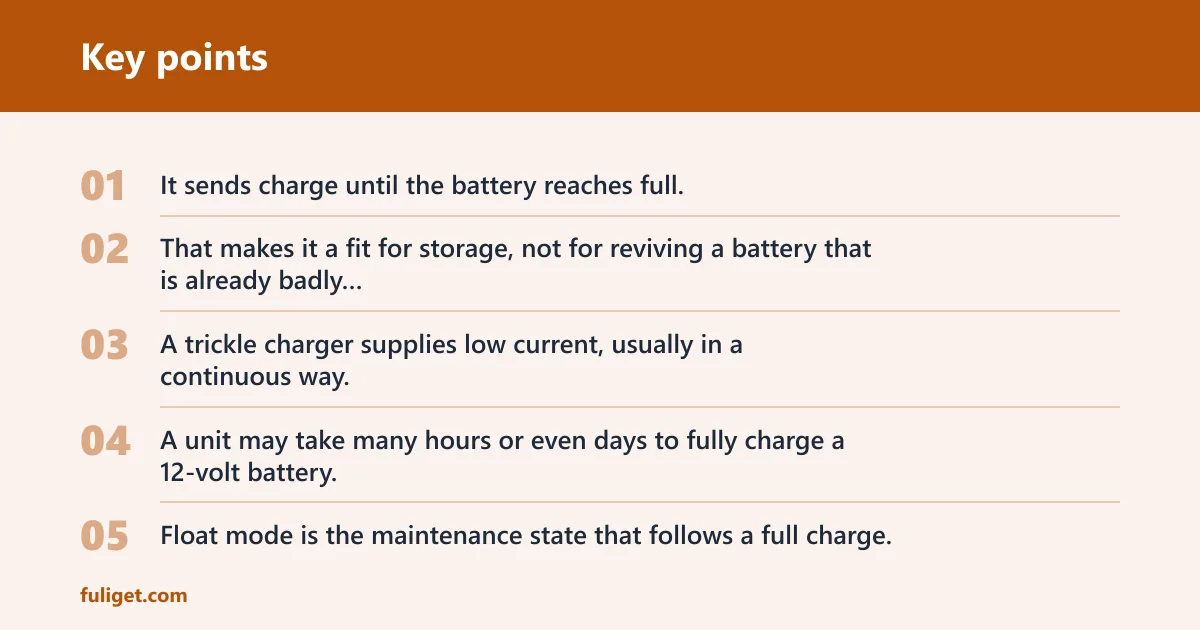
A battery maintainer is a smart charger. It sends charge until the battery reaches full, then it switches to a float or maintenance state and resumes only when voltage falls. That makes it a fit for storage, not for reviving a battery that is already badly depleted.
A trickle charger supplies low current, usually in a continuous way. A unit may take many hours or even days to fully charge a 12-volt battery, depending on battery capacity and charger amperage.
Float mode and shutoff
Float mode is the maintenance state that follows a full charge. In that state, the charger uses tiny maintenance pulses or a low hold level to prevent overcharging. That is the practical difference that matters for a battery left on a shelf or parked for the season.
It follows the same point: the maintainer reduces or pauses charging at full and returns when voltage drops, then enters float mode. That behavior is what makes it suitable for leave-connected use when the charger matches the battery type and voltage.
What happens as battery voltage changes
For 12V vehicle systems, the charger setting should match the battery voltage. A maintainer that is meant for 12V service will usually show the proper battery type setting on the listing or the manual. If the setting is wrong, float behavior is no longer trustworthy.
Many products sold as trickle chargers blur the label. Some are simple low-current chargers, while others are actually smart maintainers with a trickle-charger badge on the box. Check whether the unit has shutoff, float mode, and battery-type matching before you buy.
Battery decision table
| Scenario | Battery condition | Storage duration | Chemistry | Correct choice | Risk level | Do not use warning |
|---|---|---|---|---|---|---|
| 1 | Healthy, fully charged | Weeks | Lead-acid | Battery maintainer | Low | Do not leave a basic trickle charger on unattended. |
| 2 | Healthy, fully charged | Months | AGM | Battery maintainer | Low | Do not use a charger without an AGM-compatible profile. |
| 3 | Partly discharged | Days | Lead-acid | Battery maintainer | Moderate | Do not assume a trickle charger will recover it quickly. |
| 4 | Partly discharged | Weeks | AGM | Battery maintainer | Moderate | Do not use an unregulated charger on AGM. |
| 5 | Deeply discharged | Days or weeks | Lead-acid | Neither | High | Do not rely on either device as the first recovery step. |
| 6 | Deeply discharged | Months | AGM | Neither | High | Do not connect a basic trickle charger to a deeply discharged AGM battery. |
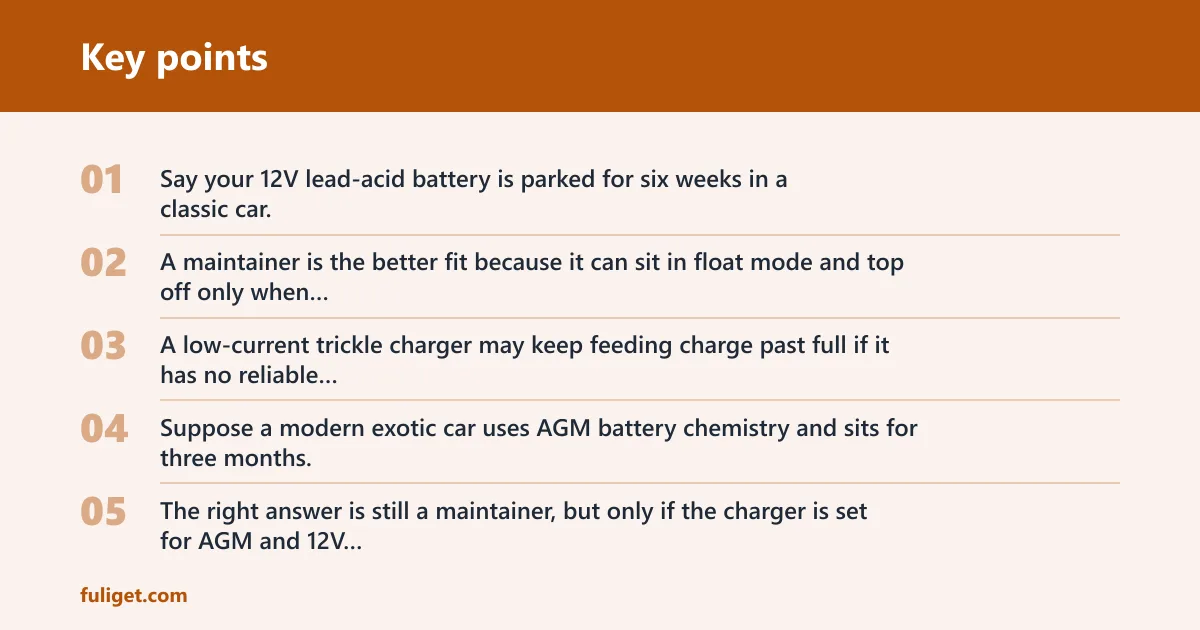
Say your 12V lead-acid battery is parked for six weeks in a classic car. A maintainer is the better fit because it can sit in float mode and top off only when voltage falls. A low-current trickle charger may keep feeding charge past full if it has no reliable cutoff.
Suppose a modern exotic car uses AGM battery chemistry and sits for three months. The right answer is still a maintainer, but only if the charger is set for AGM and 12V service. A plain trickle charger is the weaker choice because AGM batteries are more sensitive to overcharging.
Which battery type does each suit?
Lead-acid batteries are the classic storage case. They benefit from maintenance charging during off-season storage, especially when the vehicle will sit for weeks and the battery is already healthy. That is where a smart maintainer earns its keep.
AGM batteries need more care than a generic label suggests. The practical point is simple: match the charger profile to the battery, not the marketing term on the box.
12V compatibility and charger settings
For 12V vehicle systems, confirm the charger is meant for 12V batteries and that the setting matches the battery type. A battery tender enters float mode at full charge, with the exact float level varying by battery type and charger. That is the kind of detail you want to see in a listing or manual.
If the charger has no clear battery-type setting, it is not the safest choice for leave-connected use. Overcharge protection matters most on batteries that sit for long periods, because a battery that is already full does not need a charger that keeps pushing current.
Can you leave either connected?
A battery maintainer can usually stay connected for long periods because it is commonly designed to stop charging when full and resume when voltage drops. That is the behavior you want for winter storage, but only when the charger is matched to the battery type and the vehicle manual allows it.
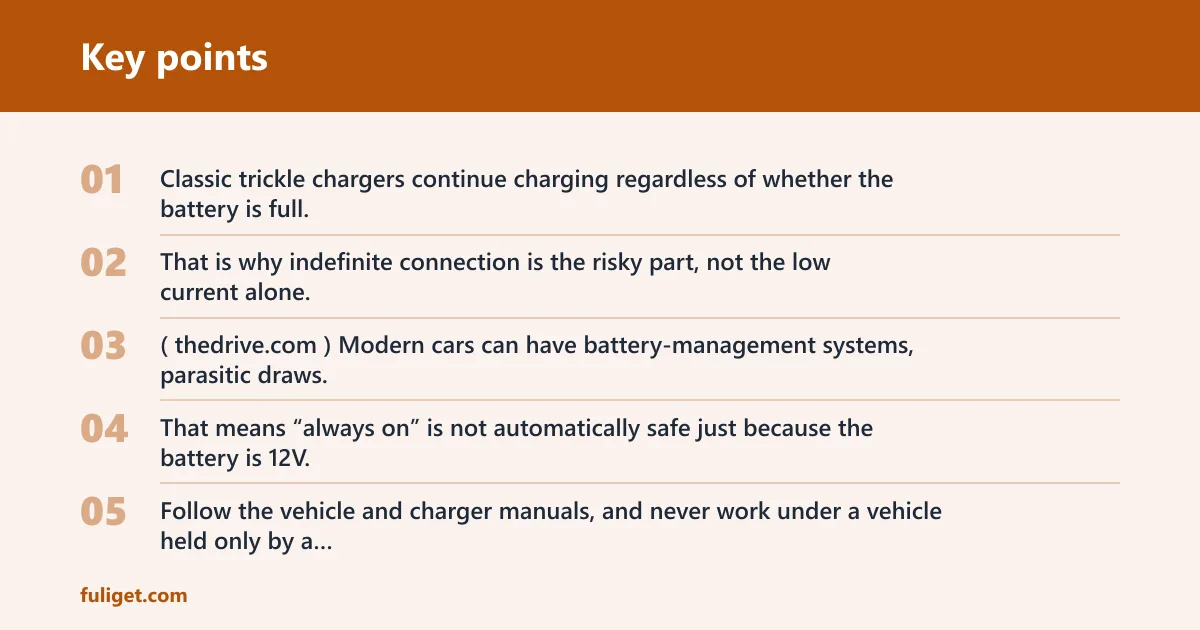
A trickle charger is a different case. Classic trickle chargers continue charging regardless of whether the battery is full, and continuous output does not reduce when full. That is why indefinite connection is the risky part, not the low current alone. (Thedrive)
When modern vehicle electronics change the answer
Modern cars can have battery-management systems, parasitic draws, and modules that stay awake longer than older vehicles did. That means “always on” is not automatically safe just because the battery is 12V. Follow the vehicle and charger manuals, and never work under a vehicle held only by a jack; keep items out of airbag zones and the driver’s view, and check local laws.
One more caution applies to deeply discharged batteries. A maintainer is built to maintain a healthy battery, not rescue one that is far below normal voltage. If the battery has been run flat or is well below its normal resting voltage, a smart charger with a recovery mode may be appropriate if the manual allows it; otherwise, the right next step is usually a proper recovery charger or service check, not a leave-connected maintainer.
Choose Battery maintainer if… / Choose trickle charger if…
Choose Battery maintainer if… the battery is healthy and you want it ready after weeks or months of storage; the battery is AGM and the charger is AGM-compatible; or the vehicle will sit while you want float mode and overcharge protection.
Choose trickle charger if… you have a simple, monitored top-off need on a compatible lead-acid battery, the unit is clearly regulated, and you will not leave it connected without checking the manual. If the battery is deeply discharged, choose neither and use a proper recovery path.
One more buying check helps: many products marketed as trickle chargers are actually smart maintainers. Read the listing for shutoff behavior, float mode, and battery-type compatibility before you decide. If the seller does not state those details, assume you have not found the right model yet.
Frequently asked questions
What is the difference between a battery maintainer and a trickle charger?
A battery maintainer watches battery voltage, stops charging when full, and resumes later in float mode. A trickle charger supplies a low current more continuously and may keep charging after the battery is full. That makes the maintainer the better choice for long storage.
Can I leave a battery maintainer on all the time?
Often yes, if the maintainer is designed for that use, the battery type matches, and the vehicle manual allows it. Battery maintainers are safer for long-term use when they are matched to the battery and the charger settings are correct, but that does not override a wrong voltage setting or a failing battery.
Will a trickle charger overcharge a car battery?
It can. Classic trickle chargers continue charging regardless of full charge, so leaving one connected too long raises overcharge risk. That risk matters most with AGM batteries and with any setup that lacks a clear float mode or regulated shutoff.
Which is better for an AGM battery: maintainer or trickle charger?
A battery maintainer is the better default for AGM because it can use an AGM-compatible profile and float at the right voltage. If you use anything else, confirm the profile in the listing or manual first.
Can a trickle charger fully charge a dead battery?
Sometimes, but slowly and not always safely. A trickle charger may take days to fully charge a dead battery, and some units are too basic for a truly depleted battery. For a deeply discharged battery, a proper recovery charger is the safer route.
What amperage do trickle chargers usually use?
Trickle chargers generally send between one and three amps. That is low current, but low current is not the same as safe indefinite connection. The key question is whether the charger regulates output and stops or floats at full charge.
Is a battery tender the same as a battery maintainer?
Battery Tender is a specific brand name, not a generic category. People often use it to mean a maintainer, because many smart maintainer products behave the same way: they stop at full charge, enter float mode, and resume when voltage drops. Check the actual product specs, not the shorthand.
How long can a trickle charger stay connected safely?
There is no universal safe time. A trickle charger that never stops charging should not be treated like an always-on maintainer, especially on AGM batteries or modern vehicles with electrical modules. If the manual does not explicitly allow indefinite connection, do not assume it does.