How to Connect a Battery Maintainer to Your Car Battery

Connect the maintainer red clamp to battery positive first, then black to the battery negative post or a clean chassis ground if the manual allows it; skip charging entirely if the battery is swollen, cracked, frozen, or below the maintainer’s minimum start voltage. Bad connections can spark, damage modules, or leave a dead battery unrecovered. Follow the exact connection order below, use an underhood ground only where the manual allows it, and stop if the battery is too far gone for the unit to detect.
What a battery maintainer does
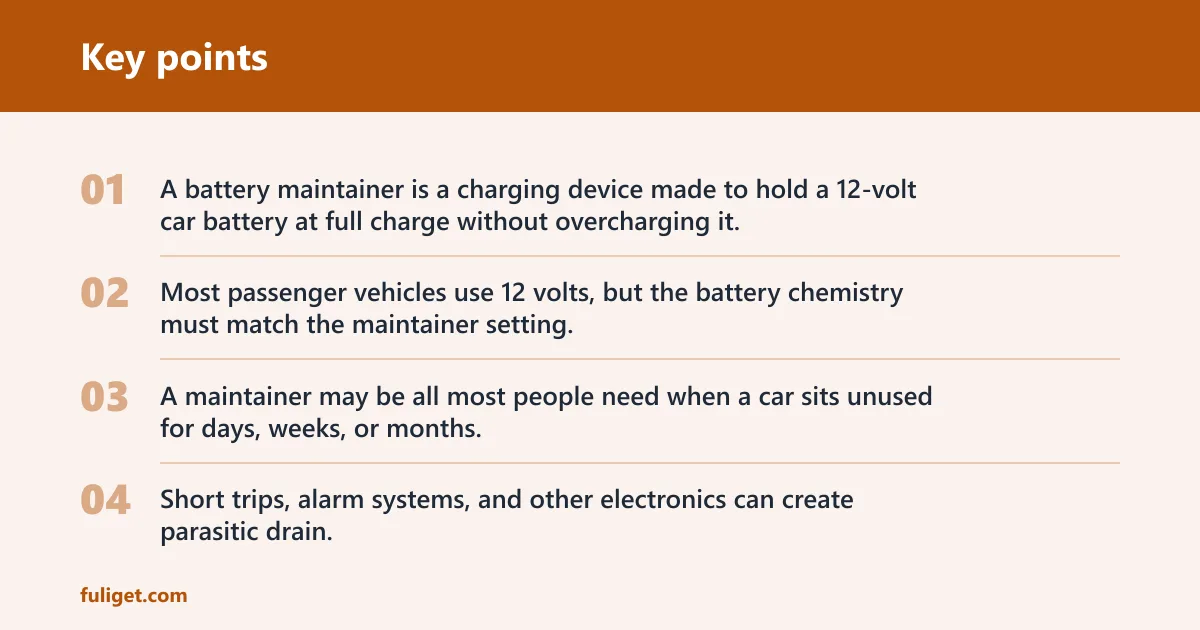
A battery maintainer is a charging device made to hold a 12-volt car battery at full charge without overcharging it. It is used for long-term storage, and most smart models switch on and off as needed, then move to float mode or maintenance mode once the battery is full. It is not a jump starter, and it is not meant to revive a dead battery. (Consumerreports)
Most passenger vehicles use 12 volts, but the battery chemistry must match the maintainer setting. That may be flooded lead-acid, AGM, gel, or lithium, depending on the vehicle. A maintainer may be all most people need when a car sits unused for days, weeks, or months.
Short trips, alarm systems, and other electronics can create parasitic drain. Storage makes that worse. If the battery keeps going flat after sitting, a maintainer can hold it up; if the battery is deeply discharged, the unit may not even detect it.
What you’ll need
- A battery maintainer rated for 12 volts
- The correct battery chemistry setting, if the unit has one
- Protective gloves and eye protection
- A dry, ventilated parking spot or work area
- A clean rag or brush for light corrosion
- A quick connector, pigtail, or eyelet lead if you plan repeated storage use
- The vehicle manual and the battery label
How do you connect a battery maintainer?
Attach the red clamp to the marked positive (+) terminal first, then connect the black clamp to the negative terminal or a clean chassis ground point if the manual allows it. After both leads are secure, plug the maintainer into AC power. That order helps limit sparks and gives the maintainer a chance to check the battery before current flows.
-
Check the battery first.
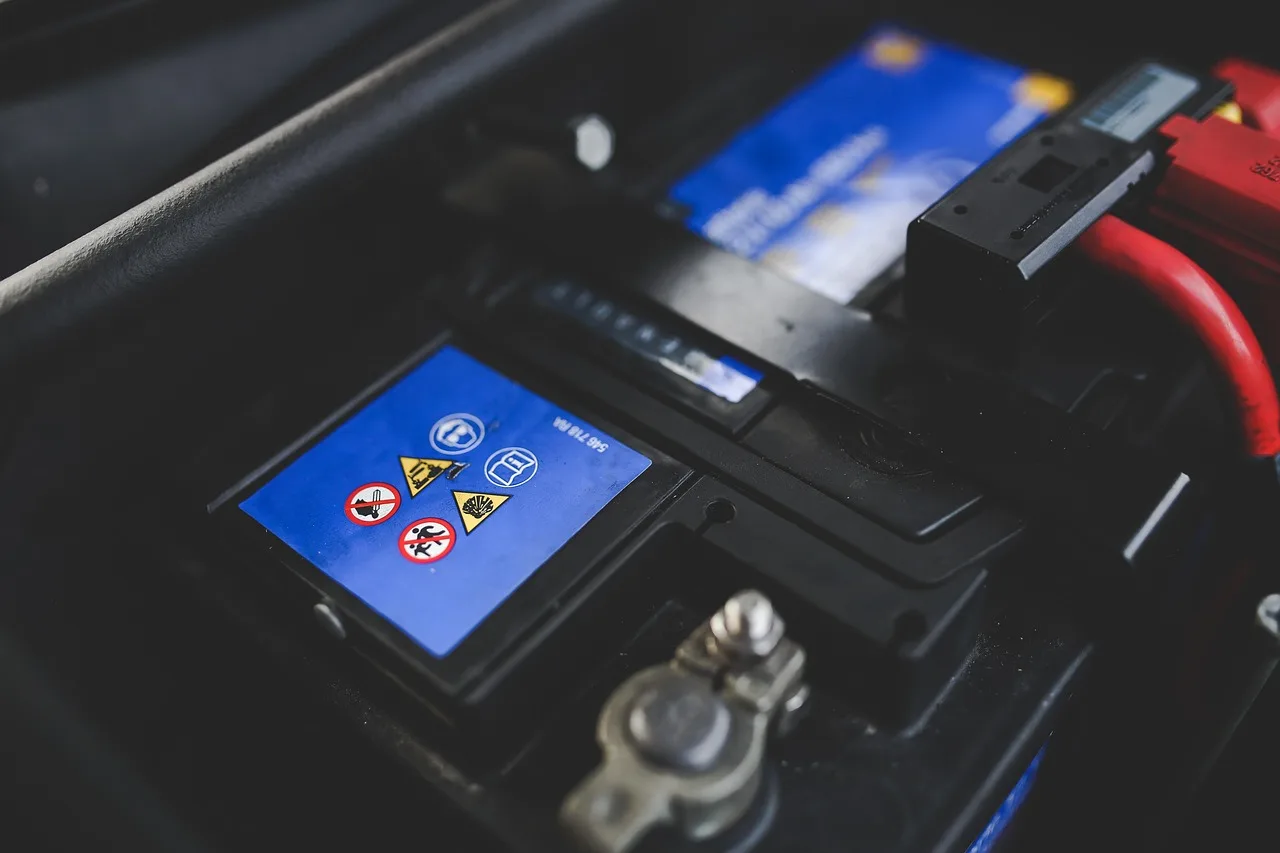
Look for cracks, swelling, leaks, frozen cases, loose posts, and heavy corrosion before you touch the clamps. Do not connect a battery that appears damaged, including if it is swollen, cracked, leaking, or frozen. A maintainer is meant to preserve charge, not rescue a battery that is physically unsafe. -
Set up a safe work area.
Park in a ventilated area, turn off the ignition, remove the key, and make sure lights, chargers, and accessories are off. Leave the hood ajar if the manual or maintainer instructions call for it, and route the cable so it will not pinch at the latch. -
Match the chemistry.
Confirm voltage and battery type on the battery label before you touch the charger controls. If the battery is AGM, select AGM-compatible mode. If the battery is flooded lead-acid, gel, or lithium, use the setting the maintainer and battery call for; do not treat every 12-volt battery the same. -
Attach the positive lead first.
Clip the red lead to the positive (+) terminal or the positive post on an eyelet lead. Then attach the black lead to the negative terminal or the approved ground point. Connection order matters, because the battery is least likely to spark when the positive side is already secure. -
Plug in last.
Insert the maintainer into AC power only after both leads are attached. Watch the indicator lights or display. Most smart maintainers show a charging state first, then switch to float or maintenance mode after the battery reaches full charge, though the exact display varies by model.
Battery in the vehicle
Leave the battery installed if the manual permits an underhood connection. Many maintainers can connect at the battery posts, and some allow the negative lead to land on a clean chassis ground away from the battery. That can reduce spark risk near the battery vent area and gives more room around the terminal clamps.
Keep the cable away from the grille, fan, belts, and hot engine parts. Consumer Reports advises routing the wire per the instructions and leaving the hood ajar, not through the grille or down along the engine.
Battery out of the vehicle
If the battery is already removed, place it on a stable surface and connect directly to the posts. Use the same order: red to positive, black to negative. This is the simplest setup because there is no chassis ground decision to make, and there are fewer nearby parts that can snag the cable.
Using a quick connector
A quick connector, pigtail, or eyelet lead is often easier and safer for repeat storage use than clips. Ibbotson suggests quick connectors, and pigtails can be safer than clips because they reduce the chance of an underhood spark. Once the lead is attached to the battery terminals, you can connect and disconnect the maintainer without opening the battery area each time.
Deeply discharged battery
If the battery is very low, a maintainer may not detect it at all. That is a common failure mode. Maintainers are meant to preserve the charge level, not bring a dead battery back from the edge, so a battery below the unit’s minimum start voltage may need a full charger or replacement instead.
Suppose the maintainer shows no charging light after correct hookup on a 12-volt battery that sat for months. That points to a battery that is too far discharged for the unit to recognize. Try a charger with a recovery mode only if the battery is not swollen, cracked, leaking, or frozen; otherwise stop and replace the battery.
Connection checklist
| battery situation | where to connect the negative lead | what to do before plugging in | the likely maintainer result |
|---|---|---|---|
| Battery in the vehicle | Negative terminal or a clean chassis ground point if the manual allows it | Confirm the hood is open, the key is out, the battery is intact, and the cable route avoids moving or hot parts | Charges, then shifts to float or maintenance mode |
| Battery out of vehicle | Negative battery post | Set the battery on a stable surface, verify the label, and attach leads in order | Charges normally if the battery is healthy |
| AGM battery | Negative terminal or approved ground point if installed in the car | Select AGM-compatible mode before AC power is applied | Charges with the correct chemistry profile and then holds in maintenance mode |
| Deeply discharged battery | Negative terminal only if the battery is intact and the manual allows it | Check whether the maintainer can detect the battery at all | May show no start, may refuse to charge, or may need a separate charger first |
Can you connect the negative lead to the chassis?
Yes, often you can, if the maintainer manual allows it and the ground point is clean metal with a solid connection. That is a common choice when the battery stays in the vehicle, because the black lead can go to a chassis ground away from the battery. It should not be used as a substitute for the correct polarity or chemistry setting.
Choose bare, unpainted metal that is close to the battery but not on a moving or hot part. Do not use rusty brackets, painted surfaces, or thin sheet metal that will not hold the clamp securely.
Will it work on an AGM battery?
Yes, if the maintainer has an AGM-compatible charging mode and you set it correctly. AGM batteries are common in modern vehicles, and advanced maintainers often have a mode made for absorbed glass mat batteries. The wrong setting can charge poorly or behave badly at full charge, so the chemistry label matters.
Read both labels before starting. If the battery says AGM, use AGM mode. If the maintainer does not offer that option, choose a different unit rather than guessing.
Common mistakes
Most hookup problems come from skipping the label check, reversing the clamps, or plugging in before the clips are secure. Another frequent miss is treating a maintainer like a dead-battery rescue tool. That leads to no-indicator confusion when the battery is simply too low for the unit to recognize.
- Do not attach black first.
- Do not plug in before the clamps are on.
- Do not use the wrong chemistry mode.
- Do not connect a swollen, cracked, leaking, or frozen battery.
- Do not route cables through the grille or into the engine path.
- Do not leave interior lights or accessories on.
Prevent problems by using a pigtail for repeat storage, keeping the hood ajar as directed, and checking the battery label before each storage season.
Frequently asked questions
How do I connect a battery maintainer to my car battery?
Connect red to the positive (+) terminal first, then black to the negative terminal or an approved chassis ground point. After both leads are secure, plug the maintainer into AC power. That sequence is the safest default for most 12-volt passenger vehicles.
Do I connect the positive or negative clamp first?
Connect the positive clamp first. Attach the red lead to the marked positive terminal, then connect the black lead. Plug in only after both clamps are attached. That order reduces spark risk and gives the maintainer a proper start-up check.
Can I leave a battery maintainer on all winter?
Yes, if the unit is a smart maintainer with float mode or maintenance mode and the battery is healthy. It is designed for long-term storage, so it can hold charge for weeks or months. Check the battery and cable setup periodically, especially in cold storage.
Should I plug in the maintainer before or after attaching clamps?
Attach the clamps first, then plug in the unit. That is the standard order for smart maintainers and it matches the common safety guidance for underhood use. Plugging in too early can create a live lead before the battery is connected.
Can I use a battery maintainer on an AGM battery?
Yes, but only with the correct AGM-compatible mode. Use the battery label and the maintainer manual to select the right chemistry setting. Do not assume a standard flooded setting is close enough, because AGM batteries call for the correct profile.
Will a battery maintainer charge a dead car battery?
Not usually. A maintainer is meant to preserve charge, not revive a battery that is too far gone. If the battery is deeply discharged, the maintainer may fail to detect it, in which case a proper charger or a replacement battery is the next step.