Are Impact Sockets Stronger Than Regular Sockets?

Yes, impact sockets are usually tougher and thicker than regular chrome sockets, so they handle impact loads better, but they are not always harder; for hand tools, chrome is often the smarter buy, and for impact tools, use impact sockets. Using the wrong one can crack a socket, round a fastener, or send broken metal flying. This guide explains hardness vs. toughness, how the two socket types differ, and when each one makes the better choice.
How impact and chrome sockets differ
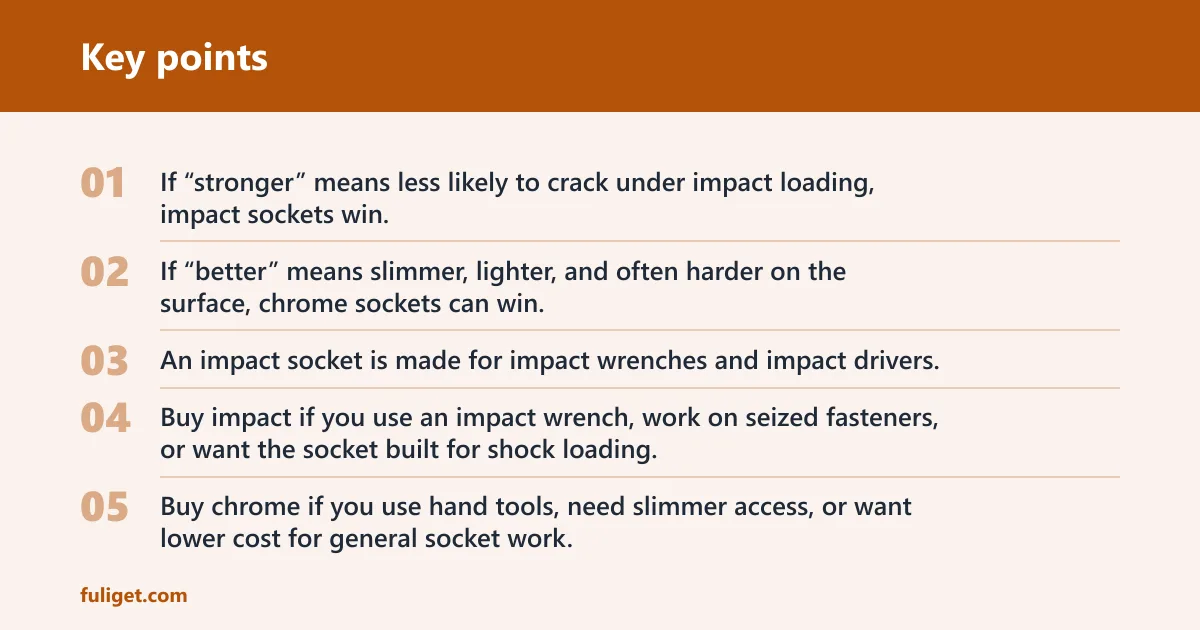
The trade-off is straightforward: impact sockets are built for repeated hammering from powered tools, while regular chrome sockets are built for hand torque and tighter spaces. If “stronger” means less likely to crack under impact loading, impact sockets win. If “better” means slimmer, lighter, and often harder on the surface, chrome sockets can win.
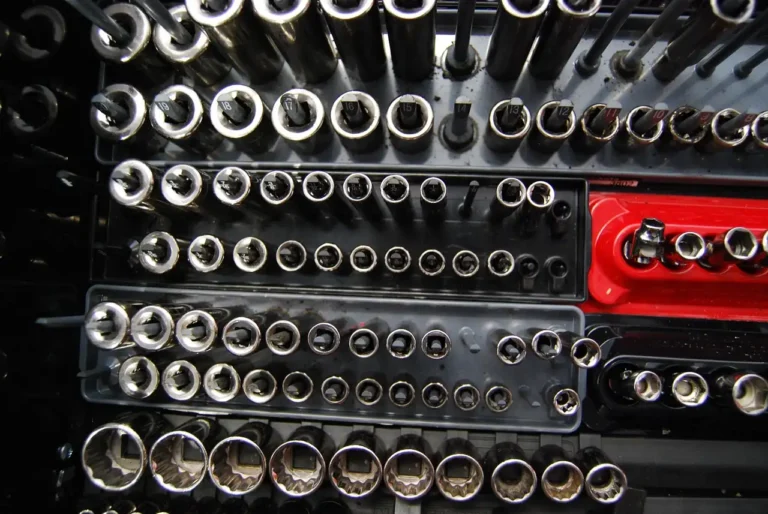
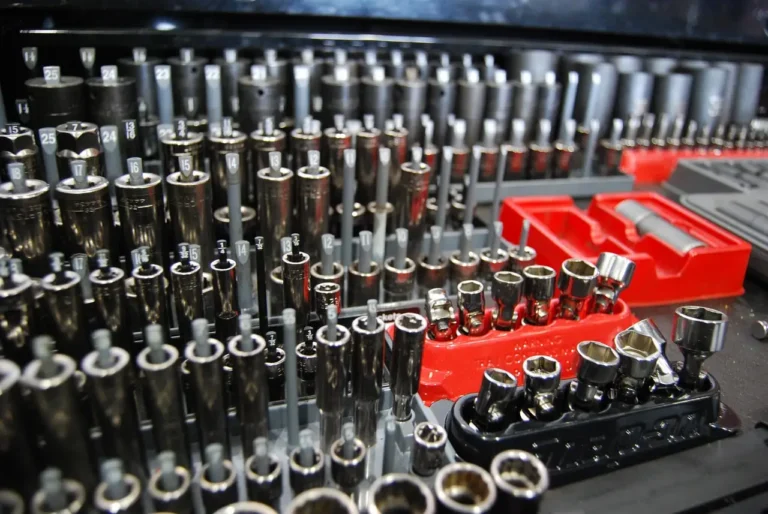
An impact socket is made for impact wrenches and impact drivers. It usually has thicker walls, more weight, and often a black phosphate or black electroplated finish. A regular chrome socket is meant for ratchets and torque wrenches, usually comes in chrome vanadium steel, and is thinner for better access.
Socket comparison matrix
| Criterion | Impact socket | Regular chrome socket | Verdict |
|---|---|---|---|
| Impact resistance | Built for repeated impact loads | Not intended for impact tools | Impact wins for powered use. |
| Crack risk | Lower under impact loading | Higher if used on an impact gun | Impact is safer under shock loads. |
| Hardness | About 40-45 HRC | About 48-52 HRC | Chrome is harder on this scale. |
| Wall thickness | Thicker walls | Thinner walls | Impact is stronger in section size. |
| Access in tight spaces | Worse because of bulk | Better because of slimmer walls | Chrome wins in cramped access. |
| Cost | Usually costs more than basic chrome | Usually cheaper | Chrome wins on price. |
| Hand-tool suitability | Works, but feels bulkier than needed | Best fit for ratchets and torque wrenches | Chrome wins for hand tools. |
| Impact-tool suitability | Made for impact tools | Not intended for impact tools | Impact wins clearly. |
Buy impact if you use an impact wrench, work on seized fasteners, or want the socket built for shock loading. Buy chrome if you use hand tools, need slimmer access, or want lower cost for general socket work.
Are impact sockets harder than chrome sockets?
Usually, no. On the Rockwell scale, impact sockets are often listed at 40-45 HRC, while standard chrome sockets are listed at 48-52 HRC. That means chrome sockets can be harder, even though impact sockets are better at surviving impact loads.
Rockwell hardness explained
Rockwell hardness measures resistance to indentation, not overall strength in every use case. A harder socket can resist surface wear better, but it may be less willing to flex when a powered tool sends repeated shock through it. That is why a harder socket is not automatically a tougher socket.
Why harder does not mean tougher
Impact loading creates fast, repeated stress pulses. A socket that is very hard can resist denting, yet still crack when the load spikes. A slightly softer socket can absorb more shock before it fails, especially if the steel and wall thickness are chosen for that job.
Why impact sockets survive impact loads better
Impact sockets survive impact loads better because they combine material choice, wall thickness, and shape for shock tolerance. They are commonly made from chrome molybdenum or similar alloy steel, and they are often described as more resistant to cracking under heavy load than regular chrome sockets.
Chrome molybdenum vs chrome vanadium
Chrome molybdenum steel, often shortened to Cr-Mo, is common in impact sockets. It has higher tensile strength and is more ductile, which helps it absorb shock without cracking as easily. Chrome vanadium steel, or Cr-V, is common in regular sockets and is often harder and less costly, but it is less suitable for impact loading.
That difference explains the apparent contradiction. A chrome socket can be harder on paper and still be the weaker choice under an impact gun. In this comparison, “stronger” means better at surviving repeated shock and resisting fracture, not simply having a higher hardness number.
Wall thickness and crack resistance
Wall thickness is one of the biggest durability differences. Impact sockets are thicker and heavier, which helps them resist cracking when torque spikes. The trade-off is clear: more metal around the socket opening improves impact tolerance, but it also takes up space and adds weight.
Picture a seized lug nut on a 1/2-inch impact wrench. A thin chrome socket may fit, but the shock can split it or chip the corners. The thicker impact socket gives the load more metal to travel through, which reduces the chance of a sudden failure.
6-point openings and fastener grip
Many impact sockets use a 6-point opening. That shape grips the flat sides of a hex fastener more directly and can help reduce rounding, especially when the fastener is already worn or rusted. It does not fix a bad fit, but it does help the socket hold the fastener more securely under high torque.
- Match the drive size. Choose the socket drive that fits the tool and the job. Common drive sizes include about 1/4-inch, 3/8-inch, 1/2-inch, and 3/4-inch, with smaller drives suited to lighter work and larger drives suited to higher torque.
- Check the load type. Use impact sockets with impact wrenches and impact drivers. The repeated shock of powered tools is the load impact sockets are built to handle.
- Check the clearance. If the socket must fit between close obstacles, a thinner chrome socket may be the better fit. The extra wall thickness that helps an impact socket survive can also keep it from reaching recessed fasteners.
Common first-timer mistake: choosing the biggest, thickest socket for every job. On a brake caliper bolt in a tight wheel well, a chrome socket may reach the fastener more cleanly than an impact socket, even though the impact socket is the safer choice on an impact gun.
Are impact sockets better than regular sockets?
They are better for impact tools, but not better for every job. A regular chrome socket is still the smarter choice for many hand-tool tasks because it is thinner, often harder, and easier to place in tight spots. The better socket depends on the tool and the access, not the label alone.
Impact tool use
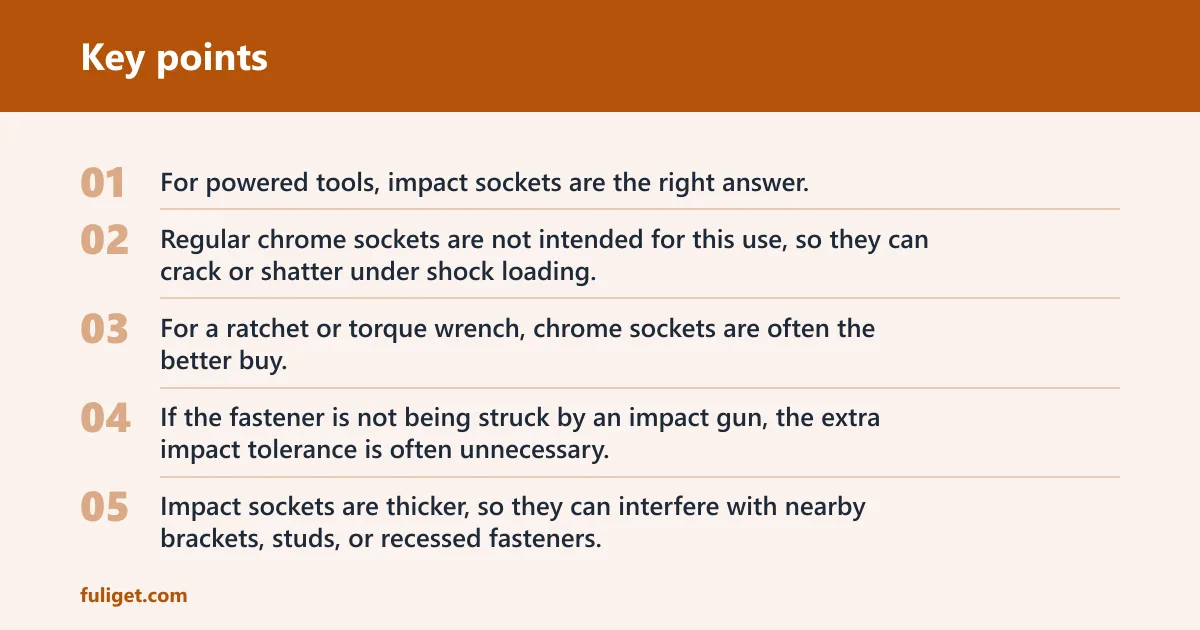
For powered tools, impact sockets are the right answer. They are designed to handle high torque and vibration, and sources describing them this way also note that they withstand impact force better than standard sockets. Regular chrome sockets are not intended for this use, so they can crack or shatter under shock loading.
Hand-tool use
For a ratchet or torque wrench, chrome sockets are often the better buy. They are made for hand tools, tend to have thinner walls, and can slide into places where an impact socket is too bulky. If the fastener is not being struck by an impact gun, the extra impact tolerance is often unnecessary.
Tight-space access
Wall thickness matters here too. Impact sockets are thicker, so they can interfere with nearby brackets, studs, or recessed fasteners. A thinner chrome socket can be the difference between a clean fit and a socket that simply will not seat fully.
A common DIY scenario: a 3/8-inch ratchet is used on a small engine cover bolt that sits deep beside a plastic clip. A chrome socket may fit without touching nearby parts, while an impact socket of the same nominal size may bind before it fully seats.
Choose impact sockets if… / Choose chrome sockets if…
Choose impact sockets when the tool is powered, the fastener is stubborn, or the job involves repeated shock loads. Choose chrome sockets when you are using hand tools, working in tighter spaces, or want the lower-cost option for general-purpose socket work. That is the cleanest split.
Automotive use
For automotive work with impact wrenches, impact sockets are the safer pick. Lug nuts, suspension hardware, and rusted fasteners create the exact kind of loading that impact sockets are built for. For torque wrench work, chrome sockets remain the standard choice.
Construction and heavy torque
On construction fasteners, anchor bolts, and larger hardware, impact sockets are the practical choice because they are built to take repeated torque spikes. A 1/2-inch or 3/4-inch impact socket is commonly used in higher-torque work, where the added wall thickness and shock tolerance matter most.
DIY and torque-wrench work
For general DIY use, chrome sockets often make more sense unless an impact tool is part of the plan. A 1/4-inch or 3/8-inch drive chrome set is usually enough for lighter hand-tool tasks, and the slimmer walls help in cramped spaces around trim, covers, and small fasteners.
Are impact sockets different by drive size?
Yes. Impact sockets are not all the same, and drive size changes both the job range and the load they are meant to handle. Smaller sizes suit lighter work, while larger sizes are chosen for higher torque applications and powered tools.
1/4-inch and 3/8-inch sockets
Quarter-inch drive is commonly recommended for lighter work, while 3/8-inch fits a broad middle range of hand-tool and light impact use. In these sizes, the socket may still be an impact model, but the tool and fastener are usually smaller and less demanding than heavy drivetrain or suspension hardware.
1/2-inch and 3/4-inch sockets
Half-inch and three-quarter-inch drives are preferred for high torque applications. These are the sizes you usually reach for when fasteners are larger, tighter, or driven by a stronger impact wrench. The socket body is built around that extra load, so the size is part of the strength story.
Are all impact sockets the same? No. A 1/4-inch impact socket for light fastening is not the same tool as a 3/4-inch socket for heavy industrial torque. The material family may be similar, but the drive size, wall mass, and intended load change the result.
Frequently asked questions
Are impact sockets stronger than regular sockets?
In the practical sense that matters most, yes. Impact sockets are stronger against repeated shock loading and are less likely to crack or shatter when used with impact tools. Regular chrome sockets may be harder, but they are not built to take the same impact abuse.
Are impact sockets stronger than chrome sockets?
Yes, if “stronger” means more resistant to cracking, splitting, or failure under impact load. Chrome sockets can be harder on the Rockwell scale, but impact sockets are built with more wall thickness and more shock tolerance, which is the strength that matters for impact tools.
Are impact sockets different?
Yes. They differ in material, wall thickness, finish, and intended use. Impact sockets are commonly made from chrome molybdenum or similar alloy steel, while regular chrome sockets are commonly chrome vanadium steel. They are also built for different tools and different kinds of load.
Are all impact sockets the same?
No. Drive size changes the job range, and socket design changes fit and access. A 1/4-inch impact socket for light work is not the same as a 1/2-inch or 3/4-inch socket meant for heavier torque. The common thread is impact tolerance, not identical construction.