
Will a Battery Maintainer Charge a Dead Car Battery?

No. Most battery maintainers only hold a battery at full charge. Many chargers can recover a low car battery well below 12.0 volts, and a charger is commonly needed when the battery is deeply discharged. Ignore that cutoff, and you can strand the vehicle and strain the maintainer. This guide explains the voltage rules, when to use a charger first, and the safest next step for a flat battery. (Consumerreports)
Battery maintainer basics
A battery maintainer is a low-current device, often around 1 amp or less, built to keep an already charged battery near full voltage. Consumer Reports says maintainers turn on and off as needed and are meant to preserve charge, not bring back a dead battery.
A battery charger is different. It sends higher current to recover a deeply discharged battery and may run a bulk charge phase before switching to absorption and float. That extra output matters when a battery has been drained by long parking or prolonged discharge.
Battery Tender is often used as a brand name for this category, but it is not the whole category. In practice, people use “battery tender” to mean a smart maintainer or smart charger/maintainer with automatic maintenance mode.
Will a battery maintainer charge a dead car battery?

Sometimes, but only if the battery is not truly dead and still has enough voltage for the maintainer to recognize it. A maintainer can help with a low battery that is still recoverable, but it is not designed to bring back a fully depleted battery or a battery with internal damage.
The low current is the limit. If the battery is deeply discharged, many maintainers will not start, or they will take so long that a charger is the better first tool. Consumer Reports also says draining a battery completely can shorten its lifespan.
When a maintainer may help
A maintainer may help when the battery is only lightly or moderately discharged and still above the device’s start threshold. Some advanced models can handle batteries down to 1V, and many smart units use a multi-stage process with soft start, bulk charge, absorption, and float mode.
When it will not recover the battery
If the battery is at 0V, reads below 2V on many devices, or is physically damaged, a maintainer is unlikely to bring it back. A cracked, swollen, leaking, or frozen battery should not be charged at all. Internal shorts and heavy sulfation can also stop recovery.
Why low current matters
Low current suits storage care, not fast recovery. A maintainer may hold voltage steady once the battery is healthy, but it does not have the charging muscle of a regular charger. That is why a deeply discharged battery often needs a dedicated charger first.
Battery voltage decision table
Use a multimeter before connecting anything. Voltage gives you a practical way to separate a battery that may recover from one that needs a charger first or may be beyond recovery.
| Battery voltage range | Likely battery state | Can a maintainer help? | Charger required first? | Safest next step |
|---|---|---|---|---|
| 12.6V and above | Fully charged or near full | Yes | No | Use float mode or maintenance mode if the vehicle will sit |
| 12.2V to 12.5V | Low state of charge, but often still recoverable | Sometimes | Maybe | Try a smart maintainer if the battery is healthy; use a charger if it drops further or will not rise |
| 8V to 12.1V | Deeply discharged | Sometimes, on advanced units | Usually yes | Use a regular charger with recovery or bulk-charge capability first |
| Below 8V | Very deeply discharged; possible sulfation or failure | Usually no | Yes | Use a charger that can recognize low-voltage batteries; if it will not accept charge, suspect failure |
| 0V | Battery may be failed, internally shorted, or disconnected | No, in most cases | Yes, with caution | Check for damage and connection problems first; do not assume recovery is possible |
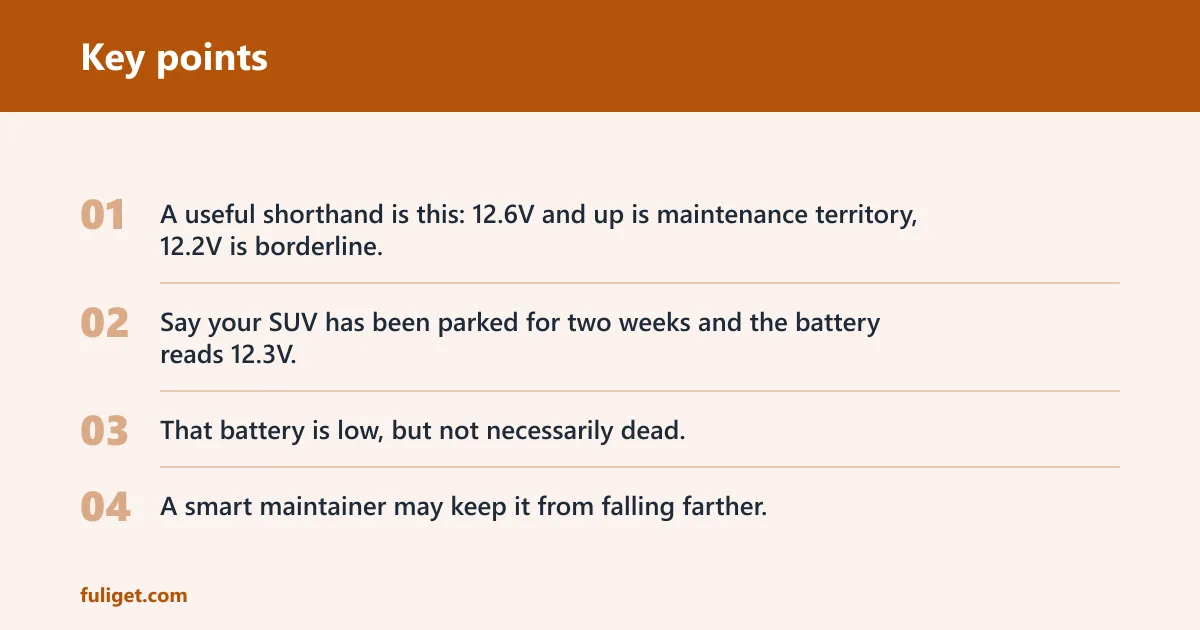
A useful shorthand is this: 12.6V and up is maintenance territory, 12.2V is borderline, 8V is a charger job, and 0V is a warning sign.
Say your SUV has been parked for two weeks and the battery reads 12.3V. That battery is low, but not necessarily dead. A smart maintainer may keep it from falling farther, while a charger becomes the better choice if the voltage keeps sagging after you connect it.
When you need a regular charger first
You need a regular charger first when the battery is deeply discharged, the vehicle has been parked for a long time, or the voltage is too low for a maintainer to recognize. A dead battery may need a dedicated charger with recovery mode or a jump-start first.
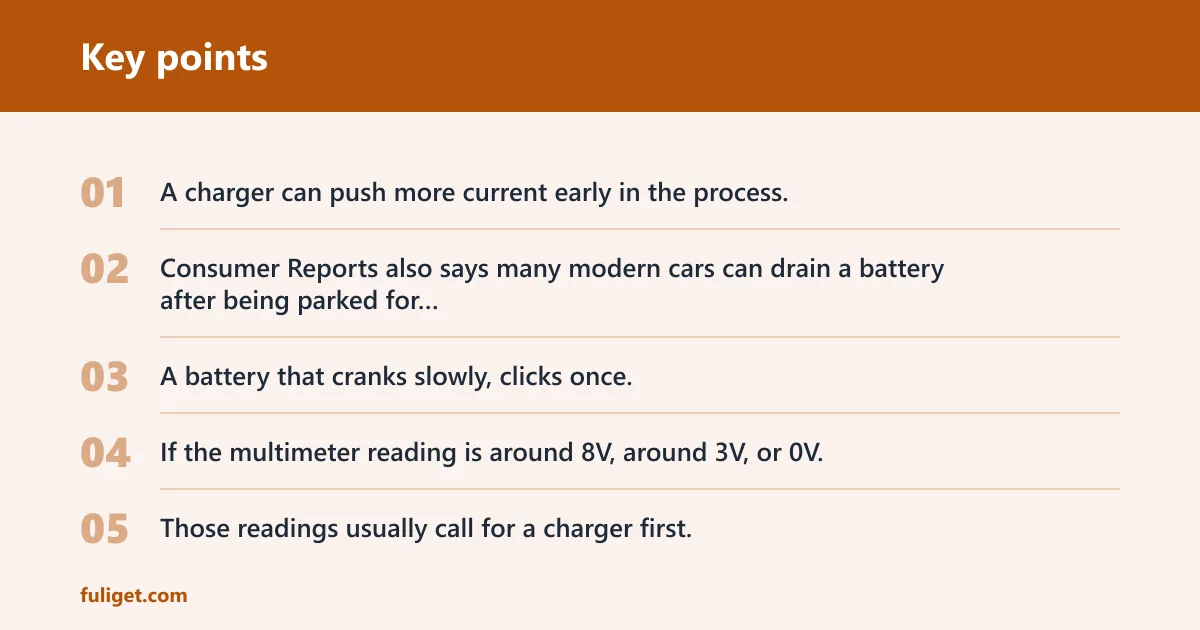
This is where bulk charging matters. A charger can push more current early in the process, which helps raise voltage faster than a maintainer. Consumer Reports also says many modern cars can drain a battery after being parked for just a week or two.
Deep discharge signs
A battery that cranks slowly, clicks once, or shows dim lights is often more than slightly low. If the multimeter reading is around 8V, around 3V, or 0V, do not expect a maintainer to do the heavy lifting. Those readings usually call for a charger first.
AGM battery settings
AGM batteries need the right charging mode. The same source notes that advanced maintainers often have modes for AGM batteries, and smart chargers may include settings that match that battery type. Use the AGM setting if the battery is absorbed glass mat, or you can end up with a poor charge.
A common first-timer mistake is to attach a maintainer to a battery that has sat all winter at 3V and wait for a fast recovery. At that voltage, many devices will refuse to start or will only nibble at the battery. A charger with a recovery mode is the safer first step.
What a smart charger can do
A smart charger can do more than feed current into a battery. Many models use a multi-stage process: desulfation, soft start, bulk charge, absorption, and float mode. That sequence is why a charger can recover a low battery more effectively than a maintainer alone.
Float mode is the maintenance stage after the battery reaches full charge. It holds the battery at a safe level without overcharging it. That is where a maintainer belongs after the battery has recovered.
Desulfation mode limits
Some smart chargers include a de-sulfate feature for traditional flooded batteries. This mode may help with sulfate buildup, but it is not a promise of repair. A battery with heavy sulfation, an internal short, or severe age-related wear may still fail.
When monitoring still matters
Even with smart charging, you still need to check the battery type and watch for trouble. A charger can be the right tool and still be the wrong choice for a cracked, swollen, leaking, or frozen battery. Those batteries should not be charged until they are replaced and handled safely.
What to do before you charge
Check the battery with a multimeter before you connect a maintainer or charger. That reading tells you whether the battery is in maintenance range, deep-discharge range, or failure range. It also gives you a baseline so you can see whether the battery accepts a charge.
Inspect the case carefully. Do not charge a battery that is cracked, swollen, leaking, or frozen. If the terminals are corroded, clean the connections first so the charger can read the battery correctly.
- Measure battery voltage with a multimeter.
- Compare the reading to the voltage table.
- Check for swelling, cracks, leaks, or frost.
- Match the charger setting to the battery type, including AGM if needed.
- Use a charger first if the battery is deeply discharged.
- Switch to float mode or a maintainer only after the battery reaches full charge.
Picture a weekend car that sat for a month and now reads 8.4V. That is not a maintainer job. A charger with a bulk phase is the next step, and the maintainer becomes useful only after the battery reaches a healthy charge level again.
How long does a battery charger take to charge a dead car battery?
A charger can take anywhere from a few hours to more than a day, depending on battery size, state of discharge, and charger output. A fully dead 50Ah battery may take 48+ hours to recharge at 1A, which is why a low-output maintainer is slow for recovery work.
Higher-output chargers usually recover a low battery faster than a maintainer, especially in the bulk phase. Even then, a battery that is badly sulfated or nearly failed may charge slowly, stop accepting current, or never return to full health.
How long should you charge a dead car battery?
Charge until the battery reaches full charge and the charger enters float or stops the bulk phase, then reassess. There is no safe fixed time for every battery. A battery that starts at 12.2V will usually need far less time than one that starts near 8V or below.
If the charger reports an error, the battery may be too deeply discharged or damaged to recover normally. At that point, the right move is to stop and test the battery, not keep forcing charge into it.
Will a battery tender charge a dead car battery?
A Battery Tender-style device may charge a dead car battery only when the battery is still within the unit’s recovery range. In normal use, it is for seasonal storage and maintenance, not for reviving a flat battery that has fallen too far or a battery that has failed internally.
If the battery is only low, a smart Battery Tender may work because it can switch through charging stages and then hold the battery in maintenance mode. If the battery is deeply discharged, a regular charger is the better starting point.
Will a battery tender charge a dead battery?
Not reliably. The term “battery tender” often points to a smart maintainer, and maintainers are built to keep charge, not rebuild a fully dead one. If the battery is below the device’s start threshold, the tender may do nothing or show an error.
Will a battery charger charge a dead car battery?
Often yes, if the battery is deeply discharged rather than physically failed. A charger has the higher current and recovery stages needed to bring voltage back up. If the battery is damaged, internally shorted, or completely refused by the charger, replacement is the safer answer.
Will a battery maintainer charge a battery?
Yes, but only within limits. A maintainer can top off a battery, hold it at full charge, and prevent self-discharge during storage. It is not the right tool for rebuilding a battery that has dropped too far, especially if voltage is very low.
Think of it as a caretaker, not a rescuer. Once the battery is healthy, the maintainer can keep it in float mode and prevent overcharging. Before that point, a charger usually has to do the heavy lifting.
Can a battery maintainer damage a battery?
Usually not, if the maintainer matches the battery type and is used on a healthy battery. Smart maintainers turn on and off as needed, which helps prevent overcharging. Problems show up when the wrong mode is used, or when a damaged battery is left connected for too long.
Damage can also happen indirectly if you rely on a maintainer for a battery that should have been charged with a higher-current charger. That can leave the battery undercharged for a long period, which is not the same as safe maintenance.
Will a battery tender charge a dead battery?
Only if “dead” means low, not failed. A Battery Tender-style maintainer may recover a battery that is still above the device’s practical cutoff, but it is not meant to bring back a battery that is at 0V, below the start threshold, or physically damaged.
That is why voltage matters. If the battery is around 12.2V, a maintainer may be fine. If it is around 8V, a charger is the correct tool. If it is 0V, inspect for failure before doing anything else.
What voltage is too low for a battery maintainer to work?
Below about 2V is too low for many maintainers to start, and 0V is usually beyond what a maintainer can handle safely. Some advanced models can work down to 1V, but that is not the normal case. Once voltage falls that low, a charger with recovery capability is usually required.
If the battery is below 8V, treat it as deeply discharged rather than maintenance-ready. If it will not accept a charge after a proper charger is connected, the battery may be sulfated beyond recovery or internally failed.
When do you need a regular charger instead of a maintainer?
You need a regular charger when the battery is deeply discharged, the voltage is below the maintainer’s start range, or the battery has sat long enough to lose most of its charge. A maintainer is for preserving a good battery, while a charger is for recovering one that is low.
Use a charger first if the battery reads around 8V, around 3V, or 0V. Use a maintainer after the battery recovers, especially for storage or seasonal vehicles. If the battery is AGM, choose a charger with the correct AGM setting.
Frequently asked questions
Can a battery charger charge a dead car battery?
Yes, if the battery is deeply discharged rather than physically failed. A regular charger is built to supply higher current and often has a bulk charge phase that a maintainer lacks. If the battery is damaged, frozen, or internally shorted, charging may not be possible or safe.