

How to Release a Floor Jack and Lower a Car Safely

Lower the car by taking weight off the jack stands, then crack the floor-jack release/lowering valve in small steps until the car settles. If it shifts, binds, or drops fast, close the valve and reset. A bad release can tip the car, crush pinch welds, or trap the jack under load. This checklist covers safe stand removal, controlled descent, and what to do when the jack sticks, jerks, or feels unstable.
Before you release the jack
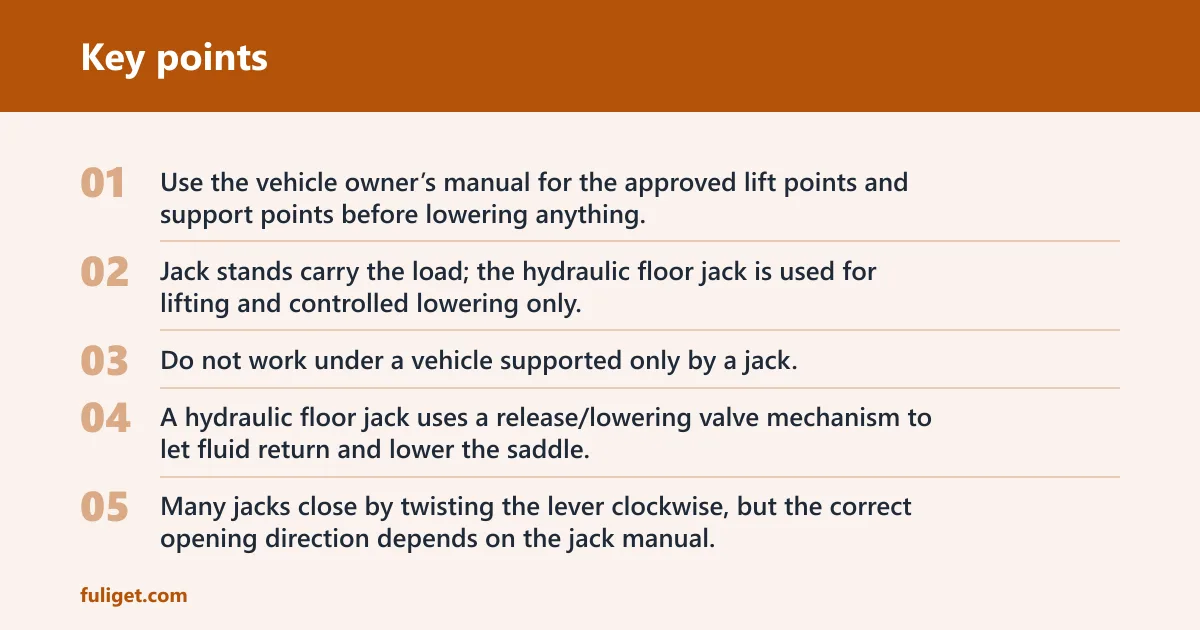
Use the vehicle owner’s manual for the approved lift points and support points before lowering anything. Put the car on firm, level concrete; if you must work on asphalt, use properly load-spread support, set the parking brake, and chock the opposite wheels so the vehicle cannot roll as the load changes.
Jack stands carry the load; the hydraulic floor jack is used for lifting and controlled lowering only. Do not work under a vehicle supported only by a jack. If the stands do not match the vehicle’s weight, if the locking mechanism does not seat cleanly, or if the setup sits on soft, sloped, broken, or loose ground, reset before releasing pressure.
What the jack controls
A hydraulic floor jack uses a release/lowering valve mechanism to let fluid return and lower the saddle. Many jacks close by twisting the lever clockwise, but the correct opening direction depends on the jack manual. Low-profile jacks fit lower vehicles; standard jacks usually suit more common ride heights and higher initial clearance.
Also check the jack’s rated capacity in tons or pounds, plus its minimum saddle height and maximum lift height. The jack must fit under the car at rest and still rise high enough to unload the stands. If the saddle cannot reach the approved lift point without side loading, the jack is the wrong tool for that vehicle height.
What you’ll need
- Hydraulic floor jack with a working release valve
- Jack stands rated for the vehicle’s load, used in pairs
- Wheel chocks for the opposite wheels
- Vehicle owner’s manual or service manual
- Gloves and closed-toe shoes
- Flat work light if visibility is poor
- Small block or pad only if the manual approves it for the lift point
How do you lower a car with a floor jack?
Raise the car just enough to unload the jack stands, remove the stands, and then open the jack’s release/lowering valve in small increments so the car settles evenly. Keep the jack handle path clear as the vehicle comes down. If the body shifts, the saddle binds, or the car touches down early, stop, close the valve, and correct the setup before continuing.
-
Verify the support points. Confirm the jack saddle is on an approved lift point, such as a pinch weld, subframe, or designated point in the manual. Make sure the stands are under approved support points, not under a body panel or plastic cover.
-
Take the weight off stands. Pump the jack only until the stands feel light. A small lift is enough; do not chase extra height. The goal is to remove load from the stands so they can come out cleanly.
-
Remove both stands. Pull the stands out as a pair, keeping fingers and toes clear. If one stand resists, raise the car slightly more rather than forcing the stand sideways, which can shift the vehicle.
-
Crack the valve slowly. Turn the release/lowering valve in the direction listed in the jack manual, using only the small movement that your jack requires. Pause after each change so the car settles under control instead of dropping in one movement.
-
Watch the contact points. Stop immediately if the car shifts, the saddle binds, or any wheel or chassis part contacts early. Close the valve, raise again if needed, and reset the jack at the proper lift point before trying again.
-
Set the car fully down. Continue with tiny valve changes until the tires are on the ground and the jack is no longer carrying load. Remove the jack only after the vehicle sits level and stable on its own weight.
Floor jack decision table
| Symptom | Likely cause | Safe action |
|---|---|---|
| Jack won’t lower | Release valve is still closed, or the mechanism is stuck under load | Close the valve fully, raise the car slightly to unload the jack, then reopen in the direction shown in the manual with a tiny 1/8-turn movement |
| Drops too quickly | Valve opened too far | Close the valve at once, let the car settle if it already moved, then retry with shorter valve movements |
| Car shifts on stands | Stand placement is off, ground is unstable, or the load is not centered | Stop lowering, raise the vehicle again, and reset the stands on firm level ground and approved support points |
| Saddle binds | Jack is angled, the lift point is wrong, or the jack is at an awkward height | Stop, close the valve, move the jack to the correct point, and re-raise only as needed to clear the bind |
| Wheel or chassis contact before full descent | Jack stands came out too late or the car is sagging unevenly | Stop the descent, raise the car enough to correct clearance, and check that the contact point is approved and centered |
How do you remove jack stands safely?
Remove jack stands only after the jack has taken a little weight off them. That transfer matters. If the stands still carry load, they can kick, bind, or drag the vehicle when pulled free. Keep the car on the jack long enough to clear both stands, then lower in controlled steps.
-
Load the jack first. Pump until the stands feel loose, not lifted out of alignment. This keeps the vehicle from settling when you pull them out.
-
Check the stand locks. Make sure the locking pin, pawl, or ratchet is not wedged under side load. If it is, raise the car a little more before touching the stand.
-
Pull both stands clear. Take them out from opposite sides when possible. That keeps the vehicle from rocking as the support points change.
-
Clear the pinch points. Keep hands, feet, and loose clothing away from the tires, jack saddle, and stand bases. The car can settle with enough force to catch fingers.
Picture a sedan on stands where the rear is slightly higher than the front. If the left stand sticks in the weld pocket, a half-inch extra lift can free it without forcing the stand sideways. That is safer than prying against a body seam.
Why won’t my floor jack go down?
Most often, the release/lowering valve is not opening enough, the jack is still carrying too much load, or the saddle is twisted against the lift point. Start by closing the valve, raising the car slightly to unload the jack, and then reopening the valve in the manual’s direction with very small movements.
-
Reset the valve position. Close the valve fully first, using the direction listed in the manual, then try a controlled open again. A partial open under load can feel like a stuck jack.
-
Unload the saddle. Raise the car just enough to remove pressure from the jack mechanism. If the jack is bound against a seam or subframe edge, this can free it.
-
Inspect before retrying. Look for fluid leaks, a bent handle, a crooked saddle, or a jack that will not hold position. If the jack still resists normal movement, stop using it until it is inspected or replaced.
Suppose the jack opens and the car starts down, but the saddle catches after a half-inch. That usually points to a side load at the lift point, not a need for more force. Close the valve, raise slightly, and realign the saddle before trying again.
Common mistakes
Most lowering problems come from rushing the final few inches. The release/lowering valve should move in tiny increments, the stands should come out before the full descent, and the vehicle should stay on firm, level ground throughout. If the car shifts, stop instead of trying to “catch” it with the jack.
- Using the jack as the only support while hands or tools are under the car
- Opening the release/lowering valve too far at once
- Removing stands before the jack has taken the load
- Setting the jack on a body panel, trim, or plastic cover
- Working on soft, sloped, broken, or loose ground
- Ignoring the jack’s capacity, minimum saddle height, or lift limit
A common first-timer mistake is trying to lower the car from a stand height that is already near the jack’s limit. If the saddle is near maximum lift height, the descent can feel jerky and unstable. A better setup starts with the right jack style for the vehicle height, then lowers only after the stands are fully unloaded.
Floor jack and lower checklist
-
Confirm wheel chocks. Keep the chocks on the opposite wheels before the final valve movement. The car should not be able to roll as weight comes back onto the tires.
-
Unload the stands. Lift just enough to make the stands loose, then remove both stands before the last descent. Do not leave one stand carrying half the load.
-
Clear your hands. Pull fingers away from the pinch weld, saddle, and stand pockets before opening the valve. The vehicle can settle faster than it looks.
-
Open in tiny steps. Turn the release/lowering valve in the smallest movement your jack requires and pause after each one. If the car settles unevenly, close the valve and reset.
-
Stop at first contact. If a wheel, chassis edge, or jack part touches too early, stop immediately. Raise slightly, check alignment, and continue only after the contact point is clear.
-
Remove the jack last. Once the car is fully on the ground, close the valve and slide the jack out only after the vehicle is stable on its own weight.
-
Remove the wheel chocks last. Take the chocks off only after the vehicle is fully on the ground and the job is finished.
Frequently asked questions
Floor jack vs car jack
A floor jack is a hydraulic lifting tool with wheels and a release valve for controlled lowering. “Car jack” can mean a scissor jack, bottle jack, or floor jack. For garage work, a hydraulic floor jack is sturdier and better for routine maintenance than an emergency jack.
How do you lower a car after using jack stands?
Take a little weight off the stands with the floor jack, remove the stands, then lower the car slowly with small valve movements. If the vehicle shifts or the jack binds, stop and reset the setup. The stands should never be the last thing removed under load.