
How Does a Torque Wrench Work?

A torque wrench loads an internal spring, beam, or sensor until the set torque is reached, then it clicks, bends, or sends a signal. Use it only in the marked direction and at the handle grip point. Used badly, it can strip threads, loosen fasteners, or leave wheel and engine hardware underclamped. This guide explains the mechanism inside, why accuracy changes, and which setup mistakes alter torque at the fastener.
What is a torque wrench?
A torque wrench is a tool that measures and applies a specific amount of rotational force to a nut, bolt, or screw. That target value comes from the manufacturer’s torque specification, and it varies by application, fastener size, and joint design. The goal is simple: keep torque within the required range.
Foot-pounds and meter-kilograms are commonly used units on the scale. Read the unit printed on the wrench, not the unit you expect to see. A 20 foot-pound setting is not the same thing as 20 meter-kilograms.
What you’ll need
- A torque wrench sized to cover the required torque range
- The correct socket or bit for the fastener
- The manufacturer’s torque specification
- An extension or adapter only if the job requires one
- A clean fastener and mating surface
How does a torque wrench work inside?
Inside the wrench, force at the handle passes through a calibrated part that resists bending or movement. As you pull, that internal element stores or senses load until it reaches the set limit. At that point, the wrench gives feedback so you stop before adding more torque.
The sequence is straightforward: force enters at the grip, the internal element deflects or senses that force, the mechanism reaches its threshold, and the wrench signals the user. Smooth pulling matters because jerking can spike the load past the target before the mechanism responds.
How the force path works
- Set the torque value to match the spec.
- Attach the correct socket or bit squarely to the fastener.
- Pull at the marked handle grip point.
- Let the internal spring, beam, dial, or sensor react to the applied load.
- Stop when the wrench clicks, bends to the mark, or signals on the display.
Say your bolt calls for 25 foot-pounds and the wrench is set to that value. A steady pull brings the internal element to its limit, the wrench signals, and the fastener reaches the target without extra force. A quick jerk can overshoot that point.
How does a click torque wrench work?
A click-type torque wrench works by setting a torque limit ahead of time. As the fastener tightens, an internal clutch or spring-loaded mechanism typically reaches the preset point and releases with an audible click. That click is the warning to stop pulling, not a cue to keep going.
Click-type wrenches are common for automotive and bicycle work because they are quick to read and easy to use. They still depend on correct setup, correct direction, and regular calibration. If the wrench has been dropped, overloaded, or stored at the wrong setting, the click point can drift.
How does a click torque wrench work?
The wrench stores the chosen setting in an internal spring assembly. When applied torque reaches that limit, the mechanism slips slightly and produces the click sound at the set torque limit. The handle may move a little at the same moment, but the key point is that the signal means “stop now.”
That release point is sensitive to technique. Pulling from the wrong place on the handle changes the effective torque. So does using a cheater bar, side-loading the head, or adding an adapter without accounting for the change in mechanical advantage.
Torque wrench types and how they differ
Beam, click, dial, and digital torque wrenches all apply the same basic idea, but they sense load in different ways. The differences matter because the feedback style, accuracy range, and failure points are not the same. A tool that fits one job may be a poor fit for another.
| Type | Sensing method | User feedback | Typical strengths | Common failure mode | What can make delivered torque inaccurate |
|---|---|---|---|---|---|
| Beam | Pointer-and-scale mechanism | Pointer moves across the calibrated scale | Simple mechanical design, no batteries | Bent beam or hard-to-read pointer | Side-loading, worn calibration, extensions, adapters |
| Click | Preset internal spring and release clutch | Audible click at target torque | Fast use, common for automotive and bicycle work | Spring drift or worn release parts | Wrong setting, side-loading, adapters, worn calibration |
| Dial | Dial gauge linked to internal deflection | Direct-reading gauge display | Higher-accuracy applications | Dial damage or lost zero | Side-loading, extensions, adapters, calibration drift |
| Digital | Electronic sensor and processor | Screen readout; may beep or vibrate | High precision use cases | Battery, sensor, or display failure | Wrong unit selection, side-loading, adapters, worn calibration |
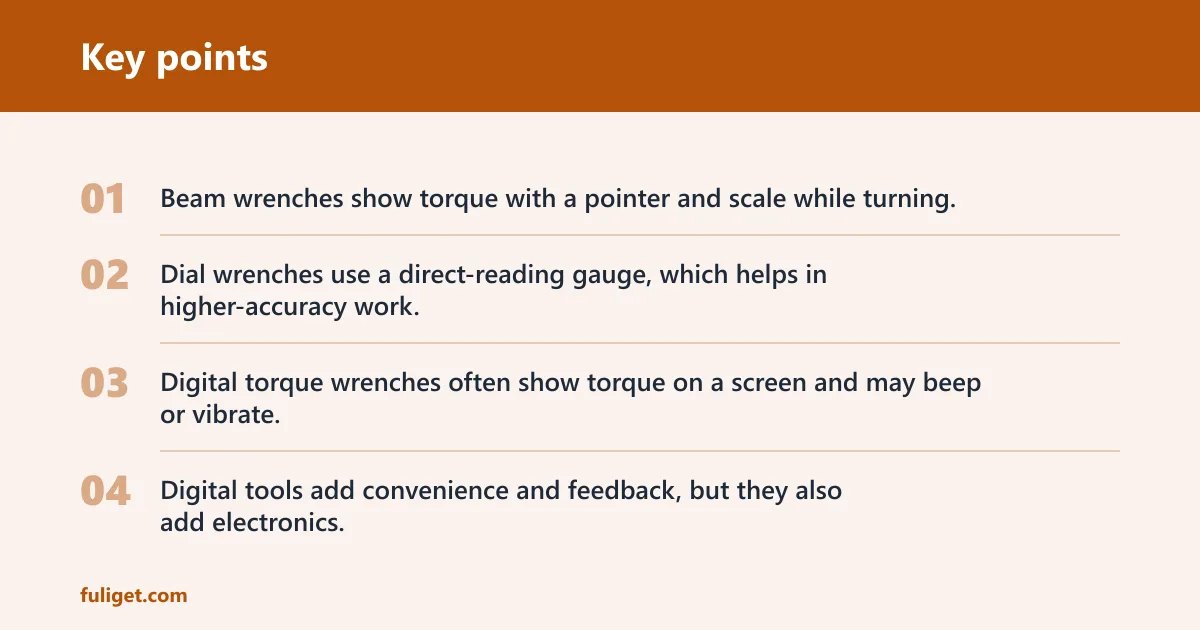
Beam wrenches show torque with a pointer and scale while turning. Dial wrenches use a direct-reading gauge, which helps in higher-accuracy work. Digital torque wrenches often show torque on a screen and may beep or vibrate. Beam tools are simple. Digital tools add convenience and feedback, but they also add electronics.
How do direction and range affect use?
Some torque wrenches work in both directions, while others are intended mainly for clockwise tightening. That matters because the internal mechanism may only measure accurately in one direction. Check the wrench body and the manual before using reverse torque or left-hand fasteners.
Working range matters too. A wrench is most accurate in the portion of its scale where the mechanism is designed to operate. Use a tool that covers the needed torque without living at the very bottom or very top of its range. A 10 to 150 foot-pound wrench is a poor choice for a 7 foot-pound fastener.
Why working range matters
Accuracy usually drops near the edges of the scale. That is why beginners should choose a wrench that places the target value in the middle of the range when possible. For low-torque jobs, a smaller wrench is often the better tool.
Suppose a fastener needs 88 meter-kilograms and the wrench scale is printed in foot-pounds. Read the wrong unit and the result is far off. The setting must match the printed unit and the target value at the same time.
Does a torque wrench work with an extension?
Yes, but an extension can change the effective torque at the fastener depending on how it is used. A straight extension on the drive end usually changes access more than torque, but added length, angle, or an offset adapter can change mechanical advantage. That means the wrench reading may no longer equal the torque at the bolt.
If an extension or adapter is required, keep the setup square and short when possible. If the adapter changes the centerline or adds an offset, the delivered torque may need compensation. That is one reason service manuals often specify the exact setup to use.
Common mistakes
Most torque errors come from setup, not from the tool itself. Read the wrong unit, use the wrong range, or pull from the wrong spot on the handle and the number at the fastener changes. Calibration drift then adds another layer of error.
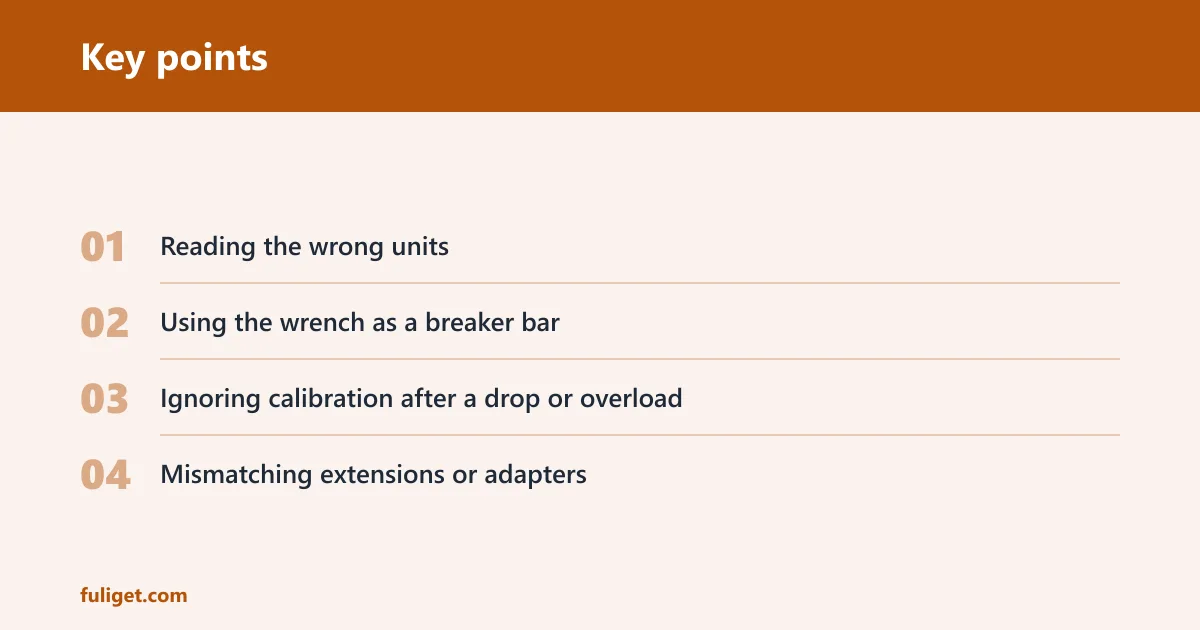
- Reading the wrong units: Foot-pounds and meter-kilograms are not interchangeable. Match the wrench scale to the spec before tightening.
- Using the wrench as a breaker bar: Break loose stuck fasteners with a regular bar. A torque wrench is for controlled tightening.
- Ignoring calibration after a drop or overload: If the wrench falls, is used past its limit, or is stored incorrectly, have it recalibrated.
- Mismatching extensions or adapters: If the setup changes mechanical advantage or angle, the torque at the fastener can differ from the wrench reading.
Calibration keeps the wrench close to its marked value. Torque wrenches should be recalibrated at fairly regular intervals, and sooner after drops or overloads. If a click wrench suddenly feels mushy, if a beam pointer no longer returns to zero, or if a digital reading looks inconsistent, recheck calibration before trusting it.
A common first-timer mistake is setting a click wrench to about 30 foot-pounds for a wheel fastener and then adding another partial turn after the click. That extra pull raises the actual torque above spec. Stop at the signal, then move to the next fastener.
Frequently asked questions
How does a torque wrench work in both directions?
Some models measure torque in clockwise and counterclockwise directions, but not all do. The direction limit depends on the internal mechanism and the maker’s design. Check for a bidirectional rating before using the wrench on left-hand threads or reverse-torque fasteners.
Does a torque wrench work in reverse?
Only if the wrench is built and marked for reverse operation. Many click-type tools are intended mainly for clockwise tightening. If the scale, head, or manual does not list reverse use, do not assume the reading stays accurate when turned the other way.
Does a torque wrench work with an adapter?
Yes, but adapters can change the torque delivered at the fastener if they alter the drive geometry. Keep the adapter short and straight when possible. If the service manual gives an offset correction, use that number instead of guessing.
What do you use a torque wrench for?
You use it for any fastener that needs a specific torque value, such as wheel lugs, engine components, bicycle parts, and other joints where clamping force matters. The tool helps keep the fastener tight enough to hold, but not so tight that threads or parts are damaged.
Why use a torque wrench?
Use one because the joint is designed around a target clamping load, not just “tight enough.” That target is set by the manufacturer to protect threads, seals, bearings, and safety-critical parts. A torque wrench helps you hit that value instead of guessing.
How does a torque wrench work diagram?
A simple mental diagram is: hand force enters at the handle, the internal spring or beam resists that force, the wrench measures the load as it rises, and a signal appears when the target is reached. Beam models show movement on a scale, click models release, and digital models report the number on a screen.