Oil Filter Wrench Types: Cup, Strap, Pliers, or Claw?

Choose a cup wrench for the correct filter size and a chain, strap, pliers, or claw tool when the filter is stuck, crushed, buried, or mounted with poor access; the failure mode should decide the tool. Use the wrong wrench and you can round the can, split the housing, or turn a quick oil change into a leak and cleanup job. This guide compares cup, strap, pliers, claw, and chain wrenches by fit, grip, access, and damage risk so you can buy the right one once.
How different wrench types compare
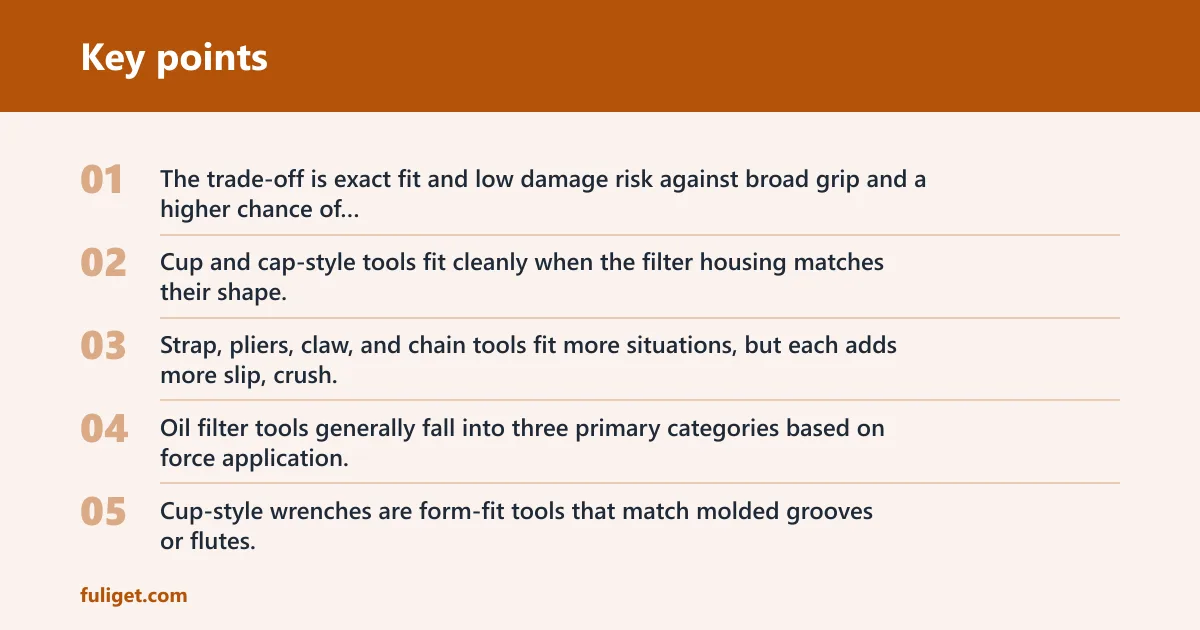
The trade-off is exact fit and low damage risk against broad grip and a higher chance of canister damage. Cup and cap-style tools fit cleanly when the filter housing matches their shape. Strap, pliers, claw, and chain tools fit more situations, but each adds more slip, crush, or puncture risk.
Oil filter tools generally fall into three primary categories based on force application. Cup-style wrenches are form-fit tools that match molded grooves or flutes. Strap and band wrenches wrap around the canister and grip by friction. Claw and pliers-style tools use mechanical bite with adjustable jaws or self-tightening legs.
| Type | Fitment | Grip strength | Damage risk | Best access conditions |
|---|---|---|---|---|
| Cup / cap-style | Exact diameter and flute count | Very high when matched | Low | Cartridge housings, tight bays, direct access |
| Strap | Broad diameter range | Moderate | Low to moderate | Open space around the canister |
| Pliers-style | Broad diameter range | High torque | Moderate to high | Open underbody access, side access |
| Claw / three-jaw | Works across a canister band | High on stuck filters | Moderate to high | Room for a ratchet drive and tool swing |
| Chain | Large filters, heavy-duty use | High | High | Plenty of room to swing |
Which wrench for which failure mode?
Pick the tool for the symptom first. A smooth oily canister needs friction or bite; a seized canister needs strong removal grip; a rounded or fluted cap needs exact form-fit; a tight top-mounted filter usually needs a compact cup or claw; a damaged filter often needs the tool that can still bite without adding more puncture risk.
| Filter condition | Clearance | Install/removal risk | Best tool type | Fallback tool |
|---|---|---|---|---|
| Smooth oily canister | Open | Slip risk is high | Claw | Strap |
| Seized canister | Open or moderate | High torque needed | Claw or pliers | Chain |
| Rounded/fluted cap | Tight or open | Fit must be exact | Cup | None if size is wrong |
| Tight top-mounted filter | Tight | Limited swing room | Cup | Claw |
| Open underbody filter | Open | Moderate damage tolerance | Pliers or claw | Strap |
| Damaged filter | Varies | Canister already compromised | Claw | Chain, with caution |
Say your spin-on filter is oily and sitting under the engine with room to reach it. A claw tool often gives more consistent bite because the jaws tighten as force rises. If the canister is already crushed, a chain adds grip but also adds denting and puncture risk.
When is a cup wrench the right call?
A cup wrench is the right call when the filter housing has a known diameter and flute count, and when you want the cleanest engagement with the least canister damage. Cup-style oil filter wrenches are socket-like attachments that work with a ratchet or breaker bar, and they are the best match for cartridge housings and tight access.
Cap sockets provide the most positive engagement and fit cartridge-style housings. A cup wrench needs the exact diameter and flute count of the filter housing, so it is not the same as a “close enough” universal tool. If the match is wrong, the cup can slip, round the housing, or refuse to seat fully.
3/8-inch drive fitment matters
Many cup and claw tools use a 3/8-inch drive ratchet, often with extensions for tight engine bays. That drive size is useful because it keeps the setup compact while still allowing enough torque for removal. If the housing sits near a firewall or suspension member, an extension can improve access without changing the socket fit.
A 64-mm, 14-flute design is advertised for specific Toyota, Lexus, and Scion applications. That is the sort of exact match cup tools require. A mismatch in either diameter or flute count defeats the whole point of the tool.
When should you choose strap, pliers, or claw?
Choose strap, pliers, or claw when the filter is a spin-on canister and the fit is not the main problem. Strap wrenches fit a wide range of diameters and wrap with a light touch. Pliers-style tools give strong force in open spaces. Claw tools add a self-tightening 3-jaw pattern that helps on stubborn filters.
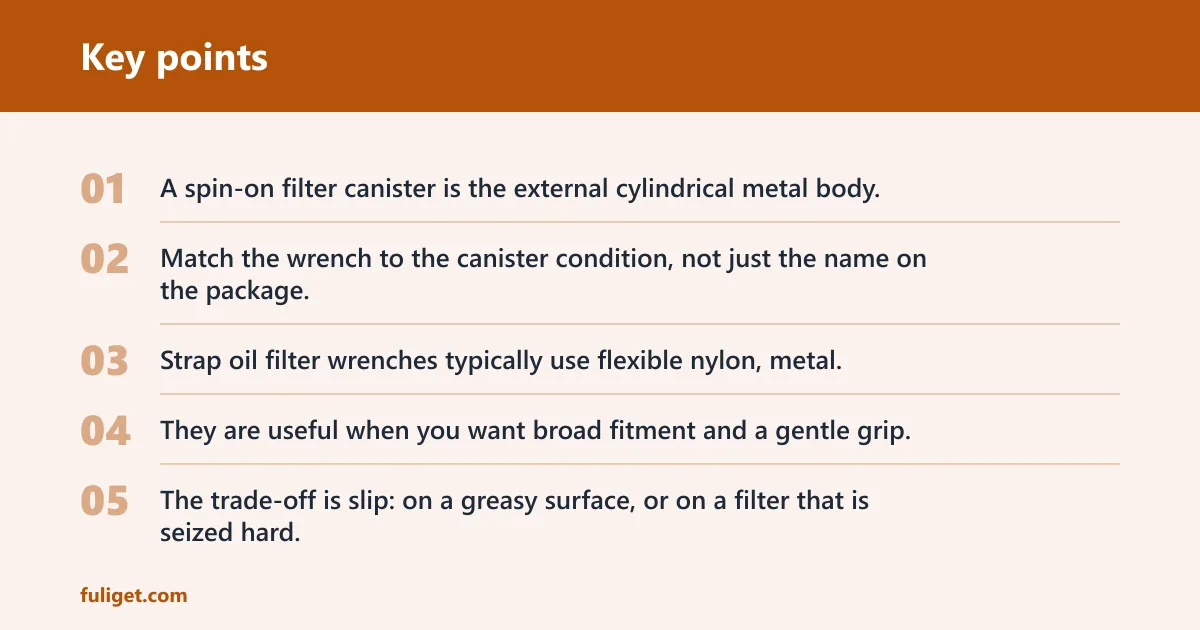
A spin-on filter canister is the external cylindrical metal body, and bite tools can crush or puncture it. Match the wrench to the canister condition, not just the name on the package.
Strap wrenches
Strap oil filter wrenches typically use flexible nylon, metal, or rubber straps that wrap around the canister. They are useful when you want broad fitment and a gentle grip. The trade-off is slip: on a greasy surface, or on a filter that is seized hard, the strap can ride up instead of turning the canister.
Pliers-style wrenches
Pliers-style oil filter wrenches use long handles and serrated jaws. They work well in open spaces because the handles give force and the jaws bite into the canister. They are less suitable for thin metal filters that can crush, dent, or puncture under load.
Claw wrenches
Claw oil filter wrenches typically use self-tightening jaws or legs in a 3-jaw universal pattern. They are highly useful on severely overtightened filters and can work with a ratchet drive. Three-jaw universal wrenches cover roughly the 2-1/2 to 4-inch canister band, which makes them useful across many common spin-on filters.
Chain wrenches
Chain oil filter wrenches are the heavy-duty option for large filters and stubborn service work. They can dent, crush, or puncture a filter, so they belong on large canisters where damage risk is acceptable and there is room to swing. They are useful, but they are the least polite tool in this group.
How do you size an oil filter wrench?
Start with filter diameter, then check flute count if the housing is a cap-style filter, then confirm drive size and clearance. Filter diameter is the outside size of the spin-on canister, usually measured in inches or millimeters. A common spin-on filter diameter range is roughly 2.5 to 4.5 inches, and that size helps guide tool selection.
For cup-style tools, the fit is exact. For strap, pliers, claw, and chain tools, the diameter range matters more than a precise flute count, but access still matters. A tool that fits the canister on paper may still fail if the engine bay blocks the handle swing.
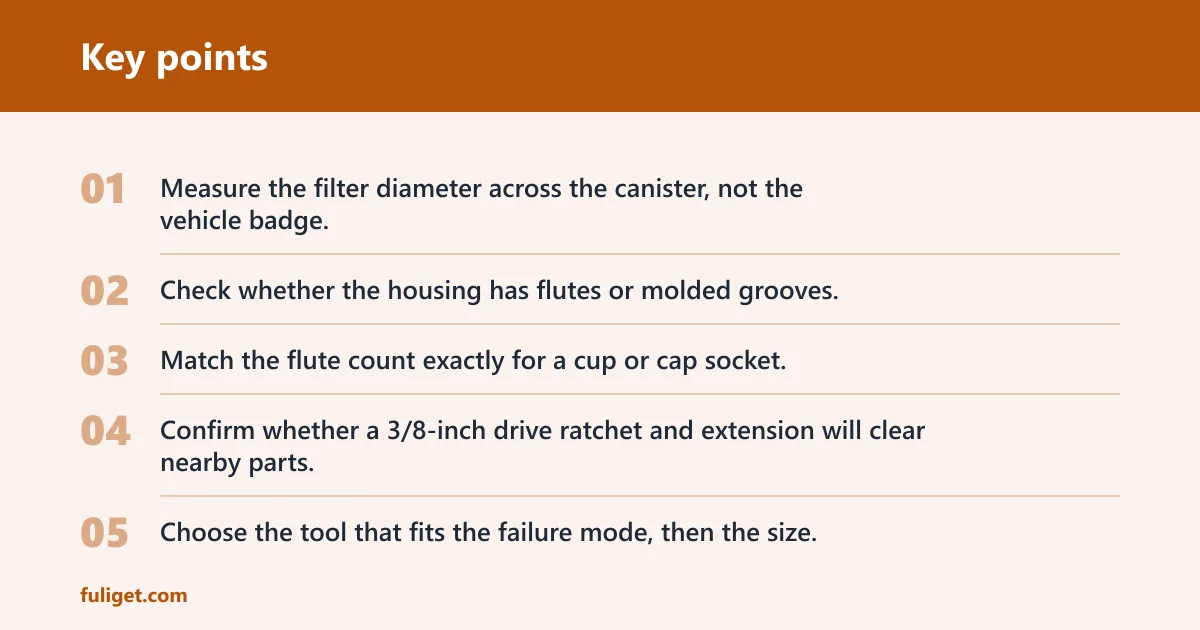
- Measure the filter diameter across the canister, not the vehicle badge.
- Check whether the housing has flutes or molded grooves.
- Match the flute count exactly for a cup or cap socket.
- Confirm whether a 3/8-inch drive ratchet and extension will clear nearby parts.
- Choose the tool that fits the failure mode, then the size.
Can one wrench fit multiple cars?
Sometimes, but only if the diameter range, flute pattern, and access match across the vehicles. A single claw, strap, or pliers tool can cover several spin-on filters, while a cup wrench is usually tied to one exact housing size and flute count. Mixed-fleet ownership often works best with one universal removal tool and a few exact-fit cups.
A common first-timer mistake is buying the tool for the vehicle instead of the filter. Two cars from the same brand can still use different canister diameters or different flute counts. The wrench should match the housing on the car in front of you.
Choose cup if… / Choose claw if…
Choose a cup wrench if you have a known diameter, a known flute count, a cartridge housing, or a tight engine bay where you want a clean socket-like fit. Choose a claw wrench if the filter is stuck, oily, or slightly damaged and you need a self-tightening grip with a ratchet drive.
Choose strap if you want gentle broad fitment and the canister is not heavily seized. Choose pliers if the filter is in open space and you need force fast, but accept a higher chance of crushing a thin canister. Choose chain only when size, access, and damage risk all point toward a heavy-duty removal tool.
Quick buying logic
If you only want one tool for one vehicle, start with the exact cup size the housing requires. If you work on several vehicles or expect stubborn filters, add a claw or strap wrench. If the filter sits in an open underbody location and the canister is steel, pliers can be the practical backup.
Do not use removal tools for installation. Tightening a filter with a claw, pliers, chain, or strap can distort the seal, mark the canister, or invite overtightening. Installation belongs to the hand-tight method specified by the filter maker or the vehicle manual.
Frequently asked questions
Which oil filter wrench is best: cup, strap, pliers, or claw?
The best one depends on the failure mode. Cup is best for exact-fit cartridge or fluted housings. Strap is best for broad fitment with a light grip. Pliers are best in open space when force matters. Claw is best when the filter is stuck and you need strong, self-tightening bite.
What is the difference between a cup and cap-style oil filter wrench?
A cup wrench is the socket-like tool you turn with a ratchet or breaker bar. A cap-style oil filter wrench is the matching socket profile that fits a cartridge housing or fluted cap exactly. In practice, the terms are often used together for the same exact-fit removal tool.
When should I use a strap wrench instead of pliers?
Use a strap wrench when the canister is intact, the grip needs to be gentle, and there is enough swing clearance for the strap to wrap and turn. Use pliers when you have open access and need more force. Pliers are stronger, but they can crush thin metal filters.
Which oil filter wrench works best on a stuck filter?
A claw wrench is usually the first pick for a stuck spin-on filter because the jaws tighten as force rises. Pliers are also strong in open space. A chain wrench can work on very stubborn filters, but it raises the chance of denting, crushing, or puncturing the canister.
Do I need an exact size for a cup-style oil filter wrench?
Yes. Cup wrenches require the exact diameter and flute count of the filter housing. If either one is off, the tool may slip, fail to seat, or round the cap. That is why cup tools are precise but limited; they are not a universal removal choice.
Can one oil filter wrench fit multiple cars?
Yes, but mostly the strap, claw, pliers, and some chain tools. A cup wrench usually fits one exact housing size and flute pattern, so it is less flexible. For multiple cars, choose a tool that covers the common diameter range and still leaves enough access in the tightest bay.