How to Read a Tire Pressure Gauge on Your Car

When checking tire pressure cold, after the car has sat about 3 hours or been driven less than a mile, compare the result to the driver-side door-jamb placard first; a common rule of thumb is to trust the reading only if it repeats within about 1 psi. Bad readings lead to underinflated tires, poor wear, and wrong adjustments. This guide shows how to read analog, digital, and stick gauges, spot bad seals and hot-tire bias, and decide whether the number is trustworthy.
What you’ll need
- Tire pressure gauge in stick, dial, or digital form. Digital models may need batteries.
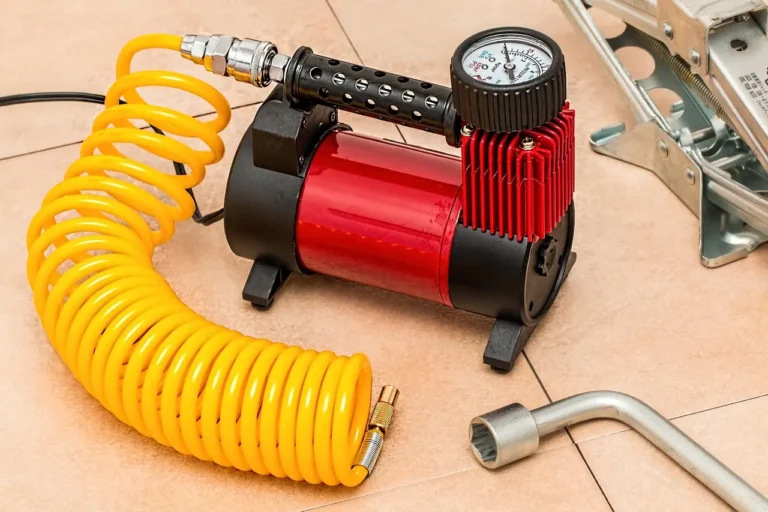
- Air compressor or gas-station pump for topping up pressure.
- Driver-side door-jamb placard or the owner’s manual for the cold PSI target.
- Optional note app or paper to compare all four tires side by side.
- A valve stem cap, if your valve stems use one.
How do you read a tire pressure gauge?
Start with the cold-PSI target on the driver-side door-jamb placard, then read the gauge in PSI and compare the number directly to that target. Ignore the tire sidewall for normal inflation; it lists a maximum, not your recommended setting. If the gauge style differs, the reading still means the same thing. (Wikipedia)
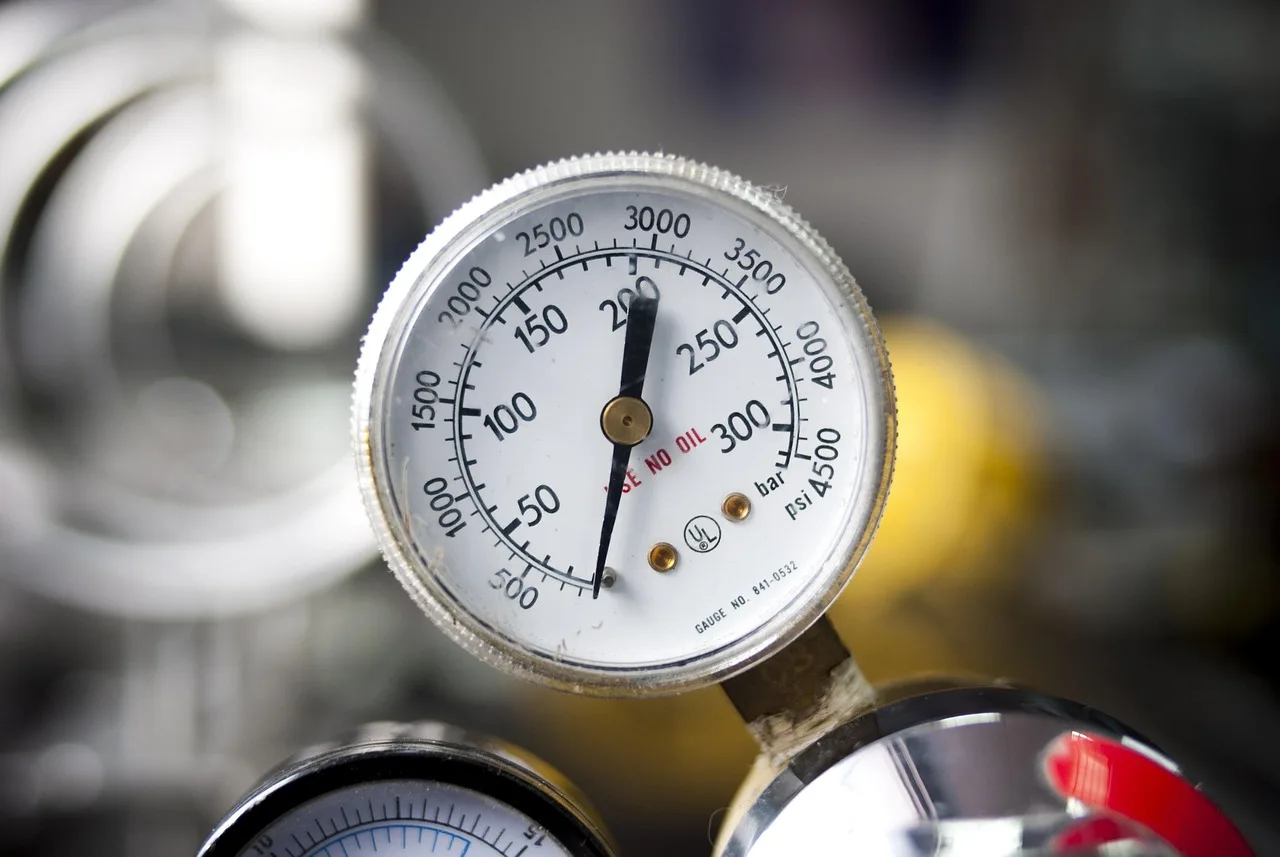
Stick gauges show a sliding scale. Dial gauges show a needle. Digital gauges show a number on screen. The display changes, but the task does not: capture one steady PSI reading, then compare it to the placard value for front or rear tires.
- Find the placard on the driver-side door jamb.
- Match your tire position to the front or rear target.
- Check the tire cold, not after driving.
- Read the PSI from the gauge display or dial.
- Compare that PSI to the placard and adjust if needed.
How do you know what PSI your tires should be?
Use the driver-side door-jamb placard first. It lists the recommended cold PSI for front and rear tires, and that target is the one to follow for normal driving. The sidewall number is the tire’s maximum inflation pressure, not the car’s set point.
For a cold-tire check, wait about 3 hours after parking, or make the reading after under a mile at low speed. Temperature matters too; a change of about 1 PSI per 10°F is enough to move the number.
How do you use the gauge on the valve stem?
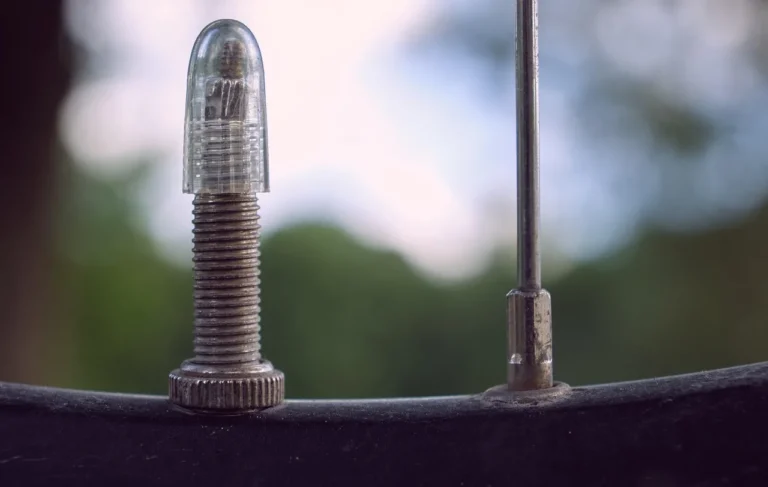
Press the gauge straight onto the valve stem until the hiss stops and the reading settles. A brief hiss is normal if the seal is good. If the tool is angled or loose, air escapes while you measure and the number can read low or jump around.
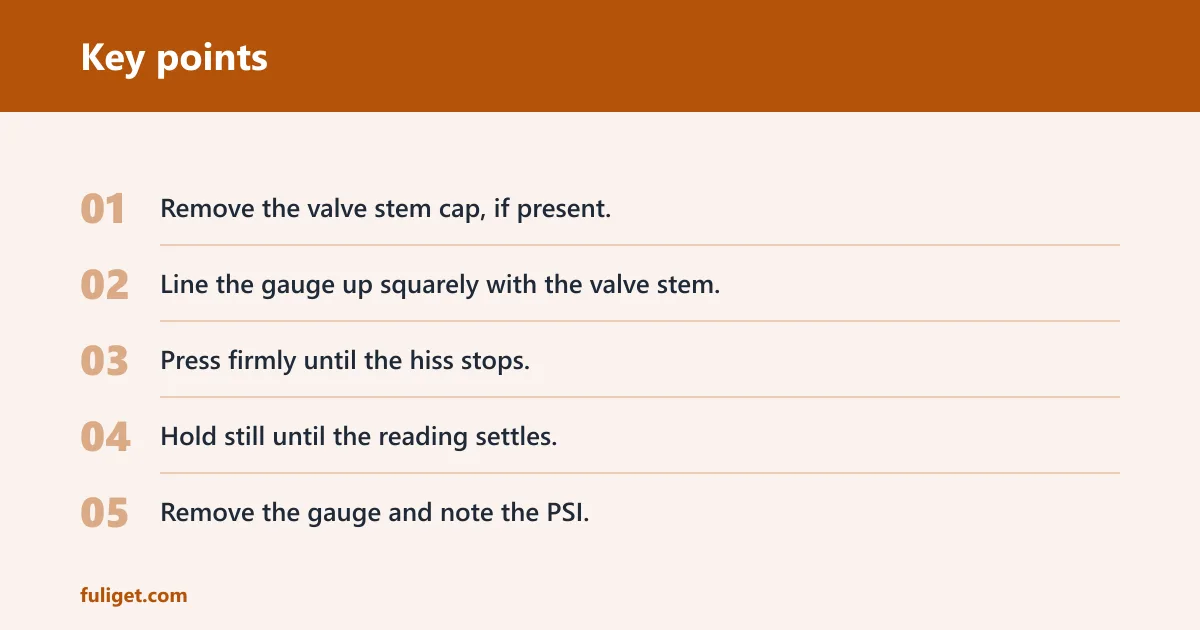
Hold the gauge steady for a moment, then remove it and read the value. If the display flickers, the needle bounces, or the number looks incomplete, repeat the check. A clean seal matters as much as the gauge itself.
- Remove the valve stem cap, if present.
- Line the gauge up squarely with the valve stem.
- Press firmly until the hiss stops.
- Hold still until the reading settles.
- Remove the gauge and note the PSI.
- Repeat once if the number jumped or looked uncertain.
How do I read a tyre pressure gauge correctly?
Read the same way you would any PSI scale: find the number that stays put, not the one that flickers during contact. For an analog gauge, the stable needle position is the reading. For a digital gauge, the final fixed number is the reading. For a stick gauge, the exposed mark is the reading.
Say your door placard calls for 35 PSI and the gauge shows 34.5 PSI twice in a row. That is close enough to trust. If the same tire shows 33 one minute and 36 the next without any air added, check the seal again before adjusting pressure.
How do you know the reading is right?
A trustworthy reading repeats, stays steady, and matches the tire’s condition. A poor seal can make a good gauge seem wrong. A hot tire can make a correct reading seem high. And a weak battery in a digital gauge can cause flicker or sudden jumps.
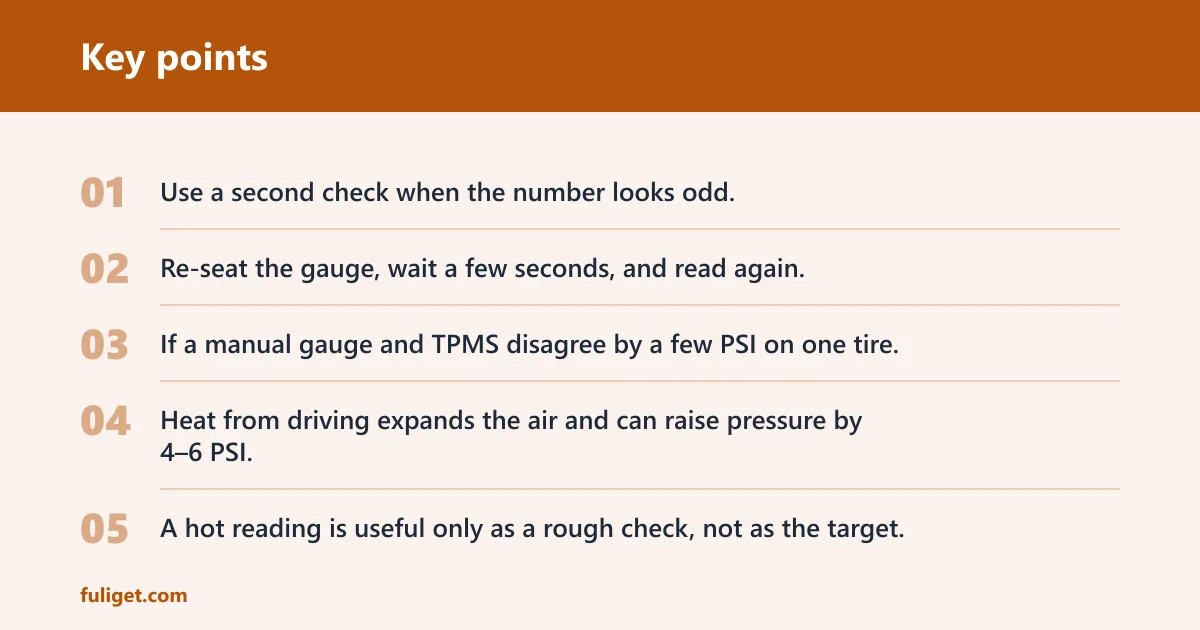
Use a second check when the number looks odd. Re-seat the gauge, wait a few seconds, and read again. If a manual gauge and TPMS disagree by a few PSI on one tire, believe the manual gauge first and inspect the tire’s temperature, valve stem, and recent driving history.
Gauge reading interpretation table
| Display type | Example reading | What it means | Likely cause | Next action |
|---|---|---|---|---|
| Analog needle between marks | 34.5 PSI between 34 and 35 | The tire pressure is probably near that midpoint | Normal analog resolution | Repeat once; if it matches within 1 PSI, use it |
| Digital reading that jumps | 33, then 36, then 34 PSI | The reading is not stable yet | Loose seal, moving gauge, or weak battery | Press squarely again and recheck with fresh batteries if needed |
| Brief hiss with no stable reading | Hiss continues, then no value holds | The gauge is not sealing properly | Angled placement or valve stem obstruction | Realign on the stem and retry until the hiss stops |
| Hot tire versus cold tire difference | 35 PSI cold, 39 PSI after driving | The hot reading is inflated by heat | Driving warms the air inside the tire | Use the cold reading for setting pressure; do not bleed air from the hot reading alone |
| One tire low versus TPMS warning | Manual gauge says 31 PSI; TPMS is off | The tire may be only slightly low and TPMS has not updated | TPMS lag or small pressure loss | Inflate to placard PSI, then recheck the same tire |
Should I check tire pressure when the tires are cold or hot?
Use the cold reading for setting pressure. Heat from driving expands the air and can raise pressure by 4–6 PSI, so a hot tire may look overinflated even when it is set correctly for cold conditions. A hot reading is useful only as a rough check, not as the target.
If the tire was driven a short distance at low speed, the reading may still be close enough to use as a warning sign. But if the tire has been on the road for a while, wait for it to cool before adjusting. Otherwise, you may let out air that the tire actually needs.
How do you measure tire pressure with a gauge at a gas station?
Use the pump to add air, then recheck with your handheld gauge or the pump’s gauge. Gas-station compressors can disagree with your own gauge, and they can overinflate a tire if you stop at the pump reading alone. Always verify the final PSI on the tire itself.
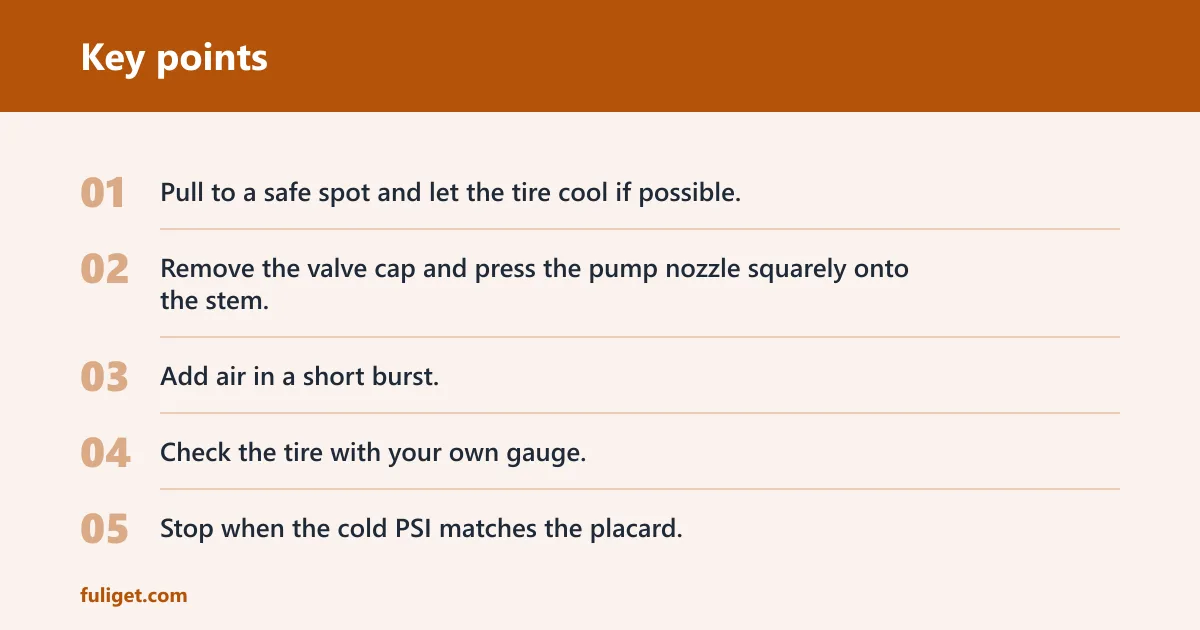
Most daily drivers do fine with a basic gauge, and some pricier models can add or bleed air. If the pump has a built-in gauge, treat it as a helper, not the final answer.
- Pull to a safe spot and let the tire cool if possible.
- Remove the valve cap and press the pump nozzle squarely onto the stem.
- Add air in a short burst.
- Check the tire with your own gauge.
- Stop when the cold PSI matches the placard.
- Repeat on the other tires as needed.
What should I do if my tire pressure is a few PSI low?
Add air in small increments, then recheck. A practical rule of thumb is to add air in about 2 PSI increments, then recheck. That avoids overshooting the target, especially when the pump gauge and your handheld gauge do not match exactly.
Suppose the placard says 35 PSI and one front tire reads 32 PSI cold. Add air, recheck, and stop at 35 PSI or the closest repeatable value. If the same tire keeps losing pressure, inspect the valve stem, the valve core, and the tread for a puncture.
How do you compare manual readings with TPMS?
TPMS is a warning system, not a measuring tool you should trust for exact PSI. It often signals only after significant loss, and it can lag behind a manual gauge check. If one tire is a few PSI low, the dashboard may not light up right away.
When the manual gauge and TPMS disagree, use the gauge for the number and TPMS for the alert. A single-tire mismatch is worth a second manual check on that same wheel. If the reading is stable twice and the others are normal, treat the problem as tire-specific, not system-wide.
Picture one rear tire reading 31 PSI while the other three sit at 35 PSI cold. If TPMS stays quiet, the tire still needs air. If it later triggers, that warning confirms the loss, but it should not replace the first manual check.
Common mistakes
- Using sidewall PSI as the target. The sidewall number is a maximum, not the normal cold setting.
- Setting pressure from a hot reading. Heat can add several PSI and lead to an underfilled tire after it cools.
- Not pressing squarely on the valve stem. A tilted seal leaks air while you measure.
- Trusting one flickering reading. Repeat the check if the number jumps or the needle lands between marks.
- Skipping the recheck after adding air. Pump gauges can overfill the tire if you do not verify with a second reading.
- Relying on TPMS alone. It may lag behind a manual gauge, especially on a tire that is only slightly low.
How often should you check your tire pressure?
Check tire pressure monthly and before long trips. That schedule catches slow leaks, temperature swings, and small mismatches before they become harder to correct. If the weather changes sharply, a quick reread is worth it because PSI moves with temperature.
Use the same gauge each time if possible. That makes small changes easier to spot, especially when one tire is drifting low by only 1 or 2 PSI.
Frequently asked questions
How do I read a tire pressure gauge on my car?
Press the gauge squarely onto the valve stem, wait for the hiss to stop, and read the PSI that settles in place. Compare that number to the driver-side door-jamb placard for the correct cold target, and repeat the check if the result changes by more than 1 PSI.
How do I use a tire pressure gauge on the valve stem?
Remove the cap, line the gauge up straight, and push firmly until the seal holds. A short hiss is normal. If air keeps escaping or the number flickers, lift off and try again with the gauge centered on the stem.
How do I know what PSI my tires should be?
Use the driver-side door-jamb placard or the owner’s manual. Follow the front and rear cold PSI values listed there, not the sidewall maximum. If the tire has been driven recently, wait for it to cool before making the final adjustment.
Why does my gauge reading differ from the TPMS light?
TPMS can lag behind a manual gauge and may not warn until pressure drops enough to trigger the system. A handheld gauge gives the actual PSI. If the gauge shows one tire a few PSI low, correct that tire and then watch whether the TPMS clears after the car is driven.
How often should I check my tire pressure?
Check monthly and before long trips. That cadence catches slow leaks and temperature-related changes. If a tire repeatedly comes back low, inspect the valve stem, valve core, and tread for a leak instead of just refilling it again.