What PSI Should You Set on a Tire Inflator for Your Car?

Set your portable tire inflator to the vehicle’s cold placard PSI, not the number on the tire sidewall. Get the pressure wrong and you can end up with vague steering, uneven wear, longer stopping distances, or a warning light that stays on. This guide shows how to read the placard, account for warm tires, handle front/rear differences, and deal with gauge mismatch.
What PSI should you set?
Use the pressure on the vehicle’s tire-and-loading placard, usually on the driver’s-side door jamb or B-pillar. That placard gives the manufacturer’s cold tire pressure target, and front and rear numbers can differ. If the label is missing or unreadable, use the owner’s manual before you guess.
The tire sidewall number is not the target. It is the tire’s maximum rated pressure, not the recommended running pressure for your car. Set pressure to the placard value, then confirm it with a separate gauge or the inflator’s verified reading.
Set your PSI decision table
| Scenario | Source of target PSI | Add air or wait? | Confirmation step |
|---|---|---|---|
| Cold tire at home | Driver-side door jamb or B-pillar placard | Add air until the tire reaches the placard PSI | Check with a tire pressure gauge before you finish |
| Warm tire after driving | Same placard value; use the cold target, not the warm reading | Wait for the tire to cool if you need a true setting | Recheck after at least three hours parked |
| Front and rear pressures differ | Placard’s separate front and rear numbers | Add air to each axle’s listed target | Confirm each axle with a gauge, not just one tire |
| Inflator gauge disagrees with handheld gauge | Placard PSI verified by the handheld gauge | Follow the better-verified reading and keep checking | Use the handheld gauge as the final check |
If the placard lists about 35 PSI for the front tires and about 33 PSI for the rear tires, set the rear tires to about 33 PSI. That works for the front axle, but the rear tires still need to be set to 33, not rounded up to match the front.
Picture a compact spare or temporary spare on the same car. Do not assume it uses the same pressure as the road tires. Check the placard or owner’s manual for the spare’s own number, because many spares are specified differently from the main tires.
Should you use the number on the tire sidewall?
No. The sidewall PSI is a tire limit, not the vehicle’s recommended driving pressure. That figure tells you the maximum pressure the tire can carry under its own rating, but it does not account for vehicle weight, suspension tuning, load, or handling balance.
If you need the full pressure range for a replacement tire, check the tire maker’s markings and the vehicle’s manual. For normal topping off, the placard stays in charge. When the placard and a replacement-tire question conflict, the owner’s manual is the backup source.
The sidewall number matters for safety, but it is not a fill target. Inflating to that number can put the tire well above what the vehicle maker specified for everyday driving.
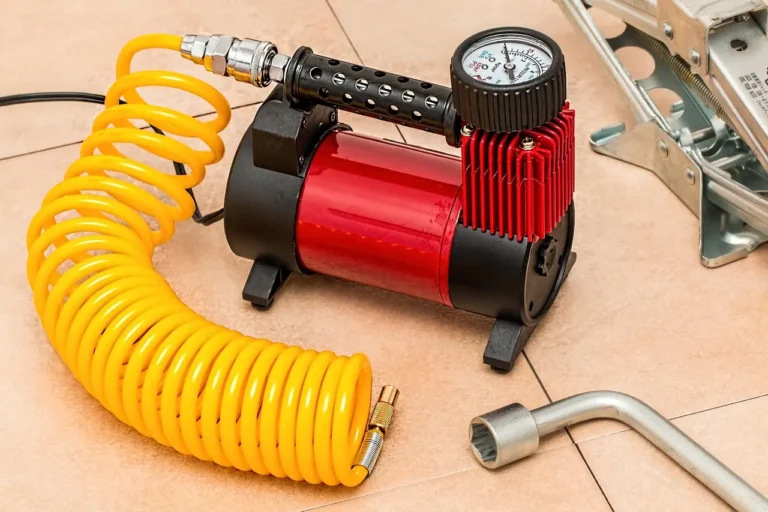
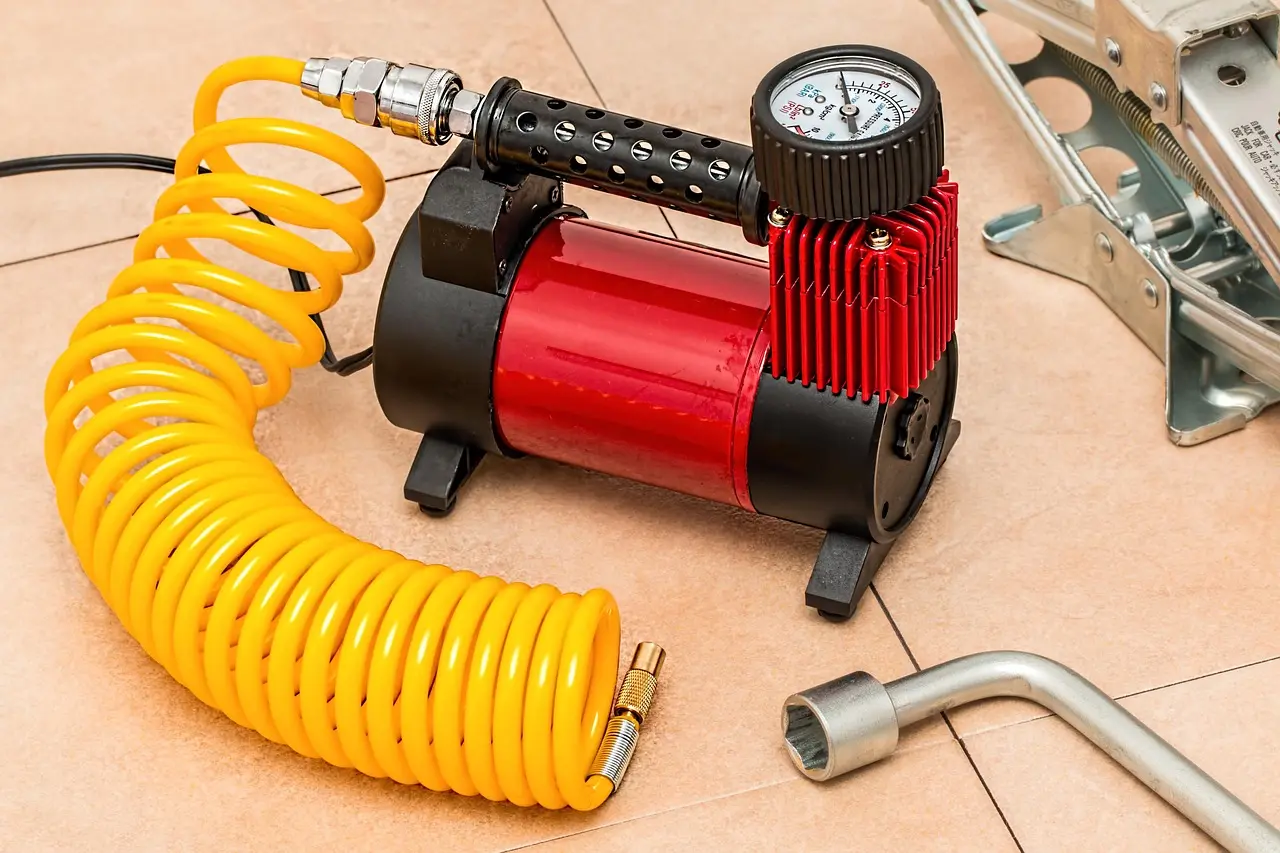
A portable tire inflator with a digital gauge or auto-shutoff makes the job simpler, but the placard still sets the target. Some 12V and cordless models shut off at a chosen pressure. Others need you to stop and check manually. Either way, the final number should match the vehicle placard on a cold tire.
Use short bursts if the inflator does not shut off on its own. Then check the pressure again. That keeps you from overshooting the target and then having to bleed air back out.
Step-by-step fill method
- Find the placard PSI for the tire you are filling.
- Attach the inflator chuck securely to the valve stem.
- Set the target pressure if the unit has auto-shutoff.
- Add air in short bursts if the inflator does not have auto-shutoff.
- Pause and check the reading before you go past the target.
- Verify the final pressure with a separate tire pressure gauge.
If your inflator display and a handheld gauge disagree, trust the better-verified reading. A separate gauge is the confirmation tool, especially when the inflator’s display seems to drift or the hose connection is inconsistent. Do not stop just because the inflator beeped first.
Use the same process when topping off after a repair or after seasonal pressure loss. The question is not whether you are adding a little air. The target is still the placard PSI, and the final check still matters.
Where do you find the correct tire pressure for your car?
Start on the driver’s-side door jamb or B-pillar placard. Federal safety standard FMVSS No. 110 requires a tire-and-loading placard, and it lists the cold pressure for the front, rear, and sometimes the spare. Many cars also include load information on the same label.
If the sticker is missing, damaged, or unreadable, check the owner’s manual. That is the backup source when the placard is not usable. If a replacement tire raises a pressure question, the manual still beats guessing from the sidewall.
Placard basics that matter
- Location: driver’s-side door area or B-pillar.
- Pressure type: cold tire pressure.
- Axle detail: front and rear values can differ.
- Spare detail: some placards list a spare pressure too.
Do you set tire pressure cold or warm?
Set it cold whenever possible. A cold tire is one that has not been driven on for at least three hours. Warm tires read higher because driving heats the air inside the tire, so a hot or warm reading does not match the placard target as cleanly.
If the car has just been driven, the safest no-guessing method is to wait until the tires are cold again, then set them to the placard PSI. Do not try to correct a warm tire with a made-up offset. The target stays the placard number.
Suppose you pull into a garage after a 20-minute drive and the inflator shows a tire at 36 PSI when the placard says 34. That is a warm reading, so it is not the number to chase. Let the tire cool, then recheck before you add or bleed air.
How to handle a warm garage or recent drive
- Park the car and let it sit long enough to count as cold, which means at least three hours.
- Check the placard for the correct front, rear, and spare values.
- Use the inflator or gauge only after the tire has cooled, if you need an exact setting.
- If you must add air before the tire cools, stop and recheck later with a cold reading.
Temperature also changes pressure. Tire pressure drops about 1 psi for every 10°F of cooling, so a car that was correct in a warm garage can read low on a winter morning. Recheck seasonally, especially after the first cold snap.
What should you do if your car has different front and rear tire pressures?
Follow the placard exactly. Many vehicles list one number for the front tires and another for the rear tires, and you should not average them. Set each axle to its own listed cold pressure. That matters most on vehicles tuned for load balance or handling.
Mark the target on a note or read it directly from the placard before you start. Then fill the front tires to the front specification and the rear tires to the rear specification. If the spare is listed, set that separately too.
Do not generalize from one tire to the next. A tire that is correct on the front axle may be wrong on the rear axle even though it is the same size and brand. The vehicle maker’s placard controls the final setting.
Does TPMS replace a gauge?
No. TPMS can display each tire’s pressure on some cars, and some systems also show the pressure you should use. That makes it helpful, but not complete. TPMS is still a warning system, not a guarantee that you are at the recommended pressure.
NHTSA says the TPMS light comes on only once a tire is about 25% low. That means a tire can be low enough to matter before the warning appears. A handheld gauge still matters for setting the exact placard pressure.
Use TPMS as a quick check, not the final word. If the car shows pressures, compare them with the placard and a gauge. If the display is missing, generic, or slow to update, rely on the placard and a manual reading.
How accurate are portable tire inflators?
Accuracy varies by model, so the safe move is to verify the reading with a separate gauge. A portable inflator with a digital gauge or auto-shutoff can get you close quickly, but the handoff from “close” to “correct” should come from a trusted gauge.
That matters more when the inflator and gauge disagree. If one says 34 PSI and the other says 36, do not split the difference without a reason. Check again with the tire fully seated on the valve stem, then use the more reliable reading as the final number.
For a quick reality check, some published tests have shown that good inflators can land close to target, but the exact result depends on the model. Because performance varies, the final check should still be your gauge, not the inflator’s display alone.
How much does tire pressure drop in cold weather?
Pressure drops about 1 psi for every 10°F in cold weather. That is enough to trip a low-pressure warning over time, especially after seasonal shifts. A tire that was correct in mild weather may read lower after an overnight temperature drop.
Recheck all four tires when seasons change, and remember the spare. Cold weather does not only affect the tires you drive on every day. It affects the spare too, and the spare may have its own target pressure.
A common first-timer mistake is to add air on a cold morning, then recheck after driving and think the tire is too high. The warm reading is higher. Use the cold placard number as the target, and save the final check for a cold tire.
Frequently asked questions
What PSI should I set my car tires to?
Set them to the cold PSI on the driver-side door jamb or B-pillar placard. Use the front and rear numbers exactly as listed, and check the owner’s manual if the label is missing or unreadable. Do not use the tire sidewall number as the target.
Where do I find the correct tire pressure for my car?
Look on the driver’s-side door jamb or B-pillar placard. Federal safety rules require a tire-and-loading placard, and it usually lists the front, rear, and sometimes spare pressures. If the label is missing or unreadable, check the owner’s manual before inflating.
What PSI should I set when topping off a tire?
Use the same cold placard PSI you would use for a full fill. Topping off does not change the target. If your inflator has auto-shutoff, set the placard number and confirm with a separate gauge when you are done.
What should I do if my car has different front and rear tire pressures?
Follow each axle’s listed pressure separately. Do not average the two numbers or copy the front pressure to the rear. Set the front tires to the front placard value and the rear tires to the rear value, then verify each with a gauge.