
What Size Drain Pan Do You Need for an Oil Change?

For most oil changes, a common rule of thumb is to choose a drain pan that holds at least 2 quarts more than the engine’s oil capacity; about 6 quarts fits many small cars, while about 8 to 12 quarts suits many trucks and SUVs. Too-small pans spill oil, waste time, and make cleanup harder. Match pan size to oil capacity, vehicle type, and the space under your car.
What size drain pan do you need?
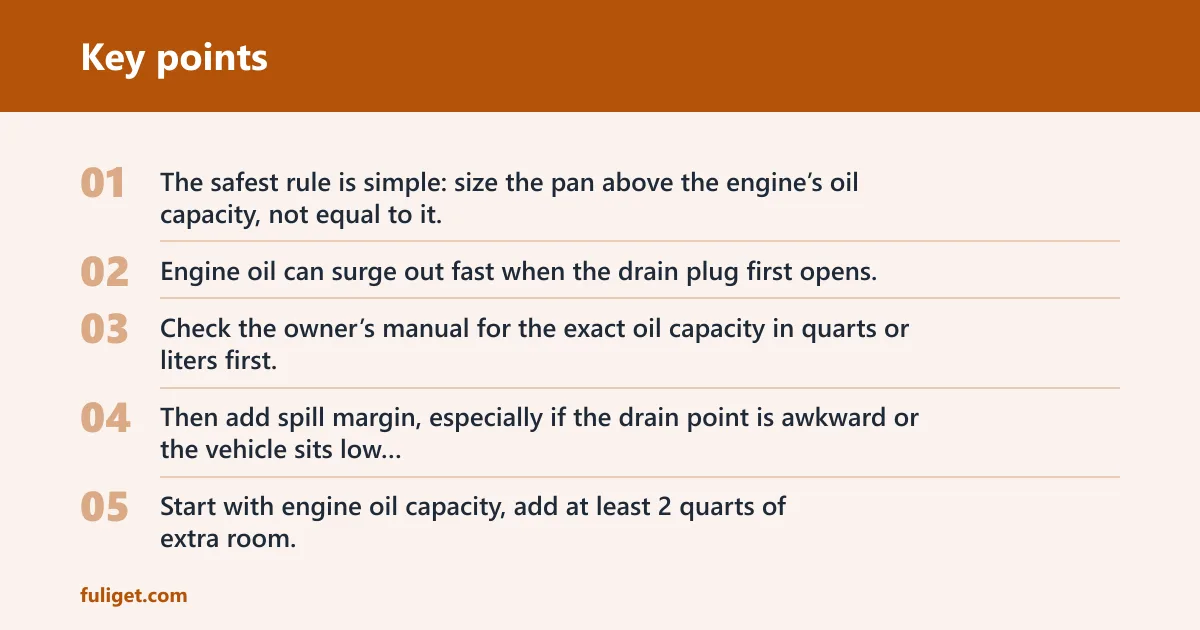
The safest rule is simple: size the pan above the engine’s oil capacity, not equal to it. Engine oil can surge out fast when the drain plug first opens, and the pan also needs room for filter drips and slightly off-center positioning under the drain stream.
Check the owner’s manual for the exact oil capacity in quarts or liters first. Then add spill margin, especially if the drain point is awkward or the vehicle sits low enough that you cannot center the pan perfectly.
A quick rule for first-time buyers
Start with engine oil capacity, add at least 2 quarts of extra room, and round up if the vehicle carries more than 6 quarts. That rule covers the common splash-and-drip mess that happens during the first few seconds after the plug comes out. If the pan also needs to hold used oil while the filter drains, choose the next larger size.
Why the pan should be larger than capacity
A drain pan collects used oil during an oil change, but the oil does not leave the engine in a neat, slow stream. The first burst can hit one side of the pan, then slow to drips, then pick up again as the filter and passages empty. Extra volume helps contain that whole sequence.
Drain pan sizing table
This table gives a practical sizing rule based on common oil capacities. It uses a minimum spill margin so you do not buy a pan that is technically close but too small in real use.
| Engine oil capacity | Recommended drain pan size | Minimum spill margin | Notes |
|---|---|---|---|
| 1.5–3 quarts | 2-gallon or 8L pan | At least 1 quart | Works for many ATVs and smaller motorcycles; a low-profile pan can help if ground clearance is tight. |
| 3.5–5 quarts | 6-quart to 12-quart pan | At least 2 quarts | Fits many compact cars; a 2-gallon drain pan can be enough only if the oil capacity is near the lower end and the pour is controlled. |
| 4–6 quarts | 12-quart pan | At least 2 quarts | Good target for sedans; choose a pan with a lip or spout if the drain plug is hard to reach cleanly. |
| 5–7 quarts | 12-quart to 15-quart pan | At least 2 quarts | Common for SUVs; the extra room helps if the pan must sit slightly off-center under the drain point. |
| 6–8 quarts | 15-quart pan | At least 2 quarts | Often a better fit for pickup trucks than a 12-quart pan; useful when the oil streams quickly at first. |
| 10–15+ quarts | 15-gallon or 20-gallon workshop cart | At least 3 quarts | For heavy-duty diesel trucks, a workshop-style cart or very large pan makes transfer and cleanup easier. |
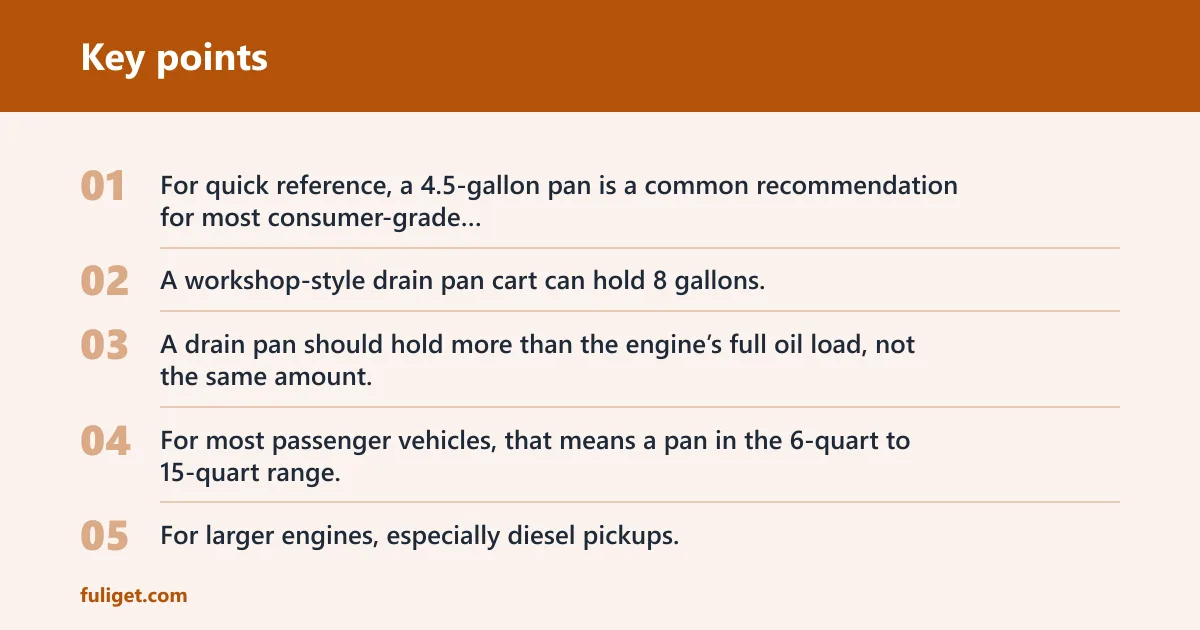
For quick reference, a 4.5-gallon pan is a common recommendation for most consumer-grade vehicles. A workshop-style drain pan cart can hold 8 gallons, which matters more for repeated service work or larger vehicles than for a simple driveway oil change.
How many quarts should an oil drain pan hold?
A drain pan should hold more than the engine’s full oil load, not the same amount. For most passenger vehicles, that means a pan in the 6-quart to 15-quart range. For larger engines, especially diesel pickups, the capacity jumps enough that a very small pan becomes a real spill risk.
Is a 2-gallon drain pan big enough for a car oil change?
A 2-gallon drain pan can be enough for some small cars, but it may be too tight for many sedans, SUVs, and trucks. Use it only when the engine oil capacity is well below the pan limit and the drain is easy to center. Once capacity rises above about 4 quarts, a larger pan is often the safer buy.
Should I buy a 12-quart or 15-quart oil drain pan?
A 12-quart pan is a solid choice for many sedans and compact SUVs, and about 15 quarts may be better if your vehicle takes 6 to 8 quarts or if extra room is wanted for splash and misalignment. The larger pan also gives more margin when the oil comes out hot and fast.
How much extra capacity should you allow?
Allow enough extra capacity for the surge at the drain plug, the drips that follow filter removal, and a drain pan that is not perfectly centered. A good floor rule is at least 2 quarts of extra room for most cars and SUVs, with more margin for trucks and high-volume engines.
Surge at the drain plug
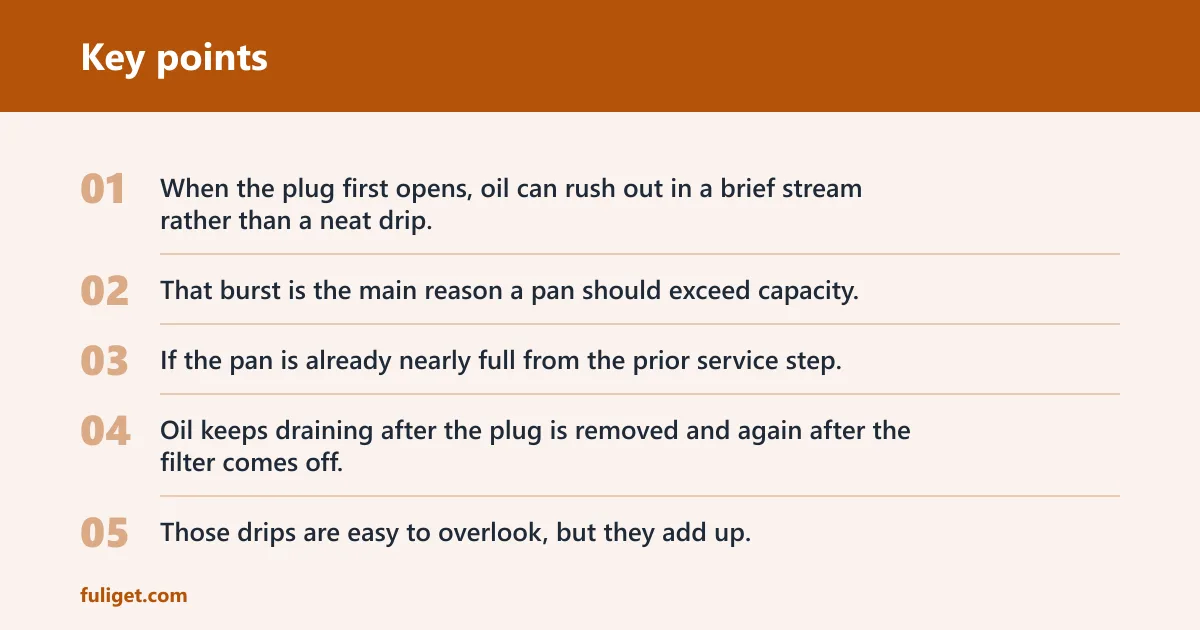
When the plug first opens, oil can rush out in a brief stream rather than a neat drip. That burst is the main reason a pan should exceed capacity. If the pan is already nearly full from the prior service step, the surge can jump the rim or splash onto the crossmember.
Filter drips after the plug is out
Oil keeps draining after the plug is removed and again after the filter comes off. Those drips are easy to overlook, but they add up. A pan with extra volume buys you time to move the pan if the flow shifts or the filter dumps a last pocket of oil.
Off-center placement under the pan
The pan often sits slightly off-center because exhaust parts, splash shields, or suspension parts block the ideal spot. That offset changes how oil enters the pan and can send the stream toward one edge. Extra room reduces the chance of overflow during that imperfect alignment.
Say your sedan takes 5 quarts and the drain plug sits near a splash shield. A 6-quart pan may technically work, but a 12-quart pan gives more room if the stream starts sideways. The larger pan also leaves space for the filter to drip while you move the pan under the next drip point.
What size works for cars, trucks, and motorcycles?
Passenger cars usually need less capacity than trucks, while motorcycles and ATVs need much less than either. The right pan size tracks the engine’s oil volume first, then the vehicle’s shape and service access. Compact vehicles can use smaller pans if the drain point is open and easy to reach.
Passenger cars and compact SUVs
Compact cars typically use 3.5–5 quarts of engine oil, and sedans typically use 4–6 quarts. For those vehicles, a 6-quart to 12-quart drain pan is the practical range. Compact SUVs often sit near the upper end of that same range, so a 12-quart pan is the safer default.
Trucks and larger SUVs
SUVs typically use 5–7 quarts of engine oil, and pickup trucks typically use 6–8 quarts. That pushes many truck and SUV oil changes into the 12-quart or 15-quart pan range. Heavy-duty diesel trucks may use 10–15+ quarts, which is where workshop carts and very large pans become more useful.
Motorcycles and ATVs
Motorcycles typically use 2–4 quarts of engine oil, and ATVs typically use 1.5–3 quarts. For those machines, a smaller pan can work, but the shape still matters. A low-profile option can help if the machine sits low, while a pour spout makes transfer to a storage container less messy.
Picture a motorcycle with a 3-quart oil capacity and limited ground clearance. A compact pan can fit under the drain plug, but it should still leave room for splash if the oil exits warm and fast. A pan with a spout and handles makes the next step, moving the used oil to a sealed container, much easier.
Do low cars need a low-profile drain pan?
Yes, low cars often need a low-profile drain pan if the standard pan is too tall to fit under the vehicle. Low-profile pans reduce height, sometimes to less than three inches, which helps on lowered cars or vehicles on ramps. The tradeoff is usually less capacity or less room for splash control.
When clearance matters more than capacity
If the pan cannot slide under the drain point, its total capacity does not matter. For a low-clearance vehicle, fit comes first. A low-profile drain pan with enough capacity for the oil volume is better than a taller pan that never reaches the drain stream.
Tradeoffs with reduced-height pans
Low-profile pans often give up some capacity to gain clearance. One low-profile option has a 2-gallon capacity. That can work for some small vehicles, but it is not the best choice for larger cars or trucks. Reduced height solves access; it does not solve every sizing problem.
Low-profile use on ramps or jack stands
Low-profile pans work best when the vehicle is raised enough to create a straight drain path. On ramps or jack stands, make sure the pan still sits flat and clear of the underbody. A pan that fits but tilts can send oil toward the rim instead of the center.
Drain pan features to look
Size matters first, but a few features make the job cleaner. An anti-splash lip helps contain sudden oil surge. A pour spout helps move used oil into a sealed container. Handles and a stable base make the pan easier to carry without sloshing oil onto the floor.
Anti-splash lip
An anti-splash lip is useful when the plug first opens and the oil hits hard. It helps keep the initial stream inside the pan instead of bouncing outward. That matters most on shallow pans, where the oil level rises close to the rim during the drain.
Pour spout for transfer
A pour spout matters after the oil is drained and cooled enough to move. It lets you pour used motor oil into a storage bottle or waste-oil container with less mess. That step matters because used motor oil should go to recycling centers or accepted collection points, never down a drain.
Handles and wide base
Handles help when the pan is full and heavy. A wide base helps it stay upright on the floor or driveway. If the pan tips while you are moving it, the real capacity becomes irrelevant because the spill happens before disposal.
Plastic vs. metal construction
Plastic drain pans are lighter and usually cheaper, but they are more prone to cracking or heat deformation. Metal drain pans are more durable and heat-resistant, but they weigh more and usually cost more. Either material can work if the size is right and the pan has enough spill margin.
Frequently asked questions
What size drain pan do I need for an oil change?
Choose a pan that exceeds your engine’s oil capacity by at least 2 quarts for most cars and SUVs, and more for larger engines. If your vehicle takes 6 to 8 quarts, a 15-quart pan is a solid choice. Check the owner’s manual first so you match the exact capacity.
What size drain pan do I need for a truck or SUV oil change?
Most SUVs fit well with a 12-quart pan, while pickup trucks often do better with 15 quarts. If the truck is diesel or the oil capacity is high, step up again to a workshop cart or large capacity pan. Extra room helps during the first surge.
How much extra capacity should a drain pan have over engine oil volume?
A good minimum is 2 quarts above the engine’s oil capacity for most vehicles. That covers surge at the plug, drips from the filter, and minor off-center placement. Larger engines may need more room, especially if you are working with a truck or diesel engine.
Can one drain pan work for cars, motorcycles, and ATVs?
Yes, if you choose the pan for the largest vehicle first and accept that it will be oversized for the smaller ones. A 12-quart pan can cover many cars, motorcycles, and ATVs, but it may be awkward under low-clearance machines unless it is low-profile or easy to position.