Do You Need an Oil Filter Wrench for an Oil Change?

No, you do not need an oil filter wrench for every oil change; use one when the filter is tight, hard to reach, or too slippery to remove by hand. Skipping the right tool can round the filter, spill oil, and turn a simple service into a stuck-filter repair. This guide gives a quick decision rule and the best fallback tool if you do not have a wrench.
Do you need one?
Hand removal is enough when the filter is reachable and was not over-tightened. A wrench becomes the safer choice when grip is poor, the canister is slick, or the filter sits close to a frame rail, exhaust part, or splash shield. If the filter is crushed, seized, or inaccessible, stop and use a better tool or get help.
Think of the choice in this order: first try hand removal, then move to a wrench that matches the filter shape, then stop before damage starts. Oil filter wrenches are made to loosen and remove spin-on oil filters, and most are built for common filter sizes. The wrong tool can slip, deform the canister, or make the job harder than it should be. (Wikipedia)
Oil filter wrench decision table
| Filter condition | Access space | Likely grip level | Risk of damage | Recommended tool choice |
|---|---|---|---|---|
| Smooth spin-on canister, not over-tightened | Open access | Good | Low | Hand removal |
| Smooth spin-on canister, oily surface | Tight space | Poor | Medium | Strap wrench |
| Round canister with limited clearance | Awkward access | Fair | Medium | Pliers-style oil filter wrench |
| Cap-style filter with flutes or hex pattern | Moderate access | Good if matched correctly | Medium | Cap wrench or oil filter socket |
| Unknown size, smooth canister, enough room for tool swing | Open to moderate access | Unknown | Medium | Adjustable jaw oil filter wrench |
| Crushed canister, stripped surface, or blocked by frame/exhaust | Poor | Poor | High | Professional help |
What filter type do you have?
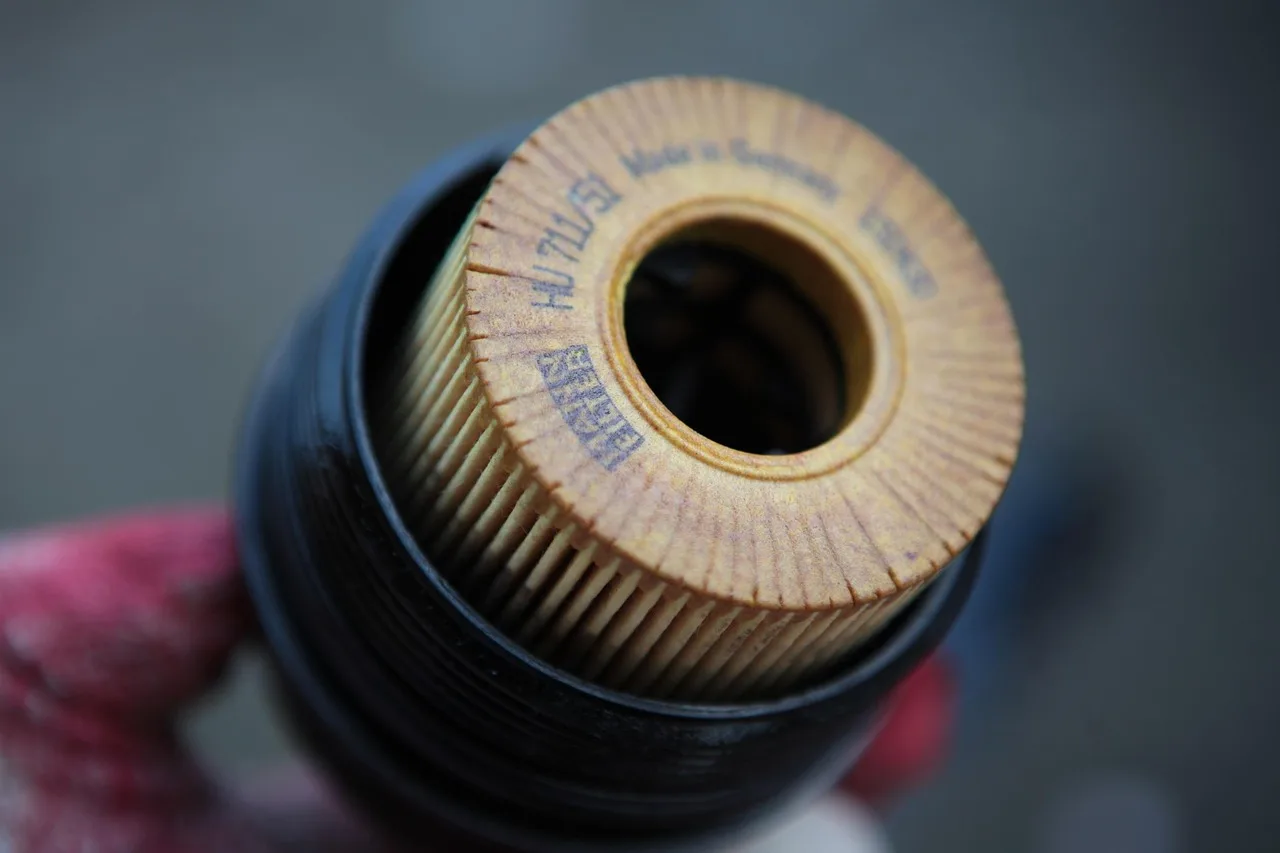
Spin-on canister filters and cap-style filters are not the same, and that changes the tool choice. A spin-on filter is a metal canister that threads onto an engine mount. A cap-style filter uses a fitted end, often with flutes or a hex shape, so the wrench must match that pattern rather than clamp the canister body.
Outer diameter matters for a spin-on filter because the wrench has to bite the canister correctly. Some filters have notches, some have a hex on the end, and many are smooth. That is why the owner’s manual is the first place to check before buying a tool. GR Auto Services recommends checking the owner’s manual for the exact oil filter size and using a caliper or ruler to measure the filter’s outer diameter.
Common oil filter wrench types include strap, cap, pliers, chain, and socket styles. Most oil filter wrenches are designed to match common filter sizes. Many common filters for Honda and Toyota fit 64mm or 65mm cap wrenches, and Toyota/Lexus cap wrench listings commonly show 64.55mm and 14 flute patterns.
How the owner’s manual helps you choose
The owner’s manual can tell you the filter spec or the service part number, which narrows the wrench type fast. If the manual lists a cap-style filter, you can look for a cap wrench or oil filter socket in the right flute count or millimeter size. If it lists a standard spin-on canister, size and shape matter more than a flute pattern.
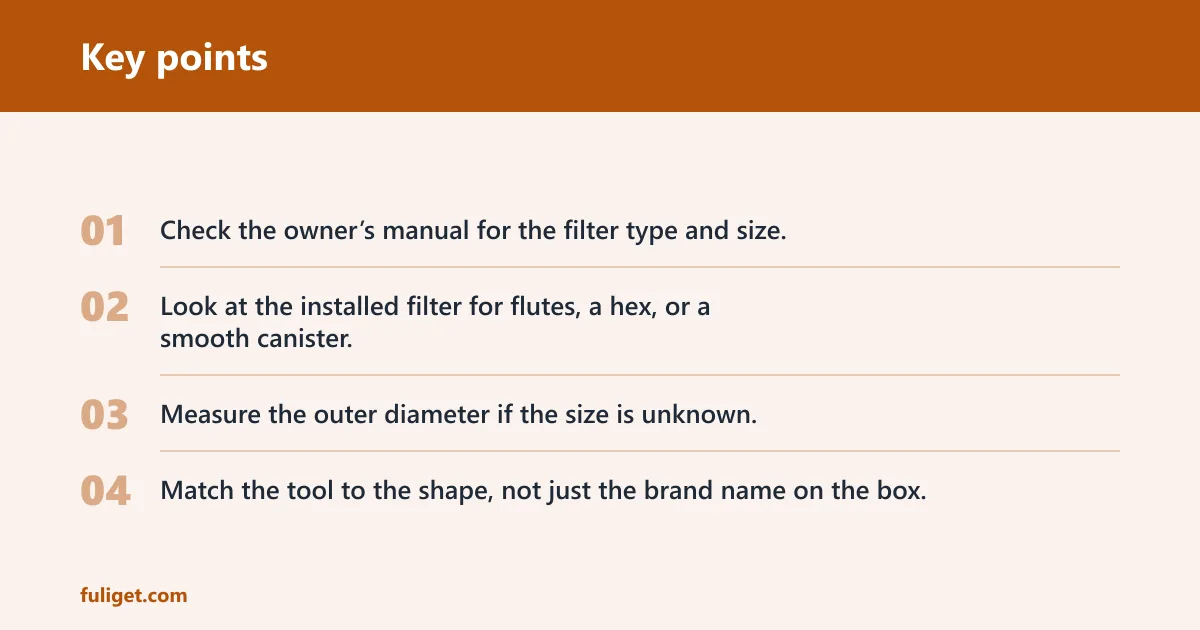
- Check the owner’s manual for the filter type and size.
- Look at the installed filter for flutes, a hex, or a smooth canister.
- Measure the outer diameter if the size is unknown.
- Match the tool to the shape, not just the brand name on the box.
When hand removal works
Hand removal works when the filter was installed with normal force, the engine bay gives you room to grip the canister, and the surface is not soaked with oil. If the filter turns with steady pressure from a dry rag or gloved hand, you do not need a wrench. Stop if the canister starts to deform or your grip slips repeatedly.
A common first-timer mistake is to keep twisting harder after the filter starts crushing. That can make the canister buckle and leave the base stuck on the engine. If the filter does not move after a controlled hand attempt, switch tools before the body tears or the seal surface gets damaged.
Suppose a smooth spin-on filter sits out in the open and breaks free with a firm hand twist. That is the best-case path: no wrench, no extra parts, and less chance of damaging the canister. Now change only one thing: the same filter is slick with oil and tucked beside a frame rail. At that point, a strap wrench is the safer move.
How to avoid slipping, stripping, or crushing the canister
- Wipe the filter body clean before you try to turn it.
- Grip near the middle of the canister, not on thin edges.
- Use steady force, not sharp jerks.
- Stop if the filter begins to oval or dent.
- Do not use a tool that contacts the seal surface or mounting threads.
Which wrench fits the job?
The right wrench depends on shape, space, and how much grip the filter gives you. A strap wrench works well on smooth filters and in tight spaces, and it helps avoid crushing the canister. A cap wrench or oil filter socket is the right choice when the filter has a matching flute pattern or diameter. Pliers-style and adjustable jaw tools help when access is awkward or the exact size is unclear.
Strap wrench
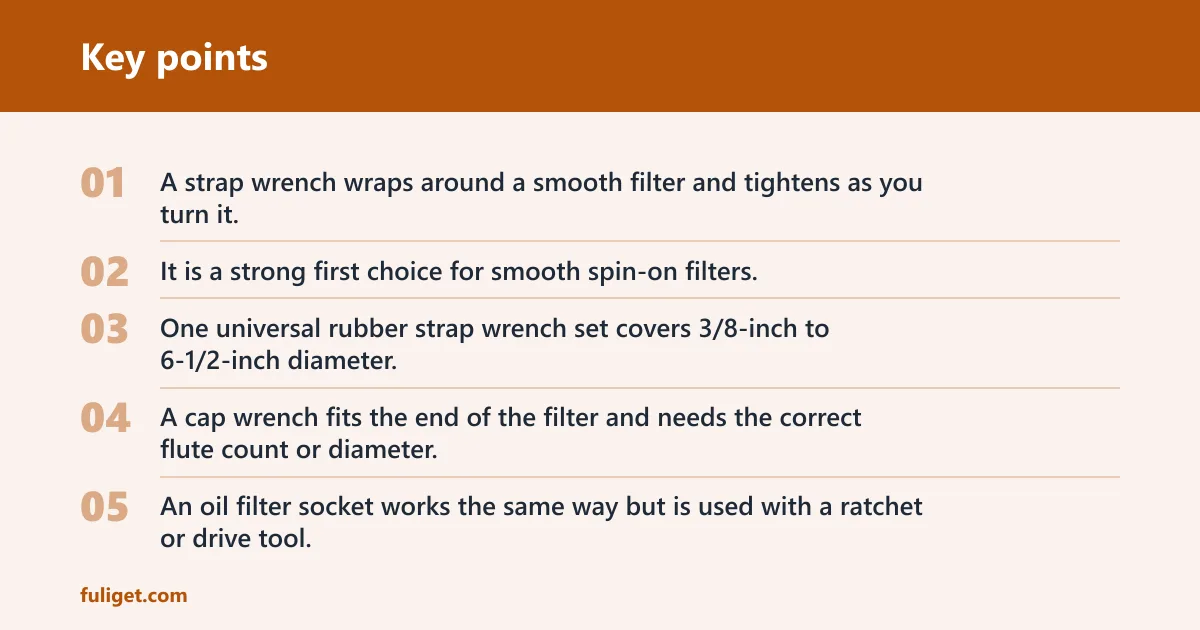
A strap wrench wraps around a smooth filter and tightens as you turn it. It is a strong first choice for smooth spin-on filters, especially when there is not much room for a large swing. One universal rubber strap wrench set covers 3/8-inch to 6-1/2-inch diameter, which gives broad coverage for common filter work.
Cap wrench or oil filter socket
A cap wrench fits the end of the filter and needs the correct flute count or diameter. An oil filter socket works the same way but is used with a ratchet or drive tool. Walmart lists a 64mm 14-flute oil filter socket for 1/2-inch drive, and that matches the kind of cap-style filter commonly seen on some Honda and Toyota applications.
Pliers-style and adjustable jaw wrenches
Pliers-style oil filter wrenches use adjustable jaws and are useful when access is awkward. They can grab filters in cramped spots where a strap cannot stay centered. Adjustable jaw oil filter wrenches cover a wide diameter range and are useful when you do not know the exact filter size. Some adjustable wrenches work for various sizes up to about 3 1/8 inches, while one Hyper Tough adjustable model fits 63.5 mm to 98 mm. Another large adjustable 3-jaw version fits 2-3/4 to 4-1/2 inch filters.
Typical oil filter diameters usually range from 2.5 to 3.5 inches, so many adjustable tools fall into the useful range for common service work. An adjustable jaw oil filter wrench sold at Walmart fits filters 2-1/2 to 4-5/8 in, which is helpful when you need one tool for several vehicles. If the filter is outside that range, stop and match the tool more closely.
Chain wrench
A chain wrench can grip stubborn filters, but it is less gentle on thin canisters than a strap wrench. It fits into the same general family of oil filter wrench options, yet it is usually better as a specialty fallback than a first choice. Use it only when the canister is sturdy enough and there is room to wrap the chain safely.
What if you do not have one?
A common fallback order is hand removal, strap wrench, pliers-style wrench, cap wrench or oil filter socket, and then professional help if needed. If you do not have the right tool on hand, borrow the correct one or pause the job rather than forcing a poor fit. Wrong-tool pressure can deform the filter, round the cap pattern, or damage the base.
If you only have a ratchet and the filter has a cap pattern, a correctly sized oil filter socket can work. If the filter is smooth and you have no special tool, a rubber strap wrench is often the best emergency buy because it fits a wide range of diameters. If access is too tight for your hand and no tool can get a centered grip, the safest option is to stop.
Say your filter is a smooth spin-on canister with oily sides and only two fingers’ worth of clearance. Hand removal may fail because your grip slips, but a strap wrench can bite without crushing the shell. If the same filter has already been dented from a failed attempt, professional help is safer than repeated force.
Frequently asked questions
Do you need an oil filter wrench for an oil change?
No, not for every oil change. You only need one when the filter cannot be removed by hand with reasonable force, when access is cramped, or when the filter shape demands a matching tool. A reachable, lightly seated spin-on filter often comes off by hand.
Is an oil filter wrench necessary?
It is necessary only in the situations where hand removal is unsafe or ineffective. A spin-on filter that is oily, over-tightened, or blocked by nearby parts usually needs a wrench. A cap-style filter also needs the right cap wrench or socket, not a general grip tool.
Can I remove an oil filter by hand?
Yes, if the filter is not over-tightened and you have enough room to grip it. Clean the canister first, then turn it steadily. If it slips, dents, or refuses to move after a controlled attempt, stop and switch to a better-matched tool before damage starts.
What can I use if I don’t have an oil filter wrench?
Start with a clean hand removal attempt, then move to a borrowed strap wrench if possible. If the filter has a cap pattern, a correct oil filter socket with a ratchet can work. If none of that fits the space or the filter is already damaged, do not force it.
What type of oil filter wrench should I use?
Use a strap wrench for smooth filters and tight spaces, a cap wrench or oil filter socket for flute-pattern filters, and pliers-style or adjustable jaw tools when access is awkward or the exact size is unknown. Match the wrench to the filter diameter or shape, not just the vehicle name.
What if the oil filter is in a tight space?
Choose a tool that can grip without a wide swing. A strap wrench is often the first choice for smooth canisters in tight spaces, while pliers-style and adjustable jaw wrenches help when the filter is partially blocked. If the tool cannot seat squarely, stop before you crush the canister.