What Does a Torque Wrench Do on a Car?

A torque wrench lets you tighten a car fastener to a specified foot-pound or newton-meter value, so wheel lugs, brake hardware, and other critical bolts end up at the maker’s stated clamp load. Ignore the spec, and you can get loose wheels, warped parts, stripped threads, or broken bolts. This guide explains what a torque wrench does on a car, when to use one, and why the correct torque matters.
What does a torque wrench do on a car?
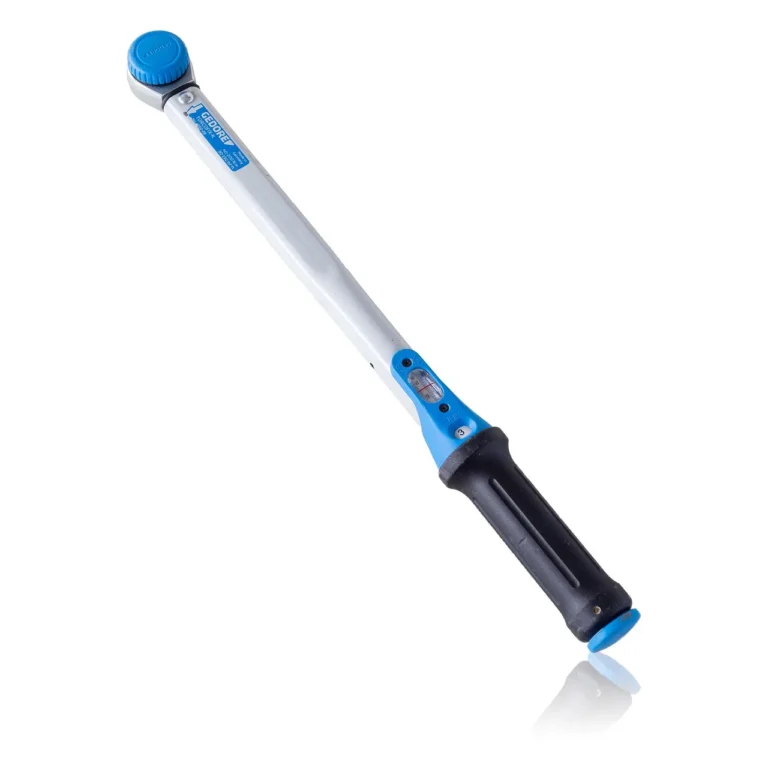
A torque wrench applies a specific tightening force to a bolt or nut. On a car, that matters because fastener torque specifications are set by the manufacturer, usually in ft-lb, in-lb, or N·m. A normal wrench can turn a fastener snug; a torque wrench helps you stop at the target instead of guessing by feel.
What changes from snug to spec
Snugging gets a fastener close. Torquing to spec gets it to a repeatable value that matches the part, the threads, and the load. That difference matters on wheel studs, spark plugs, brake hardware, and aluminum covers, where too much force can damage the part and too little can let the fastener move.
Where it fits in routine maintenance
You use a torque wrench after the fastener is seated and the part is aligned. It is common on lug nuts, spark plugs, brake caliper bolts, suspension hardware, and valve cover bolts. In those jobs, the wrench is not about extra strength. It is about consistency.
What the tool helps
A torque wrench helps apply the right amount of force to bolts and nuts, and correct torque helps prevent parts from loosening or breaking. That is why it is a car-safety tool, not just a precision tool.
How a torque wrench works
A torque wrench measures how much twisting force you are applying to a fastener. When the force reaches the set value, the wrench gives a signal or display so you can stop. That is what makes it different from a regular wrench, which gives you no exact stop point.
Click torque wrench basics
A click torque wrench is the common DIY style. You dial in the target torque, then tighten slowly. When the wrench reaches the set value, an internal mechanism releases with a click, so you know to stop. The click is a mechanical confirmation, not a green light to keep pulling.
Digital torque wrench basics
A digital torque wrench uses an electronic sensor and readout. It shows the torque value on a screen and may store data, which is useful when you want a precise number instead of a tactile signal. For repeat work, that readout can be easier to verify than a click.
What the wrench is measuring
The tool measures torque on the fastener, not the strength of the part and not the length of the wrench alone. A longer handle can change how much force reaches the bolt. That is why the set value and the correct drive size both matter.
Torque units and drive sizes
Car torque specs are usually listed in foot-pounds, inch-pounds, or newton-metres. The wrench has to match the unit and the job. A small fastener may need inch-pounds, while wheel hardware usually needs foot-pounds. If you use the wrong unit scale, the result can be far off.
Inch-pounds, foot-pounds, and newton-metres
Inch-pounds are common on smaller fasteners. Foot-pounds are common on many automotive bolts and nuts. Newton-metres appear in many factory manuals and on many modern torque wrenches. The numbers are not interchangeable without conversion, so do not assume a setting is “close enough.”
Drive size and typical use
Drive size affects how well the wrench fits the job and the torque level it can handle. A 1/4-inch drive fits small fasteners. A 3/8-inch drive is common for automotive and general mechanics work. A 1/2-inch drive is better for heavier torque applications such as wheel hardware and larger bolts.
Why the wrong range causes poor results
If the wrench range is too high for the job, the lower end may be less accurate and harder to control. If it is too small, you may never reach the needed torque safely. The tool should sit in the range where the job falls comfortably, not at the edge of the scale.
What goes wrong if torque is off
Over-tightening and under-tightening fail in different ways, but both can cause trouble. Over-tightening can strip threads, stretch studs, crack aluminum parts, or warp components such as rotors. Under-tightening can let fasteners loosen, which is a common failure mode in car repairs and a safety issue.
Over-tightening damage
Too much torque can crush gasket surfaces, pull threads from soft metal, or distort a part that needs flat, even clamping. On brake rotors, uneven or excessive clamp force can contribute to runout or distortion symptoms. On spark plugs or valve cover bolts, over-tightening can damage aluminum threads quickly.
Under-tightening risks
Too little torque can let a nut back off under vibration, heat cycles, or repeated load. That is a real concern for wheel hardware, brake parts, and suspension fasteners. A loose fastener can make noise first, then move, and then fail the job entirely.
Common failure cases
A common first-timer mistake is treating every bolt the same. A lug nut that is a little loose can loosen more on the road. A valve cover bolt that is too tight can strip a soft thread. A brake fastener that is off can affect feel, noise, or alignment of the component.
Car fastener reality check
This table shows where torque matters most on a car, what happens when it is off, and the unit range you will usually see. The exact number still comes from the vehicle manual or service data, but the pattern is consistent: bigger hardware usually uses foot-pounds, while smaller fasteners often use inch-pounds.
| Car job | Why torque matters | If under-tightened | If over-tightened | Typical unit range |
|---|---|---|---|---|
| Lug nuts and wheel hardware | Wheel clamping force must be even and repeatable | Wheel hardware can loosen, shift, or clunk | Studs can stretch, threads can strip, rotors can distort | Foot-pounds, often around 80-100 ft-lb |
| Spark plugs | Threads and sealing surfaces are easy to damage | Blow-by, poor sealing, or plug loosening | Cracked threads or damaged aluminum heads | Foot-pounds, often around 11-18 ft-lb |
| Brake caliper or bracket bolts | Brake hardware sees heat, load, and vibration | Loose hardware, noise, or movement | Thread damage, warped parts, or service problems | Foot-pounds, often around 20-100 ft-lb |
| Valve cover bolts | Small fasteners clamp soft covers and gaskets | Oil seepage or a loose cover | Stripped threads or cracked cover ears | Inch-pounds, often around 50-90 in-lb |
Two quick car examples
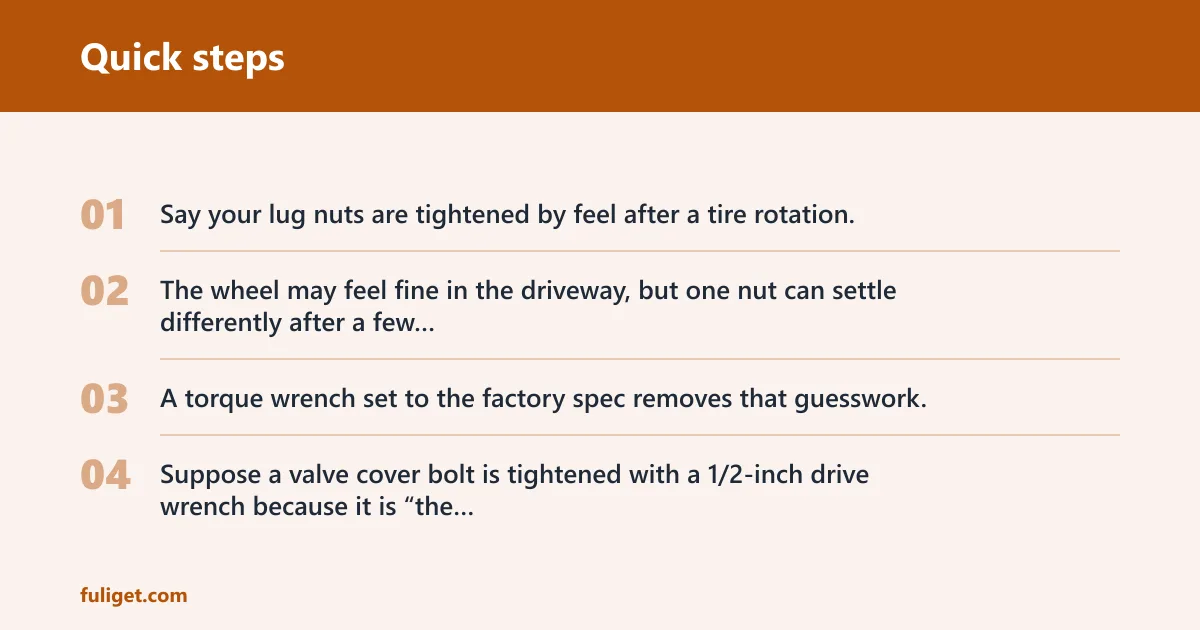
Say your lug nuts are tightened by feel after a tire rotation. The wheel may feel fine in the driveway, but one nut can settle differently after a few heat cycles. A torque wrench set to the factory spec removes that guesswork.
Suppose a valve cover bolt is tightened with a 1/2-inch drive wrench because it is “the only one on hand.” The fastener is small, the torque is low, and the soft aluminum threads can be damaged before the cover is even seated correctly.
When you should use one
Use a torque wrench when the fastener affects safety, sealing, or a machined surface. Lug nuts, brake hardware, spark plugs, and many engine-cover bolts fit that group. For simple trim hardware or small parts that are meant to be hand-tight, a plain wrench may be enough.
Jobs where spec matters most
Wheel hardware is the clearest example. Brake parts come next, because they carry load and heat. Spark plugs matter because the head material can be softer than the plug. Valve cover bolts matter because the threads and gasket surfaces are easy to damage.
Jobs where hand-tight plus spec is enough
Some jobs start by hand-tightening until the part seats, then move to a torque wrench for the final number. That is common for spark plugs, covers, and brackets. The hand-tight step gets the fastener aligned. The wrench gives the final value.
When a plain wrench is fine
A plain wrench is fine for noncritical fittings, light assembly, or parts with no published torque spec. It is also fine for initial positioning before the final torque step. The key is knowing when the final fastener load actually matters.
How to use it without making mistakes
Set the target value, match the unit, and tighten slowly. Stop at the click or the digital signal. Then move to the next fastener if the part needs even clamping. Most errors come from rushing, guessing, or mixing units.
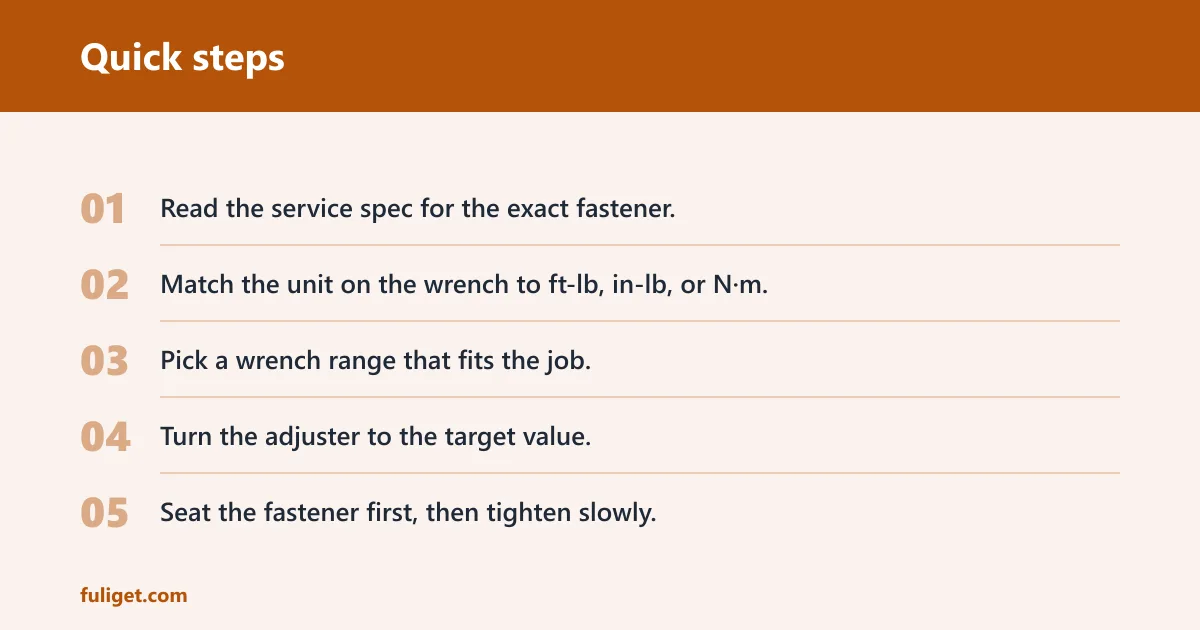
- Read the service spec for the exact fastener.
- Match the unit on the wrench to ft-lb, in-lb, or N·m.
- Pick a wrench range that fits the job.
- Turn the adjuster to the target value.
- Seat the fastener first, then tighten slowly.
- Stop at the click or the digital signal.
- Move on and repeat with the same method for the remaining fasteners.
Set the target value
Never assume a torque setting from memory. A spec for one car or one fastener type may differ from another by a wide margin. The number on the wrench must match the number in the service data, including the unit.
Tighten slowly and evenly
Fast, jerky pulls can overshoot the target. That is a problem on smaller fasteners and on accurate low-range settings. A smooth pull gives the wrench time to signal at the correct point.
Stop at the signal
With a click wrench, stop at the click. With a digital wrench, stop when the screen or alert shows the target. Do not “double click” a fastener unless the procedure specifically calls for a second pass at the same value.
Check the spec and unit twice
Mixing in-lb and ft-lb is a common mistake, and it can be a big one. The numbers look similar, but the result is very different. Also make sure the wrench range suits the job; a 1/4-inch drive is not the right tool for heavy wheel torque.
Frequently asked questions
What does a torque wrench do?
A torque wrench tightens a bolt or nut to a set value instead of leaving you to judge by feel. That matters on cars because many fasteners have a manufacturer torque specification, and the wrong force can loosen parts or damage threads, studs, gaskets, or other components.
What does a torque wrench help with?
It helps you avoid two common problems: over-tightening and under-tightening. Over-tightening can strip threads, stretch studs, or crack delicate parts. Under-tightening can let fasteners loosen from vibration or heat. That is why it is used so often in automotive maintenance.
How does a torque wrench work?
It measures twisting force as you tighten. A click wrench gives a mechanical signal when the set torque is reached. A digital wrench shows the value on a display and may store data. In both cases, the goal is the same: stop at the specified torque, not after.
Why is a torque wrench used?
It is used because cars need repeatable clamping force on important fasteners. Wheel hardware, brake parts, spark plugs, and many engine fasteners depend on the correct torque to stay secure and avoid damage. Guessing by feel is not reliable enough for those jobs.
Torque vs torque wrench
Torque is the twisting force applied to a fastener. A torque wrench is the tool that helps you apply that force to a specific value. In other words, torque is the measurement, and the wrench is the instrument that helps you reach it.
Wrench vs torque wrench
A standard wrench turns a fastener, but it does not tell you when you have reached a specified tightening force. A torque wrench does. That is the practical difference on a car: one tool turns hardware, while the other helps you stop at a known value for safety and accuracy.