
What Are Impact Sockets Used for on a Car?

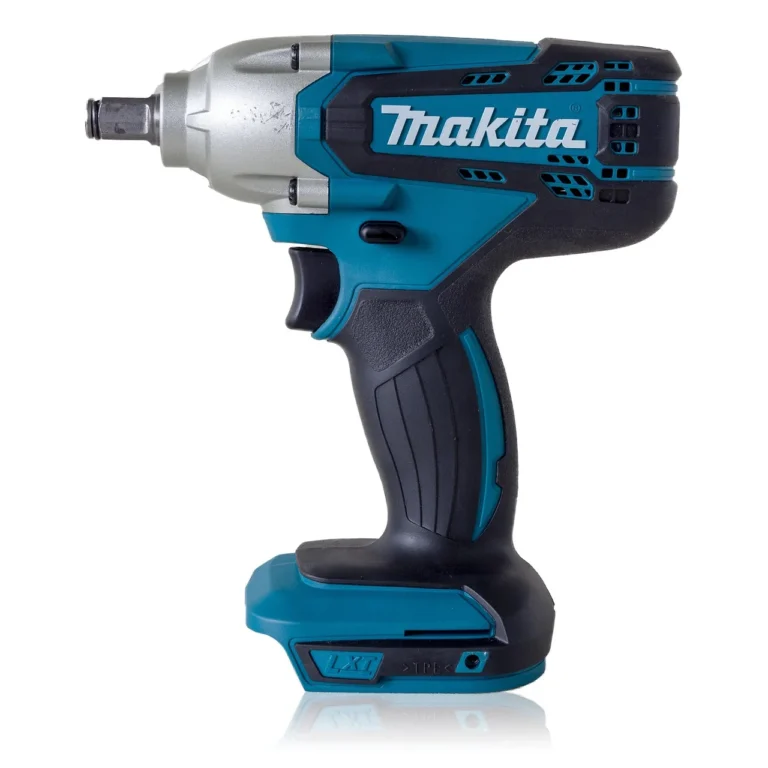
Impact sockets are commonly used with impact wrenches on wheel lug nuts, brake hardware, suspension bolts, and seized rusted fasteners. For hand tools, a regular socket is usually the better fit. The wrong socket can crack, round a fastener, or waste time on a bolt that already fights back. This guide shows which car jobs call for impact sockets, and where a standard socket gives better reach, fit, and cost.
How impact sockets handle shock and tough fasteners
Impact sockets are built for tools that strike fast and hard, not for slow hand pressure alone. An impact wrench sends repeated bursts of force, so the socket needs to absorb shock loadings without splitting or shattering. That is why impact-rated sockets use tougher alloys such as chrome molybdenum steel, while many hand sockets use chrome vanadium steel.
On automotive fasteners, shape matters as much as material. Many impact socket sets use 6-point sockets on hex fasteners because six contact points grip the flats better and help reduce slippage and rounding. That matters on rusted lug nuts, suspension hardware, and exhaust fasteners, where a thin, worn, or corroded edge can fail fast under load.
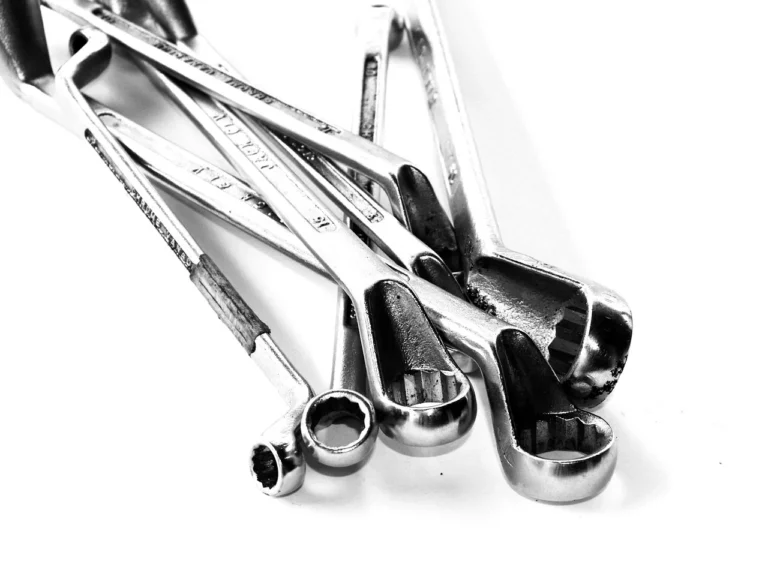
Regular chrome vanadium sockets still matter. They are usually better for low-torque hand work, tighter budgets, and jobs where you need a slimmer tool for access. They are not made for repeated impact loads from an impact gun, so keep them off powered tools.
Why impact sockets are built for shock load
The main design goal is to survive repeated hammering force. That usually means thicker walls, more flex under stress, and less brittle failure than a standard chrome socket when used with an impact wrench or impact driver. In practice, that extra margin helps when a fastener breaks loose in sharp pulses instead of one steady pull.
That extra strength does not make every job better. If the fastener comes off by hand, a regular socket often fits the same nut with less cost and sometimes less bulk. For a small bolt in a tight engine bay, a slimmer hand socket may clear nearby parts better.
Which car jobs need them most?
Impact sockets matter most when the job combines high torque, corrosion, or repeated removal. Wheel work is the clearest case. Brake and suspension hardware come next, especially when fasteners are rusty or buried in a cramped area. Engine-bay work can call for them too, but only when the bolt is stubborn enough to need an impact tool.
Lug nuts and wheel changes
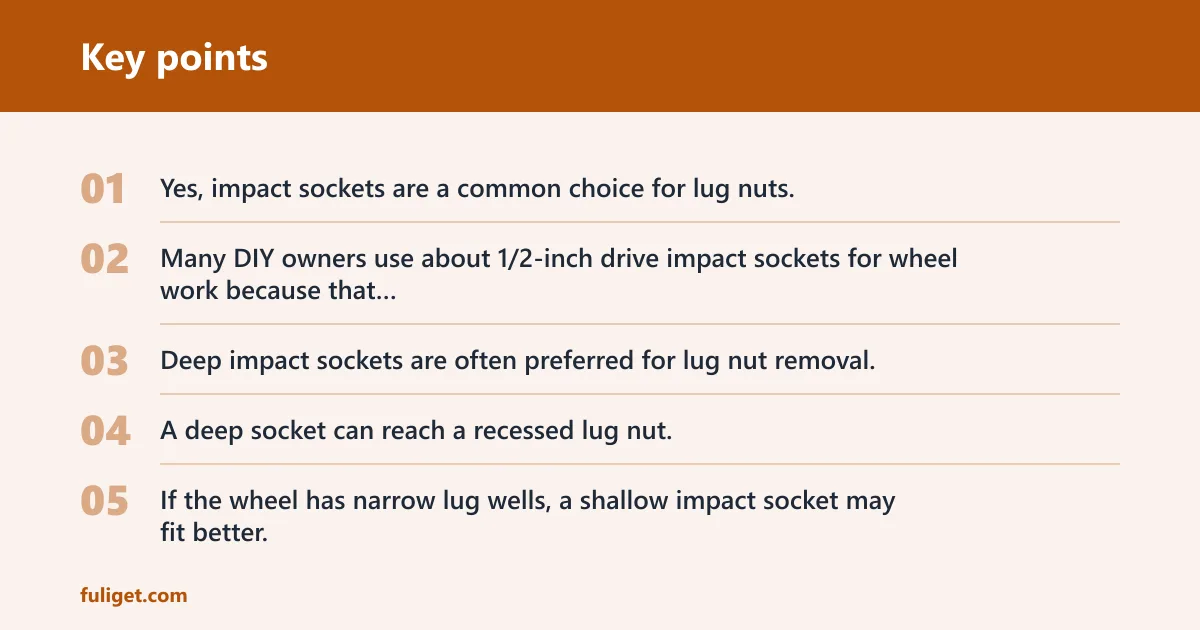
Yes, impact sockets are a common choice for lug nuts. Many DIY owners use about 1/2-inch drive impact sockets for wheel work because that drive size handles higher torque well and matches common impact wrenches used for wheels. Deep impact sockets are often preferred for lug nut removal, especially when the nut sits recessed in the wheel and needs extra reach.
Wheel clearance matters. A deep socket can reach a recessed lug nut, but it also needs room inside the wheel opening. If the wheel has narrow lug wells, a shallow impact socket may fit better, even if you give up some reach. That is a fit choice, not a strength choice.
Brake and suspension fasteners
Brake caliper bracket bolts, shock hardware, sway bar links, and control-arm fasteners often benefit from impact sockets because they are commonly tight and may be rusted. A 6-point impact socket lowers the chance of rounding the bolt head when the fastener has already seen years of heat and corrosion. If access is poor, the shorter socket may be the only one that fits at all.
Say your 14 mm suspension bolt is partly hidden behind a bracket and will not move with a hand ratchet. A 1/2-inch drive impact socket on an impact wrench is a better match than a thin chrome hand socket that may flex, slip, or crack under repeated bursts.
Stubborn engine-bay bolts
Engine-bay fasteners are a mixed case. A cam cover bolt, alternator bolt, or accessory bracket bolt may be easier to reach with a regular socket and ratchet if the torque is low. If the bolt is seized or corroded, an impact socket paired with an impact tool is the safer choice for the socket itself.
A common first-timer mistake is reaching for a long socket set when a standard shallow hand socket would clear the fastener more easily. Extra length helps only if the bolt is recessed. Otherwise, it can make the tool wobble around nearby hoses and wiring.
Car socket selection table
This table maps common car jobs to the socket type that fits the task best. It also shows where impact-rated sockets are necessary and where a regular socket is usually enough.
| Task | Fastener type | Recommended drive size | Socket depth | Point count | Impact-rated sockets necessary? |
|---|---|---|---|---|---|
| Wheel lug nuts | Hex lug nut, often corroded | 1/2-inch drive | Deep | 6-point | Yes, if using an impact wrench |
| Brake caliper bracket bolts | Large hex bolt | 3/8-inch or 1/2-inch drive | Shallow or deep, depending on clearance | 6-point | Yes, with powered removal |
| Shock and sway bar hardware | Hex bolt or nut | 1/2-inch drive | Deep for recessed fasteners | 6-point | Yes, for stubborn or rusted hardware |
| Valve cover or intake bolts | Small hex bolt | 3/8-inch drive | Shallow | 6-point | No, unless an impact tool will be used |
| Accessory bracket bolts | Hex bolt | 3/8-inch drive | Shallow | 6-point | Usually no for hand tools |
| Rusted exhaust hardware | Hex nut and bolt | 1/2-inch drive | Deep | 6-point | Yes, if an impact wrench is used |
| Do not use | Cracked, rounded, or split socket on an impact gun | Any | Any | Any | No |
When impact-rated sockets are not necessary
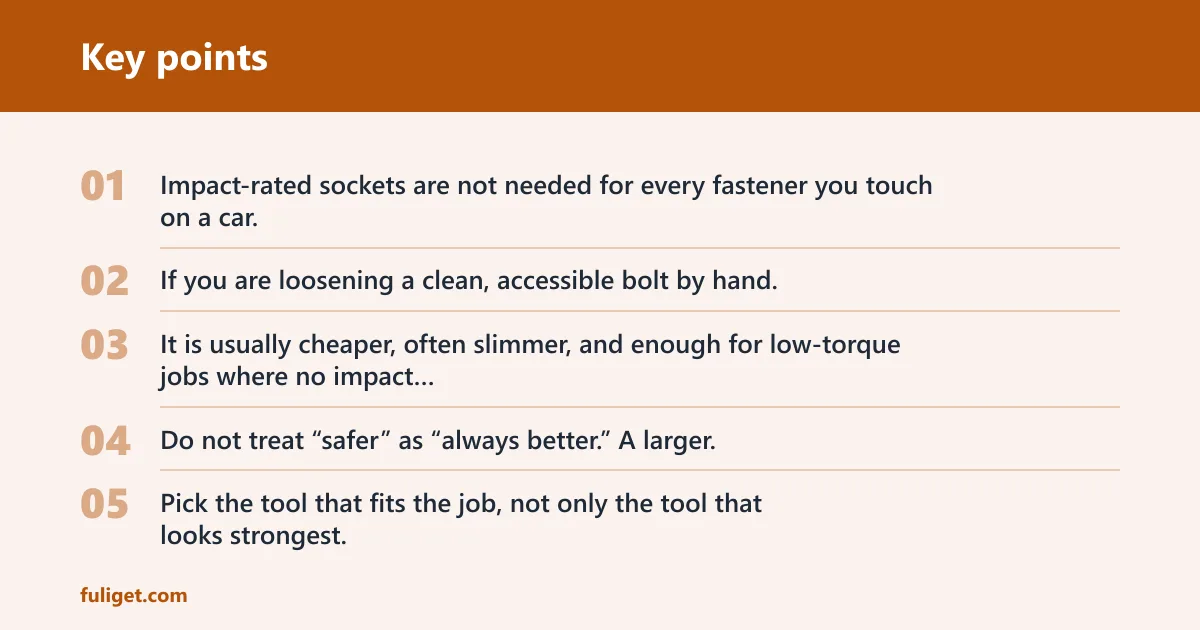
Impact-rated sockets are not needed for every fastener you touch on a car. If you are loosening a clean, accessible bolt by hand, a standard chrome vanadium socket is often the smarter choice. It is usually cheaper, often slimmer, and enough for low-torque jobs where no impact tool is involved.
Do not treat “safer” as “always better.” A larger, thicker impact socket can be awkward in a cramped engine bay, and a shallow hand socket may be the only one that reaches a nut without fouling nearby parts. Pick the tool that fits the job, not only the tool that looks strongest.
Do not use cases and failure signs
Do not use a chrome vanadium hand socket on an impact wrench. The warning is simple: chrome vanadium sockets were never made for impact guns, and repeated shock can crack or split them. If a socket shows any visible cracking, splitting at the drive end, rounded corners, or a loose fit on the fastener, retire it.
Also retire a socket that has a visibly distorted square drive, chipped chrome, or polished internal corners that no longer grip well. Those signs point to wear that can lead to slippage and rounding, especially on a stubborn lug nut or suspension bolt. Replace the socket before it damages the fastener.
Can you use impact sockets with a ratchet?
Yes. Impact sockets can be used with a hand ratchet, and many DIY mechanics do exactly that. The socket material is not the problem on a ratchet; the question is whether the socket depth, diameter, and point count fit the fastener and the space around it. For hand use, an impact socket is usually safe, just not always the best choice.
For low-torque fasteners, a regular socket is often the better choice because it may be thinner and cheaper. If you need extra reach, a deep socket makes sense. If space is tight, a shallow socket may fit better. The best hand-tool choice is the one that reaches the bolt cleanly without extra bulk.
If the job is simple, a chrome vanadium socket on a ratchet can be the most practical option. Save impact sockets for fasteners that are likely to see impact-tool use or heavy torque.
What size impact sockets do you need for car work?
For many car jobs, the two drive sizes that matter most are about 3/8-inch and 1/2-inch. Choose 3/8-inch for smaller engine-bay hardware and general hand-tool work. Choose 1/2-inch for wheels, brakes, suspension, and other higher-torque jobs, especially when an impact wrench is part of the plan.
3/8-inch drive versus 1/2-inch drive
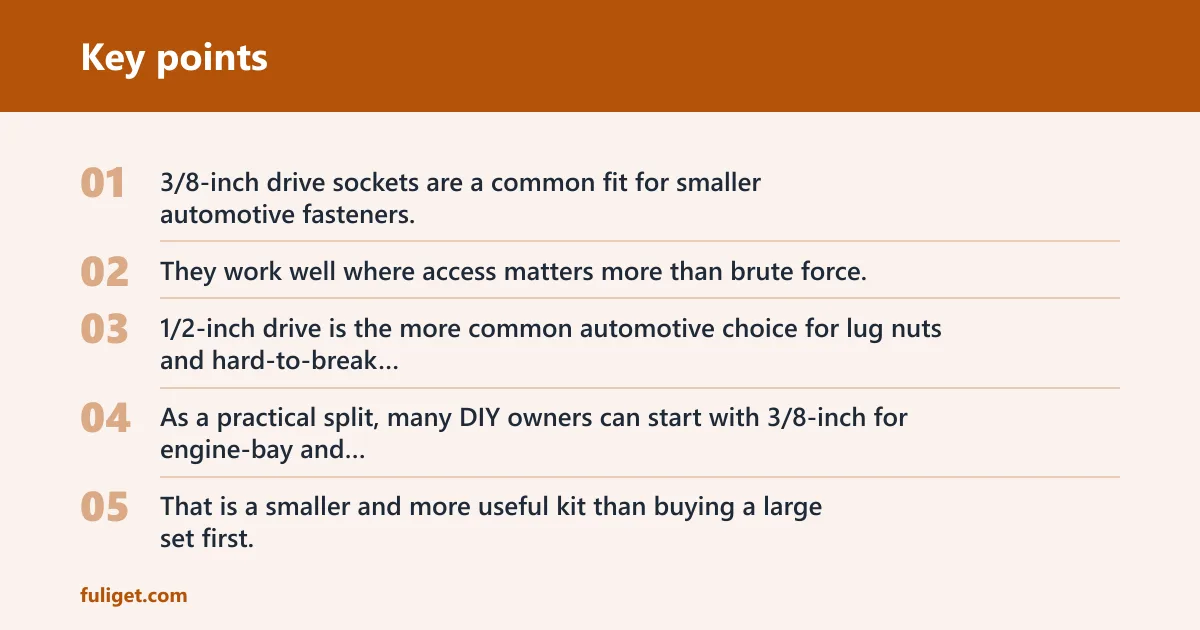
3/8-inch drive sockets are a common fit for smaller automotive fasteners. They work well where access matters more than brute force. 1/2-inch drive is the more common automotive choice for lug nuts and hard-to-break fasteners because it matches the torque output of an impact wrench better and leaves more margin for stuck hardware.
As a practical split, many DIY owners can start with 3/8-inch for engine-bay and interior work, then add 1/2-inch impact sockets for wheel service and suspension jobs. That is a smaller and more useful kit than buying a large set first.
Metric and SAE ranges
Automotive sets may include both metric and SAE sizes. Common metric ranges run from 10mm to 24mm in many car-oriented sets, with some broader sets going from 8mm to 19mm or even 9mm to 30mm. Common SAE coverage runs from 3/8 inch to 1-1/4 inch, with wheel and general service sets often covering smaller spans such as 3/8 inch to 1 inch.
Use the fastener type on your vehicle to decide which system to buy first. Many newer cars are mostly metric. Older domestic vehicles and some accessories may still use SAE hardware. If you are unsure, check the exact fastener sizes before buying a set.
Shallow versus deep sockets
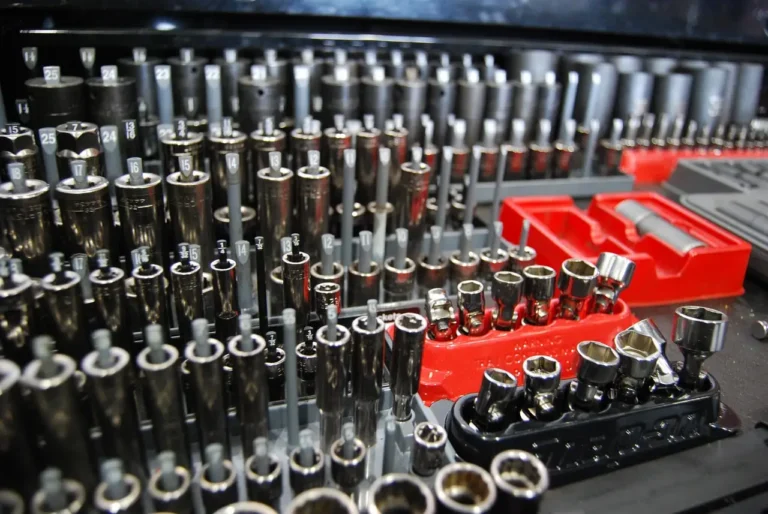
Shallow impact sockets are ideal for cramped spaces. They are shorter, so they can clear nearby brackets, hoses, and bodywork more easily. Deep impact sockets are better for recessed bolts, long threaded rods, and lug nuts that sit far down in the wheel opening. Garagetooled specifically notes shallow sockets for cramped spaces and deep sockets for lug nut removal.
Many automotive sets include both because the fit problem changes by job. A shallow socket can solve clearance trouble in the engine bay. A deep socket can reach a wheel nut or stud without needing extra adapters.
What impact sockets are made
Impact sockets are commonly made from chrome molybdenum steel, often called CR-MO, or a similar impact-rated alloy. Regular hand sockets are commonly made from chrome vanadium steel. The difference matters because impact-rated alloys are tougher and more flexible under shock, while chrome vanadium is better suited to steady hand torque than repeated hammering force.
Most automotive impact sockets are 6-point. That design fits hex fasteners better and helps reduce rounding. Many sets are also sold in shallow and deep versions so you can pick reach or clearance as needed.
Set contents vary, but the most useful kits for car work usually focus on the sizes you are most likely to touch, not a huge spread you may never use. Examples include the Sunex 3580 SAE range from 5/16 to 3/4 inch and metric from 8mm to 19mm, the NEIKO 02448A SAE range from 3/8 inch to 1-1/4 inch and metric from 10mm to 24mm, and the EPAuto ST-015-2 1/2-inch drive SAE range from 3/8 inch to 1 inch. Garagetooled also lists a 1/2-inch drive metric set ranging from 9mm to 30mm.
Frequently asked questions
What is an impact socket used for?
Impact sockets are used with impact wrenches and impact drivers on car fasteners that need high torque or repeated shock loads. The most common jobs are lug nuts, suspension bolts, brake hardware, exhaust fasteners, and rusty engine-bay bolts. For ordinary hand-tool work, a regular socket is often the better fit.
Can you use impact sockets on lug nuts?
Yes. Lug nuts are one of the core uses for impact sockets, especially 1/2-inch drive sets. Deep sockets are often preferred because they reach recessed lug nuts more easily. If you are using an impact wrench, the socket should be impact-rated rather than a standard chrome hand socket.
What is the difference between impact sockets and regular sockets?
Impact sockets are built from impact-rated alloys such as chrome molybdenum steel and are made to handle shock loadings from powered tools. Regular sockets are commonly chrome vanadium steel and are intended for hand tools. Impact sockets are usually thicker and more durable under shock, while regular sockets can be slimmer and cheaper.
Are impact sockets necessary for tire changes?
If you use an impact wrench for tire changes, yes, impact sockets are the right choice. If you remove lug nuts by hand with a breaker bar or ratchet, a regular socket can work. The key difference is the tool: powered impact tools call for impact-rated sockets, while hand tools do not require them.
Do impact sockets help prevent rounding bolts?
They can. A 6-point impact socket grips the flats of a hex fastener better than a loose or worn socket, which reduces slippage and rounding. That benefit is strongest on rusted or damaged fasteners. A rounded or cracked socket should be retired because it can make rounding more likely, not less.