
What Size Jack Stands Do I Need for My Vehicle?

Choose jack stands by matching two numbers: their rated load should exceed the weight carried at the supported end of the vehicle, and their minimum-to-maximum height range must cover the lift height you need. Buying the wrong height can leave the stands too short, unstable, or impossible to fit under the vehicle. This guide shows how to estimate the right tonnage, check lift range, and pick stands for cars, SUVs, trucks, and lifted vehicles.
How jack stands are sized
Jack stands need two checks. First, the load rating must cover the end of the vehicle you are supporting, not only the full curb weight on the door sticker. Second, the stand must adjust low enough to slip under the lift point and high enough to hold the vehicle at the service height you need.
A floor jack lifts. Jack stands hold the vehicle after it is up. Use wheel chocks on level ground to keep the opposite wheels from rolling, and follow the vehicle manual for the exact lift points, which may be the frame rail, pinch weld, control arm, or axle.
Load rating: per stand or per pair
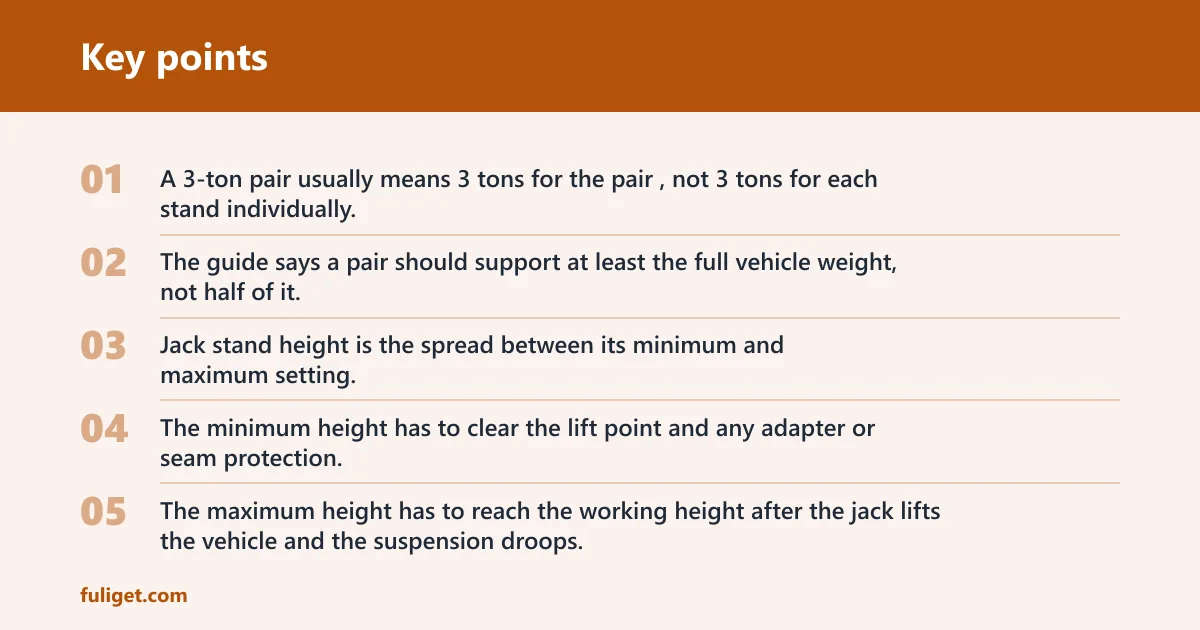
Read the label carefully. A 3-ton pair usually means 3 tons for the pair, not 3 tons for each stand individually. That distinction matters because a pair used under one axle should support the full load on that end of the vehicle.
The guide says a pair should support at least the full vehicle weight, not half of it. That is a conservative floor for selection, but the better check is the load on the axle or corner you plan to support, especially on front-heavy vehicles or anything carrying cargo or accessories.
Height range: collapsed and fully raised
Jack stand height is the spread between its minimum and maximum setting. The minimum height has to clear the lift point and any adapter or seam protection. The maximum height has to reach the working height after the jack lifts the vehicle and the suspension droops.
That extra clearance matters. A pinch weld can sit lower than the surrounding rocker. A control arm or axle mount can sit higher than the frame rail. If the stand reaches the weight rating but stops short by an inch or two, it is the wrong stand for the job.
Why the vehicle manual matters
The correct lift point depends on the vehicle, and the manual is the best reference. Some vehicles call for frame rails. Others call for reinforced pinch welds or specific suspension points. Do not guess if the manual gives a defined location.
What size jack stands do I need for my vehicle?
Start with the supported end of the vehicle, not the whole vehicle. For most cars and crossovers, 2-ton or 3-ton stands are the common starting points. For half-ton pickups and heavier SUVs, 6-ton stands are the safer baseline when the axle load and lift height push beyond light-duty ratings.
Cars and crossovers
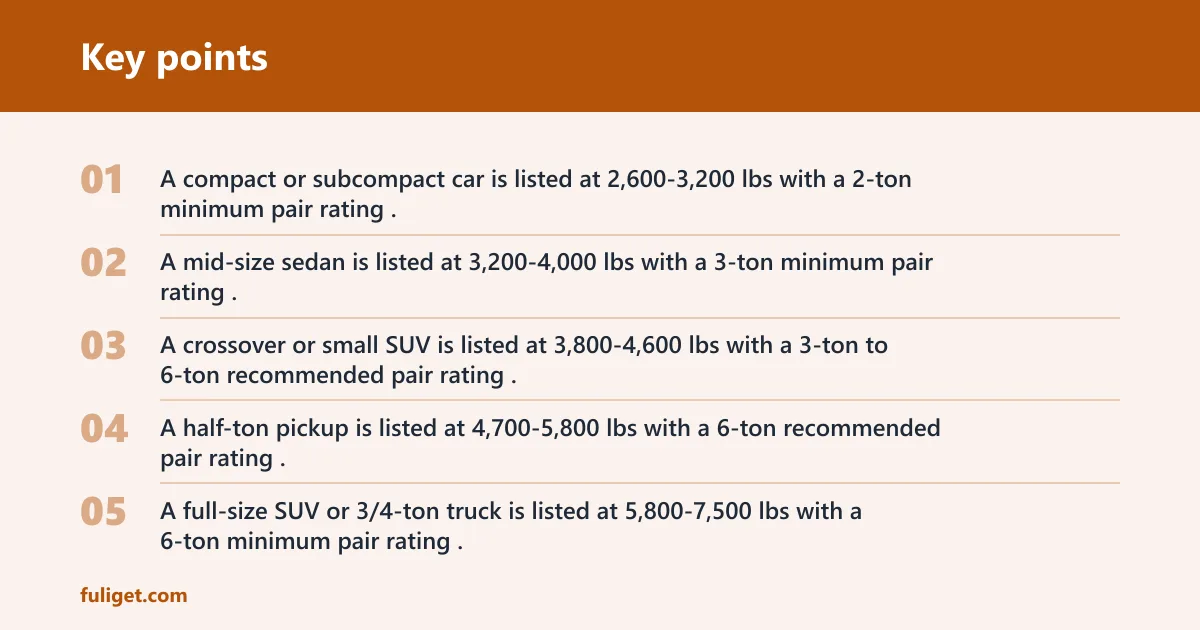
A compact or subcompact car is listed at 2,600-3,200 lbs with a 2-ton minimum pair rating. A mid-size sedan is listed at 3,200-4,000 lbs with a 3-ton minimum pair rating. A crossover or small SUV is listed at 3,800-4,600 lbs with a 3-ton to 6-ton recommended pair rating.
That range is why a curb-weight-only shortcut can mislead you. If the front end carries most of the engine weight, or if the rear holds cargo, the supported corner can be well above a simple split of the total weight.
SUVs and half-ton pickups
A half-ton pickup is listed at 4,700-5,800 lbs with a 6-ton recommended pair rating. A full-size SUV or 3/4-ton truck is listed at 5,800-7,500 lbs with a 6-ton minimum pair rating. That does not mean every job needs the tallest stand in the aisle, but it does mean the margin starts to shrink on bigger vehicles.
Suppose a half-ton pickup has the front axle carrying more weight than the rear because of engine placement, a winch, or cargo in the bed. A 6-ton pair can still be the right starting point, but only if the height range fits the lift point and the axle load stays within the stand’s rating.
Lifted or heavy-duty vehicles
Heavy-duty or lifted trucks and vans are listed at 7,500-10,000 lbs with a 6-ton to 12-ton recommendation. Lifted trucks often need extra stand height more than extra load rating, but the two issues are linked. A taller stand with the wrong rating is still a poor choice.
For lowered cars, the opposite problem shows up: the stand may have enough capacity but not a low enough collapsed height to slip under the pinch weld or frame rail. That is a height problem, not a tonnage problem.
Jack stand sizing worksheet
Use this worksheet as a first pass. Then compare it with the vehicle manual and the actual lift point you will support. If your vehicle carries cargo, accessories, or unusually heavy front or rear weight, size up one tier when the answer is close.
| Vehicle type | Curb weight range | Minimum recommended stand rating | Minimum required stand height range |
|---|---|---|---|
| Stock car | 2,600-4,000 lbs | 2-ton to 3-ton | About 11-17 inches for many low vehicles; confirm clearance at the lift point |
| SUV | 3,800-7,500 lbs | 3-ton to 6-ton | About 11-21 inches, depending on frame rail or pinch weld height |
| Half-ton truck | 4,700-5,800 lbs | 6-ton | About 11-21 inches, sometimes more for suspension droop or taller tires |
| Lifted vehicle | 7,500-10,000 lbs | 6-ton to 12-ton | Choose the tallest stable range that still fits under the lift point and adapter |
Decision rule: if the load rating is close, size up one tier. If the stand reaches the load but not the lift point, choose a taller stand. If both are close, move to the next size and confirm the manual before buying.
A common first-timer mistake is buying 3-ton stands for a truck because the weight rating sounds ample, then discovering the stands stop short once the suspension hangs free. The fix is not more jack pressure. It is a taller stand with the right rating.
Do jack stands need to match full vehicle weight?
They need to match the supported end of the vehicle, and in practice that often means the full vehicle weight should not exceed the pair’s combined capacity. The safer check is the axle load or the vehicle’s front or rear weight rating, because that is closer to the real load sitting on the stands.
Using axle weight instead of curb weight
Use axle load or axle weight rating when possible. Curb weight is only the starting point. A front-heavy vehicle can place much more than half its weight on the front axle, while cargo, tool boxes, spare parts, or camping gear can increase the rear load beyond a simple split.
This is why the same stand can be fine for one corner job and marginal for another. A single-corner support task on a sedan may not demand the same rating as supporting both front corners for brake work.
When cargo or accessories change the answer
If the vehicle is loaded, the conservative answer is to size up. Roof racks, winches, bumpers, winch mounts, bed cargo, and recovery gear all change the supported load. If you cannot verify the actual axle load, choose the next rating tier and verify the height range before work starts.
When to size up one rating tier
Size up when the answer is close, when the vehicle has a heavy front end, or when the job requires the vehicle to sit high on the stands for a long time. A 3-ton stand may be fine for a sedan, but a 6-ton stand is the better call when the supported end is heavy, the vehicle is modified, or the margin is thin.
Which height range do you need?
Measure from the ground to the lift point after the vehicle is raised just enough for the stand to fit. Then check the stand’s collapsed height against that number and its maximum height against the working height you want. The right height range is the one that clears both ends of the lift.
Measure from the lift point to the ground
Use the exact point the manual calls for. A pinch weld adapter can add height. A frame rail may need less. A control arm or axle point can sit in a different spot entirely, so the same stand may fit one vehicle and fail on another with the same tire size.
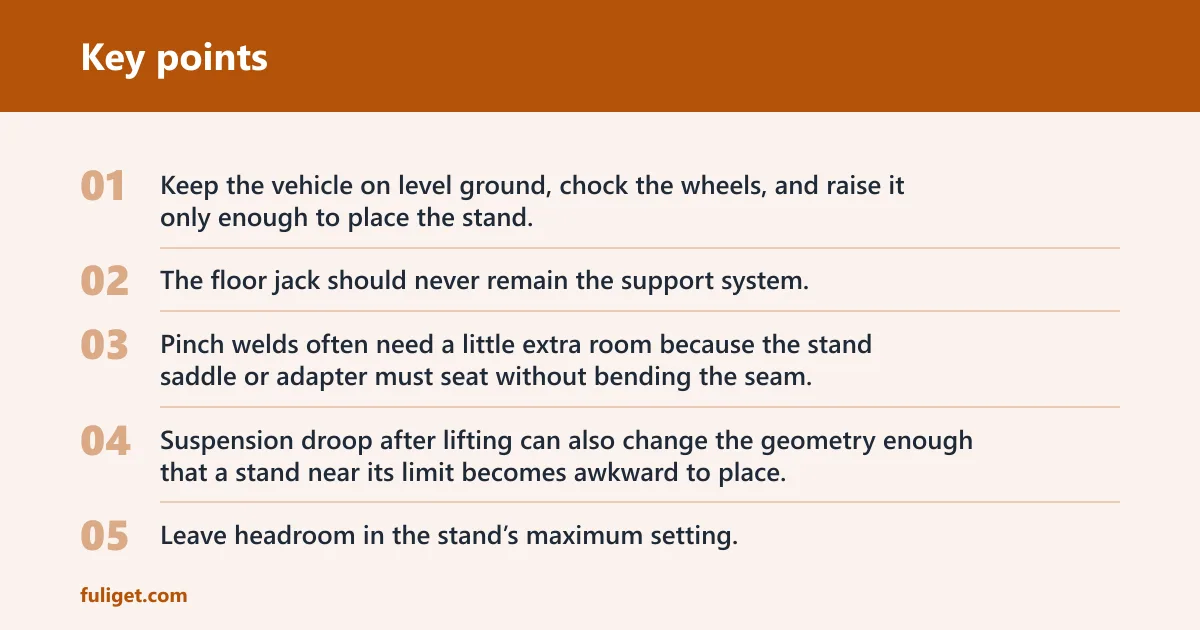
Keep the vehicle on level ground, chock the wheels, and raise it only enough to place the stand. The floor jack should never remain the support system.
Check clearance for pinch welds and suspension droop
Pinch welds often need a little extra room because the stand saddle or adapter must seat without bending the seam. Suspension droop after lifting can also change the geometry enough that a stand near its limit becomes awkward to place. Leave headroom in the stand’s maximum setting.
What to do when the stand is tall enough but not low enough
That is a common buying failure. If the minimum height is too tall for your lift point, the stand simply will not fit under the vehicle. In that case, choose a shorter model, a different saddle design, or the proper adapter recommended by the vehicle or stand maker.
Say your sedan needs only a small lift for brake service, but the stand’s minimum height is higher than the pinch weld. The stand may be rated correctly at 3 tons, yet it still cannot be used. The height range, not the rating, is the problem.
Pin-style vs. ratcheting jack stands
Both styles can work. The better choice depends on how you want the height to lock and how much adjustment speed matters. If the rating and height fit your vehicle, the locking style is the next decision.
Solid pin locking design
Pin-style jack stands use a solid steel locking pin through holes in the post. That through-pin support concept is straightforward and mechanical, and some buyers prefer it because the lock is easy to inspect. The tradeoff is slower setup and fewer quick adjustments between holes.
Toothed bar and pawl design
Ratcheting stands use a toothed vertical bar and a spring-loaded pawl. They adjust quickly, often with one hand, which makes them convenient when the stand height needs to change in small increments. They also have a well-publicized recall history in certain models, so buyers often check the listing and recall status carefully before choosing one.
Which design fits which use case?
Choose pin-style if you want a direct mechanical lock and do not mind slower height changes. Choose ratcheting if quick one-hand adjustment matters and the specific model has the height range you need. Either way, the stand still has to fit under the vehicle and support the load on that end.
Can ramps replace jack stands?
Ramps can help when you need access under the front or rear of a vehicle and the wheels can stay on the ground. They do not replace jack stands for jobs that require a wheel to come off, the suspension to droop, or the vehicle to sit at a different height on each corner.
Where ramps help
Ramps are useful for oil changes, some inspections, and other tasks where the vehicle can stay in a parked, wheel-supported position. They can be easier than stands for quick access, and they avoid some of the height-matching issues tied to pinch welds or tall lift points.
Where ramps do not replace stands
Ramps do not solve brake work, suspension work, tire removal, or anything that requires the supported end to hang free. If the manual calls for the wheels off or the suspension unloaded, use jack stands instead of ramps.
Frequently asked questions
What size jack stands do I need for my car?
For many cars, the starting point is a 2-ton or 3-ton stand, but the better check is the load on the supported end and the height at the lift point.
What size jack stands do I need for my truck?
For a half-ton pickup, the guide lists a 6-ton recommended pair rating at 4,700-5,800 lbs. For a full-size SUV or 3/4-ton truck, the guide lists a 6-ton minimum pair rating at 5,800-7,500 lbs. Check the supported axle load and the stand’s height range before you buy.
Do jack stands need to be rated for the full vehicle weight?
The guide says a pair should support at least the full vehicle weight, not half of it. In practice, the safer check is the load on the axle or corner being supported. If the vehicle is loaded or front-heavy, curb weight alone can understate the real load.
How tall do jack stands need to be for an SUV or truck?
Height depends on the lift point and the amount of suspension droop you need. Many SUVs and trucks need stands with roughly an 11-21 inch range, but the exact number depends on whether you are using a frame rail, pinch weld, control arm, or axle point.
Are 3-ton jack stands enough for a half-ton pickup?
Usually not as the first choice. A 3-ton pair may also run short on height for truck service, so check both the load rating and the stand’s lift range.
What’s the difference between pin-style and ratcheting jack stands?
Pin-style stands use a solid steel locking pin through holes in the post. Ratcheting stands use a toothed bar and a spring-loaded pawl. Pin-style units are often preferred for their direct locking method, while ratcheting stands are valued for quick one-hand height changes.