

How to Use a Floor Jack Safely on Your Car

Use a floor jack on level ground only, chock the wheels on the opposite end, set the saddle at the vehicle’s specified lift point, and lift just enough to place the jack stands next. Skip any step and the car can shift, slip, or drop, damaging parts and causing serious injury. This guide covers the pre-lift go/no-go check, the correct lift sequence, and the failure points that most often catch DIY owners. (Caranddriver)
What you’ll need
- Floor jack with a readable capacity label
- Jack stands rated for the vehicle
- Wheel chocks
- Owner’s manual
- Flashlight
- Gloves
- Pinch-weld adapter if your vehicle or jack calls for one
Before you lift
Start by deciding if you are only changing a tire or doing work under the vehicle. That choice changes the setup. A floor jack is a hydraulic rolling lift tool, not a support device for long jobs, so under-car service needs jack stands. For a wheel swap or brake check, you may lift one corner or one end; for under-car work, plan stand placement before the car comes up.
Confirm the vehicle manual first
Open the owner’s manual before you choose a lift point or gear selection. The owner’s manual usually lists approved lift and support points, and it may also specify Park, a lower gear, or a service mode for vehicles with air suspension. Do not guess from nearby seams, plastic covers, or the shape of the rocker panel.
Inspect the equipment
Check that the jack rolls freely, the saddle is not damaged, and the rating label is readable. Inspect the jack stands for bent pins, cracked welds, or rust damage. Use only stands that are correctly rated for the vehicle and set at equal height on the same end when you transfer load to them.
How do I properly use a car jack?
Use the jack as a temporary lifting tool, not as the thing that holds the car while you work. Set the car on a flat, hard surface, lock it in place with the parking brake and chocks, position the saddle on the correct reinforced lift point, and lift slowly until you reach tire clearance or stand height. Then move the weight to jack stands if any part of your body will go under the car.
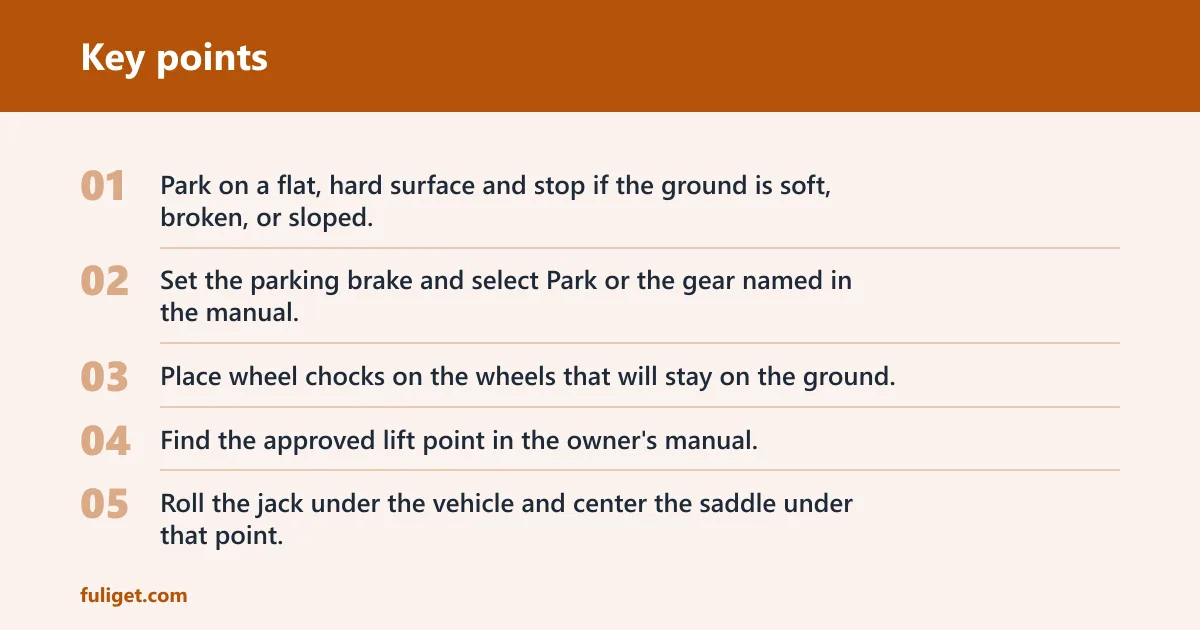
- Park on a flat, hard surface and stop if the ground is soft, broken, or sloped.
- Set the parking brake and select Park or the gear named in the manual.
- Place wheel chocks on the wheels that will stay on the ground.
- Find the approved lift point in the owner’s manual.
- Roll the jack under the vehicle and center the saddle under that point.
- Raise the car slowly until the tire just clears the ground or the service height is reached.
- Set jack stands under the approved support points before working underneath the vehicle.
Suppose a low-profile coupe needs a rear wheel lifted for a brake inspection. If the front end is lifted, the rear wheels stay on the ground, so the chocks go at the rear. A different car with a rear lift point may need a different setup. The manual decides that, not the nearby seam or a guess based on symmetry.
Where do I place the jack under my car?
Place the jack at the vehicle’s approved jacking point, not at a random seam or thin panel. Many cars have four jacking points near the rocker panels by the wheels, and some also have front or rear central lift points. Some models use reinforced pinch-weld seams, while others call for a pad or adapter. The jack saddle must sit centered on the load-bearing spot.
Find the right lift point
Use the manual, then look for a reinforced area that matches the diagram. Avoid plastic undertrays, heat shields, fuel lines, brake lines, and any panel that flexes easily. If the car needs a pinch-weld adapter, fit it before lifting so the saddle does not crush the seam.
Do not guess from nearby seams
A seam is not proof of a lift point. Some seams are cosmetic, and some are reinforced. That is why the manual comes first. If the car has a front center crossmember point or a rear differential area listed in the manual, use that instead of trying to split the difference between two side points.
How do I keep my car from rolling while jacking it up?
Stop rolling risk before the jack touches the car. Put the transmission in Park or the gear named in the manual, set the parking brake, and chock the wheels that remain on the ground. For a front lift, rear chocks are common; for a rear lift, front chocks are common. On a sloped or cracked surface, do not proceed.
- Use the parking brake every time.
- Chock the opposite end of the vehicle.
- Keep the remaining wheels on the ground until the car is secure on stands.
Say your sedan is on a driveway with a slight crown. The jack may still roll, but the car can also shift toward the low side as weight comes off the tires. That is a stop condition. Move to a better surface instead of trying to compensate with extra pumping.
How do I raise the car safely?
Keep the jack straight as you roll it into position, then pump until the car rises in a controlled way. On a typical floor jack, pumping raises the car and the hydraulic release valve controls lowering. Stop immediately if the saddle slides, the body leans, or the jack starts to tilt. Raising farther than you need only adds risk.
- Center the saddle under the approved lift point.
- Begin pumping slowly and watch the car, not just the handle.
- Stop as soon as the tire clears the ground or the car reaches stand height.
- Recheck that the saddle stayed centered and the vehicle remains level side to side.
Do not work faster when the tire first lifts. That is when a bad setup usually shows itself. If the jack moves, lower the car, reset the saddle, and check the surface before trying again.
Floor jack safely checklist
| Checkpoint | Pass condition | Stop condition |
|---|---|---|
| Surface | Flat, hard, and stable; concrete preferred | Soft, cracked, sloped, or broken ground |
| Parking brake | Fully engaged before the jack moves in | Brake not set or feels weak |
| Gear selection | Park or the gear named in the manual | Unknown setting or rolling risk remains |
| Wheel chocks | Placed on the wheels that stay on the ground | No chocks or chocks on the wrong end |
| Lift-point verification | Manual checked and approved point identified | Guessing from seams, covers, or nearby parts |
| Jack capacity | Label readable and suitable for the job | Unreadable label or unknown rating |
| Jack condition | No visible damage, leaks, or binding | Cracks, rust damage, or hydraulic leak |
| Saddle alignment | Centered on the reinforced lift point | Off-center, on plastic, or on a weak panel |
| Jack stand plan | Rated stands ready at equal height on the same end | No stands ready for under-car work |
| Load transfer | Vehicle can be moved from jack to stands | Jack is the only support planned |
| Lowering readiness | Tools cleared and path open for a slow drop | Hands, tools, or body parts in the way |
| Vehicle-specific systems | Air suspension, undertray, or adapter requirement checked | Special lift mode or adapter not confirmed |
Do I need jack stands when using a floor jack?
Yes, if any part of the job puts you under the car. A floor jack can lift the car, but it is not the support device for under-car work. Move the load onto correctly rated jack stands, set at equal height on the same end, before you reach beneath the vehicle. A jack may remain in place as a backup, but not as the only support.
Temporary lift versus supported work
For a tire change, the jack can hold the vehicle long enough to remove and refit a wheel, then lower it. For brake, suspension, exhaust, or underbody work, the jack is only the lifting step. The stands carry the load.
How much can a floor jack lift?
How much it can lift depends on the model, so check the manufacturer’s listing and the jack’s capacity label. Capacity matters as a safety margin, and a jack must exceed the vehicle weight for the job. That does not mean the jack should carry the entire car forever, only that it can safely raise the required corner or end.
Do not confuse vehicle weight with the load on one lift point. Lifting one corner or one end does not mean you are lifting the whole car equally at once. The manual and the jack rating both matter, and the smaller of the two practical limits controls the job.
How do I lower a floor jack without dropping the car?
Lower the car by opening the hydraulic release valve gradually, not all at once. Remove tools from under the car, verify that the stands or tire path are clear, and lower in a controlled way. If the vehicle is sitting on stands, raise it slightly with the jack first, remove the stands, then lower slowly.
- Clear hands, tools, and jack stands from the drop path.
- Support the vehicle with the jack if it is still on stands.
- Open the release valve slowly until the car starts down.
- Keep lowering under control until the tire or suspension is fully loaded.
- Remove the chocks last, after the car is fully on the ground.
Common mistakes
The most common failures are simple. They happen when the wrong point, the wrong ground, or the wrong support plan meets a fast lift. Fix those first and the rest of the job gets much safer.
Wrong lift point
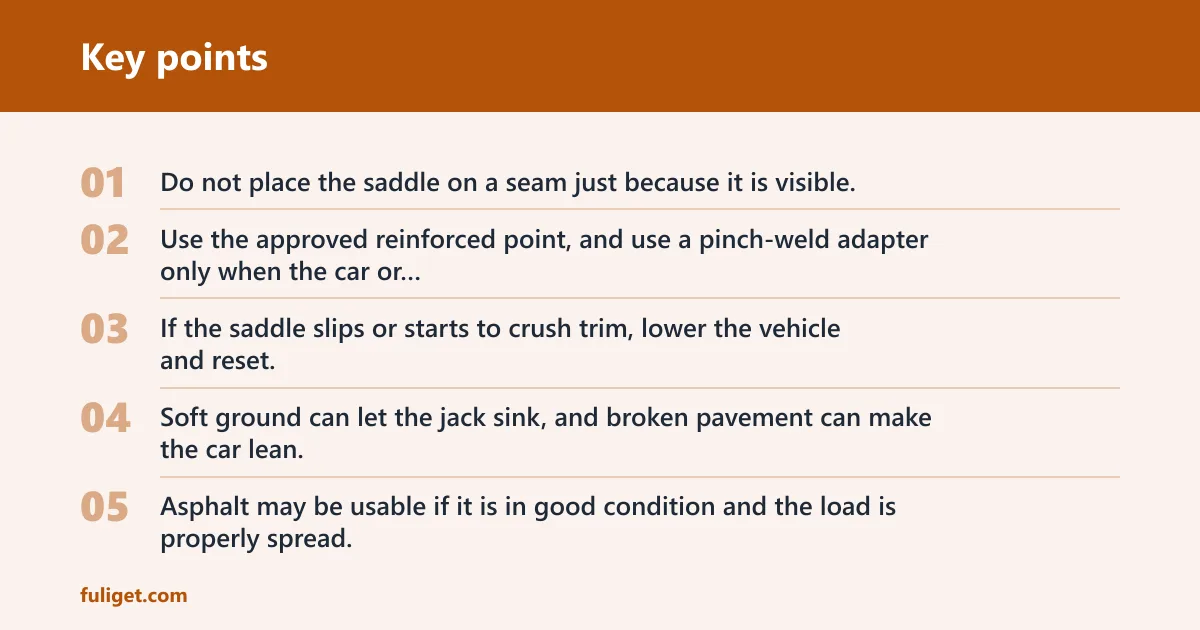
Do not place the saddle on a seam just because it is visible. Use the approved reinforced point, and use a pinch-weld adapter only when the car or jack calls for it. If the saddle slips or starts to crush trim, lower the vehicle and reset.
Unstable ground
Soft ground can let the jack sink, and broken pavement can make the car lean. A solid, level surface is the right answer. Asphalt may be usable if it is in good condition and the load is properly spread, but damaged, warm, or soft asphalt should stop the job. Gravel is a poor choice unless the surface is stabilized enough to prevent sinkage and side load.
Missing support plan
Never plan to work under a vehicle held only by a floor jack. Set jack stands before the under-car task begins. If the vehicle has an undertray, air suspension, or a service mode requirement, confirm that in the manual before you lift.
Unreadable or damaged equipment
If the rating label cannot be read, do not use the jack. If the jack leaks or the stands are bent, stop. 2CarPros also warns against old rusted or cracked stands, and that is the right standard here as well.
Frequently asked questions
How do I use a floor jack safely on my car?
Use it only as a lifting tool, not as a support device. Check the manual, verify the jack rating, keep the saddle centered on the reinforced point, and lower the car through the release valve in a slow, controlled motion. If any part shifts, reset before continuing.