
How to Use an Oil Filter Wrench Without Crushing the Filter

Use the smallest oil filter wrench setting that grips firmly, and stop as soon as the canister starts to ovalize; tighten the bite or switch wrench style before adding more force. Crush the filter, and you can slip the tool, dent the housing, or leave yourself with a mess and a harder removal. This guide shows how to set the wrench, apply torque cleanly, and recover when the first pull starts deforming the filter.
What you’ll need
- Oil-filter wrench matched to the filter and access
- Drain pan
- Gloves
- Shop towels or rags
- Penetrating oil or lubricant for the filter base
- Replacement oil filter and oil, if you are completing an oil change
How to choose a wrench that won’t crush the filter
Pick the wrench that fits the problem in front of you, not just the filter shape. A strap wrench is often a safe default because it is less likely to crush the filter and can work across multiple diameters. Cap wrenches need a specific size match. Claw and pliers-style tools can deliver more bite, but they need space and control.
Strap wrench for the safest default grip
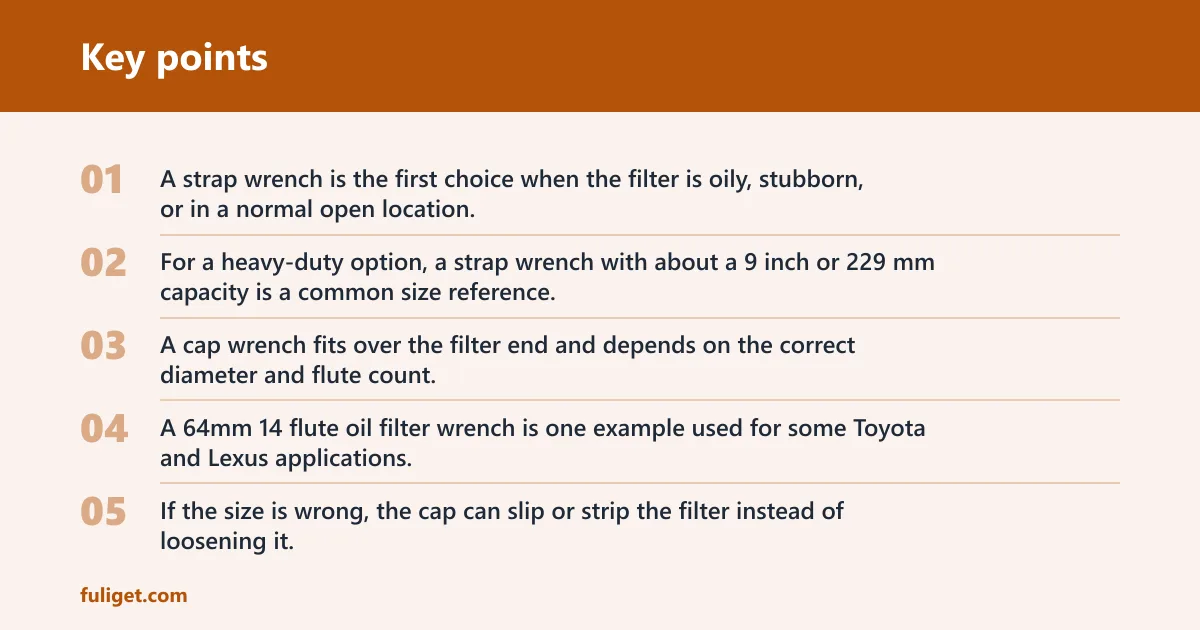
A strap wrench is the first choice when the filter is oily, stubborn, or in a normal open location. Its adjustable grip spreads force around the canister instead of pinching one spot, so it is less likely to crush the filter. For a heavy-duty option, a strap wrench with about a 9 inch or 229 mm capacity is a common size reference.
Cap wrench when the size matches exactly
A cap wrench fits over the filter end and depends on the correct diameter and flute count. A 64mm 14 flute oil filter wrench is one example used for some Toyota and Lexus applications. If the size is wrong, the cap can slip or strip the filter instead of loosening it.
Claw wrench for high torque with open access
A claw wrench uses three or more claws and can apply high torque when the filter is exposed. It works best when there is room to swing the tool and keep it square. Tight packaging near exhaust parts, steering parts, or frame rails can make this style awkward or unsafe.
Pliers-style wrench when you need body contact
A pliers-style oil filter wrench grips the filter body directly, which makes it useful on a stubborn filter with decent access. It can dent the filter if over-tightened, so start with light pressure and increase only until the jaws stop slipping. If the canister is already thin or dented, switch styles before you add more force.
Oil filter wrench decision table
| Symptom | Likely cause | Best wrench type | Grip setting | Next move |
|---|---|---|---|---|
| Slippery, oily filter | Oil film reduces friction on the canister | Strap wrench | Snug enough to stop slipping, not pinching | Dry the shell, then pull steadily counterclockwise |
| Tight clearance | Tool body cannot swing around nearby parts | Cap wrench | Exact size match | Use the correct cap or change to a lower-profile tool |
| Stuck filter | Installed too tightly or heat-bonded to the base | Claw wrench | Firm three-claw bite | Apply steady torque, then add penetrating oil at the base if needed |
| Already-dented filter | Shell is weakened and will collapse under point pressure | Strap wrench | Broad contact, light increase only | Stop at the first sign of ovalizing and change tools |
| Wrong-size cap wrench | Flutes or diameter do not match the filter | Strap wrench | Adjustable and centered | Do not force the cap; swap to the proper size or another type |
How do you use the wrench without deforming the canister?
Set the tool just tight enough to bite, then pull counterclockwise with one smooth motion. The canister is thin metal, so the goal is contact and torque, not crushing pressure. Stop the moment the shell starts to flatten, ovalize, or wrinkle at the contact point.
- Warm the engine briefly. Start the engine and let it run for about 3 to 5 minutes, just long enough to thin the oil. The filter and nearby exhaust parts can get hot fast, so wear gloves and keep your hands off the exhaust and filter body.
- Place the drain pan. Set it under the filter before you touch the wrench. A filter that starts to slip can release oil suddenly, and the pan gives you room to reset without a mess.
- Fit the wrench squarely. Center the tool on the filter and keep it flat to the canister. If the tool sits crooked, one edge takes the load first and dents the shell faster.
- Tighten to first bite. Turn the adjustment until the wrench grips firmly, then stop. Snug means the wrench holds under pull without forcing the canister to deform.
- Pull counterclockwise. Apply steady pressure in the standard loosening direction. Do not jerk the handle; a sharp snap can break traction and crush one side of the filter.
- Stop at deformation. If the shell starts to ovalize, switch to a different wrench style or reset the grip. More force on a deforming canister usually makes removal harder, not easier.
Say your strap wrench bites well on the first try, but the canister begins to flatten at one edge. Back off, widen the strap slightly if the tool allows, and retry with steadier pull. The filter body should hold shape while the seal breaks loose.
What if the filter is already stuck or dented?
If the first pull starts crushing the shell, do not keep tightening the same tool. A dented canister loses strength fast, and a deeper collapse can cause the wrench to slip or puncture the housing. Switch to a tool that spreads force better, or use lubricant at the base and wait before trying again.
When a slip starts to crush the shell
Move to a strap wrench or a better-matched cap before you add more torque. A pliers-style wrench can work here, but only if the filter is still round enough to grip without cutting into it. If the shell is already wrinkled, avoid jaw pressure on the same spots.
- Reset the grip. Release the tool and check for flattening where it contacts the filter. Reposition on an undamaged section if the canister still has enough shape to hold.
- Increase grip once. Tighten only one increment, then retry. If the wrench still slips, stop and change tool type instead of chasing it with more pressure.
- Use base lubricant. Apply penetrating oil or lubricant around the filter base, then wait about 10 to 15 minutes before retrying. That wait gives the fluid time to reach the seal instead of being wiped away by the next pull.
When the filter is oily and spins
Oil film makes the shell slippery, so the first fix is a cleaner contact patch. Wipe the canister and the wrench contact area, then use a strap wrench or a correctly sized cap wrench. The standard loosening direction remains counterclockwise, and steady pressure works better than a quick yank.
Picture a filter that feels smooth and wants to spin inside the wrench. Clean it, reset the tool, and pull once more with even pressure. If it still spins, the wrench is not biting in the right place.
When the clearance is too tight for claw or pliers
Use a cap wrench if the size is exact, or a low-profile strap wrench if the cap will not fit. Claw and pliers-style tools need room around the filter, and they lose their advantage when nearby parts block the handle or jaw travel. In tight spaces, a long handle is less important than correct fit.
Common mistakes
Most damage comes from fit problems, not from the filter itself. The wrong tool, over-tightening, and jerking the handle are the main causes of crushed cans and stripped edges.
- Using the wrong size cap wrench. A mismatched cap can slip, strip the filter, or leave round marks without loosening it.
- Over-tightening pliers jaws. Pliers-style tools can dent the canister if the jaws bite too hard.
- Pulling too fast. A sudden jerk can break the tool free and collapse one side of the filter.
- Ignoring a dented shell. Once the canister starts to deform, switch strategies before the damage gets worse.
- Skipping a wait after lubricant. Penetrating oil needs time at the base before the next attempt.
Can you remove an oil filter without a wrench?
Yes, if the filter is loose enough to turn by hand after the seal breaks. If it is stuck, oily, or buried behind other parts, a wrench is the safer choice. Without one, you may only be able to spin the filter once it has already moved, not break it free cleanly.
- Try by hand first. Grip the filter with a rag and turn counterclockwise. If it moves a fraction of a turn, continue until you can unscrew it by hand.
- Use a strap if needed. If hand force fails, fit a strap wrench before trying harder methods. It is less likely to crush the filter than jaw-based tools.
- Escalate only if clear. Move to a cap, claw, or pliers-style wrench only when access and size match the tool. Wrong-size force is what strips or crushes the canister.
A common first-timer mistake is cranking the wrench too hard on a cramped filter and bending the canister instead of loosening it. If the filter is a 64mm 14 flute style, a mismatched tool will slip long before it loosens the seal.
Frequently asked questions
How do I use an oil filter wrench without crushing the filter?
Start with the lightest grip that still holds the canister, then turn counterclockwise with steady pressure. Stop the moment the shell begins to ovalize. If that happens, reset the fit or switch to a strap wrench before you add more force.
How do I remove an oil filter without a wrench?
Try a rag-wrapped hand grip first and turn counterclockwise. If the filter does not move, the next step is a strap wrench. A loose filter can often finish by hand, but a stuck one usually needs a tool with better bite.
Why does my oil filter wrench keep slipping?
Slippage usually means the size or grip is wrong, or oil on the shell is reducing friction. Clean the filter, reset the tool squarely, and tighten only until the wrench holds under pull. If it still slips, change wrench type.
What type of oil filter wrench is least likely to crush the filter?
A strap wrench is the safest default because it is less likely to crush the filter and works on multiple diameters. It is especially useful on oily or stubborn filters where a cap wrench may not match exactly.
How tight should an oil filter wrench be?
Tight enough that it does not rotate on the canister when you pull counterclockwise, but not so tight that the shell starts to flatten. If the filter ovalizes, the grip is too hard. Back off and reset before trying again.
What should I do if the oil filter is stuck or overtightened?
Use steady torque with the best-fitting wrench, then add penetrating oil or lubricant around the base and wait before retrying. If the canister begins to dent, stop and switch to a strap wrench or a better size match rather than forcing it.