
3/8 vs 1/2 Drive Spark Plug Socket: Which Should You Buy?

For most DIY spark plug jobs, a common starting point is a 3/8-inch drive socket. Use 1/2-inch only when your ratchet or breaker bar needs more turning force and the socket still clears the plug well. Picking the wrong drive can leave you with poor access, a sloppy fit, or more force than a fragile aluminum head should see. This guide compares 3/8 vs 1/2 drive spark plug sockets by clearance, retention, and real garage use.
| Factor | 3/8 | 1/2 drive spark plug socket | Winner |
|---|---|---|---|
| Engine-bay clearance | Lower bulk. Easier to fit near firewall bracing, coil packs, and narrow plug wells. | Bulkier head and shank. More likely to hit nearby plastic covers or valve cover edges. | 3/8 |
| Leverage | Enough for normal spark plug removal when the plug is not seized. | More turning force when you pair it with a longer ratchet or breaker bar. | 1/2 drive spark plug socket |
| Torque-wrench compatibility | Common match for many 3/8-inch torque wrenches used on spark plugs. | Fits 1/2-inch torque wrenches, but those are less commonly the first choice for plug work. | 3/8 |
| Plug retention | Works well with magnetic or rubber inserts; lower mass makes the socket easier to guide. | Also available with retention inserts, but the larger body gives you more to maneuver in tight wells. | 3/8 |
| Typical passenger-vehicle fitment | More common for spark plug service on cars and light trucks. | Less common for spark plug service on passenger vehicles; better suited when the rest of the tool setup is already 1/2-inch. | 3/8 |
3/8 vs 1/2 drive spark plug socket
The core trade-off is simple: 3/8 gives you easier access, while 1/2 drive spark plug socket gives you more turning force. For spark plugs, access and plug-well depth matter more than raw drive strength, because the socket still has to reach the plug head, hold it securely, and leave room for final tightening with a torque wrench.
Engine-bay clearance
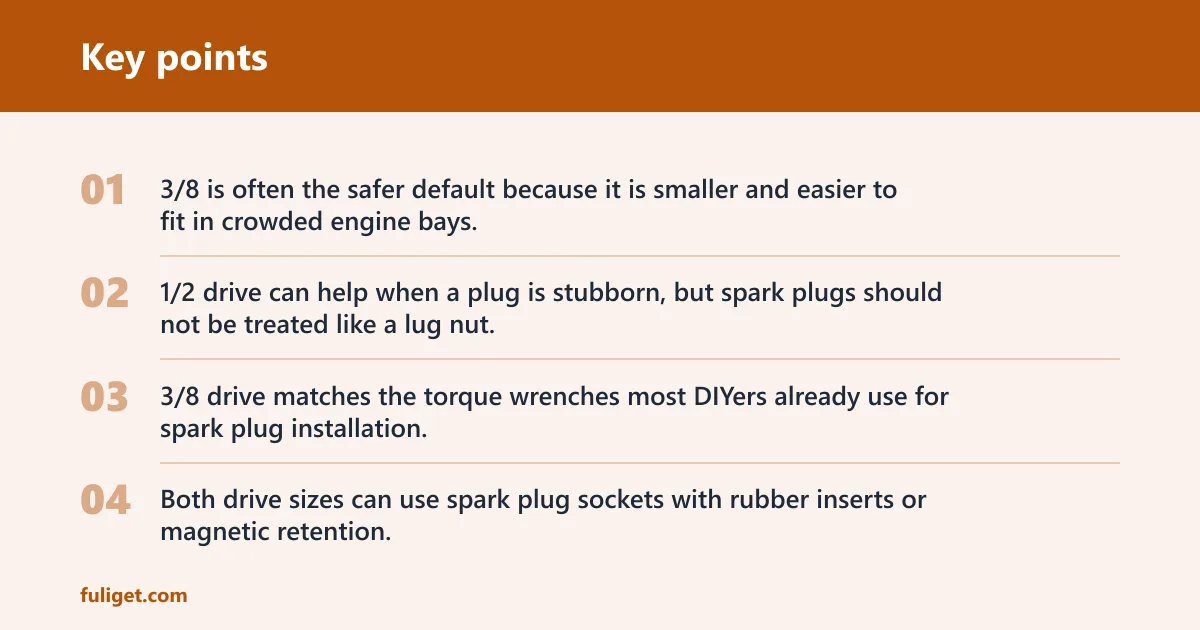
3/8 is often the safer default because it is smaller and easier to fit in crowded engine bays. A 1/2 drive spark plug socket can be a disadvantage when the space around the plug is already tight, since its larger outside diameter may contact the valve cover, coil boots, or nearby hoses before the hex fully seats.
Leverage
1/2 drive can help when a plug is stubborn, but spark plugs should not be treated like a lug nut. If a plug needs more force than a normal ratchet can provide, the first question is usually access and thread condition, not drive size alone.
Torque-wrench compatibility
3/8 drive matches the torque wrenches most DIYers already use for spark plug installation. That matters because the final step is tightening to spec, not simply removing the plug; a compatible drive size helps you avoid awkward adapters and keeps the workflow simple.
Plug retention
Both drive sizes can use spark plug sockets with rubber inserts or magnetic retention. The drive size does not change the retention style, but a smaller 3/8 socket is usually easier to guide into a deep well without bumping the plug out of the insert on the way down.
Which drive is easier in tight engine bays?
3/8 is easier in tight engine bays because the ratchet head, socket body, and extensions usually take up less space. If you are working next to a cowl, a strut tower, or a coil-on-plug cover, the smaller drive often makes the difference between a straight shot and a fight with the surrounding hardware.
Why thin-wall sockets matter
Thin-wall spark plug sockets reduce the outside diameter where clearance is limited. That matters more in some engines than drive size alone, because a thick socket can bind in the well even when the ratchet drive itself is correct.
Picture a V6 with deep plug wells and a narrow opening around each tube. A standard socket may fit the hex but scrape the sides on the way in, while a thin-wall 3/8 socket with a short extension slides in cleanly and lets you remove the plug without forcing the tool sideways.
Will a 3/8 drive work on spark plugs without breaking them loose?
Yes, a 3/8 drive will work for most spark plug removal jobs without issue. The drive size is usually not the limiting factor; plug condition, reach, and how much room you have to keep the socket square on the hex matter more. Use a longer handle only when the plug is actually resisting more than expected.
When 3/8 is the safer default
For most DIY spark plug jobs, 3/8 is the safer default because it is smaller, common, and easier to use with extensions and wobble extensions. It is also the drive size most often paired with a spark plug socket that has a rubber insert or a magnetic retainer, which keeps the plug from falling out during removal.
When extensions or wobble extensions are still needed
Deep plug wells often need more reach than the socket alone can provide. A straight extension works for a direct path, while a wobble extension can help when the approach is slightly angled and the surrounding bay prevents a straight line.
- Check the plug head size. Match the socket opening to the spark plug hex size first, usually 5/8 inch, 13/16 inch, or 16 mm. Drive size does not matter if the socket opening is wrong.
- Measure the well depth. If the plug sits deep below the valve cover, plan on a longer socket and at least one extension. Deeper wells also raise the chance that a thin-wall design is needed.
- Confirm your ratchet size. Use the drive size that matches the tools you already own, especially your torque wrench. That avoids adapters and keeps the final tightening step straightforward.
- Choose the retention style. Pick magnetic retention if you want easier plug capture, or rubber insert if you want a simple budget option. Either one can work if the socket fits the well cleanly.
When is 1/2 drive the better choice?
1/2 drive is the better choice when you need more turning force and the engine bay has enough room for the larger socket body. It is also useful if your only long handle is a 1/2-inch breaker bar and the plug wells are open enough that the extra bulk will not interfere with access.
When the bulk becomes the downside
That extra turning force comes with a trade-off. In crowded bays, a 1/2 drive spark plug socket can be harder to seat squarely, harder to remove after loosening, and more awkward to use with a torque wrench if the surrounding space is already cramped.
A common first-timer mistake is choosing 1/2 drive because it sounds stronger, then discovering the socket will not clear the plug tube on a transverse V6. The fix is usually a thinner socket or a 3/8 setup with the correct extension, not more force.
Spark plug socket fitment basics
A spark plug socket is a deep socket with a retention insert, usually rubber or magnetic, and it is made in common spark plug hex sizes such as 5/8 inch, 13/16 inch, and 16 mm. The drive size is only one part of the fit; the socket opening, wall thickness, and overall length all matter.
Deep sockets, plug wells, and thin-wall designs
Deep plug wells call for longer sockets or extensions so the ratchet can reach the plug without bottoming out on the valve cover. Thin-wall versions exist for engines where the plug tube leaves little outside clearance, and they can be the right answer when a standard socket fits the hex but not the surrounding space.
What size spark plug socket do you need for your car?
Check the plug hex size before buying. Many passenger vehicles use 5/8 inch or 16 mm spark plugs, while some older or specific applications may use 13/16 inch. The engine manual or the plug spec is the reliable source; drive size alone will not tell you which opening fits.
- Identify the plug hex. Read the plug spec or service manual and confirm whether the head is 5/8 inch, 13/16 inch, or 16 mm. This is the size the socket opening must match.
- Inspect the access path. Look at the plug well depth and the space around the tube. If the socket body looks close to the walls, plan on thin-wall construction.
- Pick the drive that matches your tools. Choose 3/8 if your ratchet and torque wrench are both 3/8-inch, or choose 1/2 only if that is the tool set you already use and the bay allows it.
- Buy the retention style you prefer. Magnetic retention is easier when the plug sits deep or the boot is stubborn, while rubber insert sockets are common and inexpensive. Either can work if the fit is correct.
Spark plug retention and torque wrench fit
Magnetic inserts hold the plug securely during removal and installation, which reduces the chance of dropping it into a cramped bay. Rubber inserts grip by friction instead; they are common in budget sockets, but they can wear, stick inside the socket, or make plug removal a little less predictable over time.
Magnetic insert vs rubber insert
Magnetic retention is usually the cleaner choice for repeated use or deep wells. Rubber insert sockets still work well, especially for occasional maintenance, but a worn insert may let the plug wiggle when you are trying to guide it past a coil boot or into a narrow tube.
Will a 3/8 drive fit most ratchets and torque wrenches?
Yes, 3/8 drive fits most ratchets and many torque wrenches used for spark plug service. That compatibility is one reason it is the default recommendation: you can remove the plug, install the new one, and tighten it to spec without changing tool families.
Spark plug socket decision matrix
| Scenario | 3/8 | 1/2 drive spark plug socket | Pick |
|---|---|---|---|
| Compact car with crowded bay | Smaller body, easier with extensions and wobble extensions. | Bulk can crowd the plug tube and nearby hardware. | 3/8 |
| V6/V8 with deep wells | Better if paired with a long extension and thin-wall socket. | Useful only if the well is open enough for the larger socket body. | 3/8 |
| Diesel or glow-plug-adjacent service | Usually the safer access choice when the space is limited. | Can help if the fastener is unusually stubborn and the bay allows it. | 3/8 |
| Existing-toolbox-only buyer | Best if you already own 3/8 ratchets and a 3/8 torque wrench. | Best only if your only long handle and torque wrench are 1/2-inch. | Depends on tools |
Choose 3/8 if… / Choose 1/2 drive spark plug socket if…
Choose 3/8 if you work on compact cars, most passenger vehicles, or anything with tight plug wells and limited space around the socket. Choose 3/8 if you already own a 3/8 ratchet and torque wrench, or if you want the cheapest setup that still covers the most spark plug jobs.
Choose 1/2 drive spark plug socket if your existing tool kit is already built around 1/2-inch drive and the engine bay leaves enough room for the larger body. Choose it only when the added turning force matters and the socket still seats cleanly; otherwise, the bigger drive becomes a disadvantage.
Frequently asked questions
Should I buy a 3/8 drive or 1/2 drive spark plug socket?
For most DIY spark plug work, buy 3/8 first. It is easier to fit in crowded bays, works with common extensions and torque wrenches, and still gives enough reach for normal plug removal and installation. Use 1/2 only when your tool set and engine access both favor it.
When is a 1/2 drive spark plug socket better than 3/8?
It is better when you need more turning force and the plug location has enough clearance for the larger socket body. That usually means less-crowded engine bays, a long breaker bar already in 1/2-inch drive, or a setup where the larger tool size does not interfere with the plug tube.
Do I need a swivel or extension for spark plug sockets?
Often, yes. Deep plug wells commonly need a straight extension, and a wobble extension can help when the socket has to approach at a slight angle. The goal is to keep the socket square on the plug hex so you do not round the edges or scrape the well.
What size spark plug socket do I need for my car?
Match the socket opening to the plug hex, not to the drive size. Common sizes are 5/8 inch, 13/16 inch, and 16 mm, but the correct answer depends on the engine and plug spec. Check the service manual or the plug itself before buying anything.
Is a magnetic spark plug socket better than rubber insert style?
Magnetic retention is usually better for deep wells and repeated use because it holds the plug without wearing out. Rubber insert sockets can still be fine for occasional work, but the insert may stick or age over time. Choose based on how often you expect to use it and how deep the plug sits.
Can a 1/2 drive spark plug socket damage spark plugs or aluminum heads?
The drive size itself does not damage the plug or head, but the bulk can make poor alignment more likely in tight spaces. If the socket does not seat squarely, you raise the chance of cross-threading or rounding the hex. Correct fit and careful final tightening matter more than the drive label.
Which drive size is easier to use in tight engine bays?
3/8 is easier in tight engine bays because it takes up less room and works better with extensions, wobble extensions, and thin-wall sockets. The smaller package is easier to position between coils, hoses, and covers without bumping the socket out of the plug well.
Do spark plug sockets come in thin-wall versions?
Yes. Thin-wall spark plug sockets exist for engines with limited clearance around the plug tube or plug hex. They are often the right choice when a normal deep socket fits the hex size but cannot physically enter the well without scraping the sides.