Battery Charger vs Maintainer: Which One Do You Need?

Use a battery charger if the battery is already low or dead. Use a maintainer if the battery is healthy and the goal is to keep it topped off during storage, and use a charger first if voltage has dropped below about 12.4 volts. Skip that split and you risk slow cranking, sulfation, or buying the wrong device. This guide maps common car-use scenarios to the right tool and gives a simple rule for choosing one or both.
| Decision factor | Battery charger | maintainer | Winner |
|---|---|---|---|
| Primary job | Replenishes a depleted battery and restores usable charge after discharge. | Holds a charged battery at storage level with low current. | Battery charger |
| Charging speed | Often offers 2A, 4A, 10A, 15A, or 25A output for faster recovery. | Low current only, aimed at long connection times. | Battery charger |
| Storage use | Can maintain on some smart units, but that is not its main job. | Designed for weeks or months of storage connection. | maintainer |
| Deeply discharged battery recovery | Better suited to bring voltage back before normal use. | Not ideal for reviving a flat battery. | Battery charger |
| Chemistry flexibility | Smart models often support flooded, AGM, gel, and lithium modes. | Some do, but not all maintainers handle lithium correctly. | Battery charger |
Battery charger vs maintainer basics
The core split is simple: a battery charger restores charge, while a maintainer keeps a battery already charged. A charger is the right tool after a dead battery, a parasitic drain event, or repeated short trips that leave the battery low. A maintainer is the right tool for storage because it keeps the battery ready without sending it through a full charge cycle.
Primary job
A charger is built for recovery. It delivers higher current, often in stages, so a battery can move from low state of charge toward full again. A maintainer works at low current and offsets self-discharge over time.
What each one is not
A maintainer is not a rescue tool for a battery that has gone flat. A charger is not the best choice for a car parked for months if the goal is long-term connection with minimal attention. Old trickle chargers blur this line, which is why the label can mislead buyers.
How a charger works
A battery charger usually delivers more current than a maintainer, so it can recover a low battery in a practical amount of time. Many modern smart chargers use automatic stage control, moving through bulk, absorption, and then float once the battery is full. Better units also add reverse-polarity protection, overheat protection, and battery-state detection.
Bulk, absorption, and float stages
Bulk mode pushes the battery up quickly. Absorption slows the charge as the battery nears full, which helps avoid overcharging. Float mode then holds the battery at a safe maintenance voltage after full charge.
Picture a sedan that has sat for two weeks with the dome light left on. A smart charger can bring the battery back up, then shift to float once the battery is full. A maintainer alone is the wrong first tool if voltage has already fallen too far.
Smart charger protections
Smart chargers are safer than old unregulated units because they monitor state and stop or step down when the battery is full. That matters on modern cars with AGM batteries, start-stop systems, and electronics that dislike overvoltage. If the charger offers a lithium setting, it should use the correct profile for that chemistry, not a lead-acid profile.
How a maintainer works
A maintainer keeps a charged battery ready during storage. It uses low current and usually shifts into float mode or pulse maintenance after the battery reaches full charge. That makes it suitable for weeks or months of connection on a healthy 12V lead-acid battery.
Float mode and pulse maintenance
Float mode holds voltage at the level needed to counter self-discharge. Some maintainers add pulse maintenance to nudge the battery back toward full as its voltage drifts down. That is maintenance, not recovery.
Why it is not for deeply discharged batteries
A maintainer is not built to rescue a battery that has fallen well below normal charge. If the battery is deeply discharged, the device may never reach the point where maintenance begins. In that case, start with a charger and confirm the battery still holds charge afterward.
Battery charger vs maintainer decision table
| Vehicle use pattern | Battery condition | Chemistry | Recommended device type | Minimum amp range | Warning signs you need charging instead of maintenance |
|---|---|---|---|---|---|
| Daily driver | Starts normally but sits for short periods | Flooded or AGM | maintainer if stored; charger if voltage is low | about 1A to 4A for maintenance; about 4A to 10A for recovery | Slow cranking, dash lights dim, resting voltage near or below 12.4V |
| Weekend car | Healthy after drives, but drops during the week | Flooded, AGM, or gel | maintainer | 1A to 2A | Needs jump starts, loses charge between outings, or fails to start after sitting |
| Seasonal storage | Fully charged before storage | Flooded or AGM | maintainer | 1A to 2A | Battery is already weak before storage begins, or there is parasitic drain |
| Fleet vehicle | Repeated short trips and mixed duty | Flooded or AGM | Battery charger | about 4A to 10A, sometimes up to 15A | Frequent low-voltage starts, battery warning lamp, repeated discharge complaints |
| Classic car | Stored for long stretches | Flooded, AGM, or lithium with the correct mode | maintainer for storage; charger for recovery | 1A to 2A for storage, 4A to 10A for recovery | Battery has been left flat, sulfation is suspected, or accessories drain the battery |
What is the difference between a battery charger and a maintainer?
A battery charger restores a depleted battery, while a maintainer keeps a charged battery at storage level. The charger uses higher current and may move through bulk, absorption, and float stages. The maintainer uses low current and is meant for long connection periods, not for bringing back a flat battery.
When recovery is possible
If the battery is only lightly discharged, some smart maintainers can top it off after a charger brings it back into range. That does not make the maintainer a rescue device. It just means it can hold the charge once the battery is healthy again.
Signs you need a charger instead
Low cranking speed, a resting voltage below about 12.4 volts, or a battery that has sat flat for days are all signs you need charging, not maintenance. If the car has parasitic drain or the battery will not hold charge after charging, the issue may be the battery itself or the vehicle load, not the maintainer.
Can a maintainer charge a dead battery?
Usually no. A maintainer is built for a battery that already has a usable charge, then keeps it from drifting down during storage. If the battery is deeply discharged, a maintainer may never recover it, and some models will not even begin normal charging.
Signs you need charging instead
Use a charger first if the battery is below about 12.4 volts at rest, the starter turns slowly, or the vehicle needed a jump start. If the battery comes off charge and drops again quickly, look for sulphation, age, or parasitic drain rather than trying to leave a maintainer connected and hoping for a fix.
-
Measure resting voltage. Check the battery after the car has sat for a while. If it is well below 12.4 volts, start with a charger rather than a maintainer.
-
Charge before maintenance. Bring the battery up with the right charger profile for the chemistry. Then switch to a maintainer if the vehicle will sit unused.
-
Confirm it holds charge. If voltage falls quickly after charging, the battery may be sulfated or failing. In that case, a maintainer will not solve the underlying problem.
Which one is better for storage?
For storage, the maintainer is the better choice. It is designed for weeks or months of connection and keeps a charged battery from self-discharging. A charger can fill the battery, but it is not the better long-term tool unless it also has a true maintenance mode.
Daily drivers
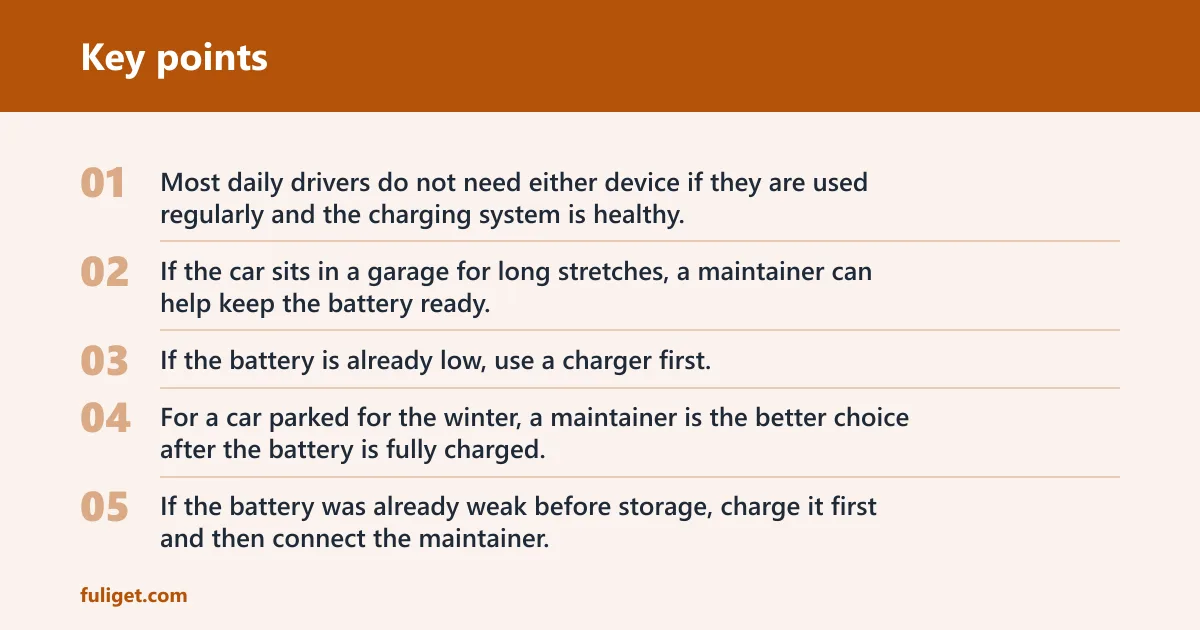
Most daily drivers do not need either device if they are used regularly and the charging system is healthy. If the car sits in a garage for long stretches, a maintainer can help keep the battery ready. If the battery is already low, use a charger first.
Weekend cars
Weekend cars often benefit from a maintainer because they run often enough to stay healthy but not often enough to stay fully topped up all week. A maintainer is usually the better fit if the battery is otherwise sound and the car starts normally after a week or two.
Seasonal storage
For a car parked for the winter, a maintainer is the better choice after the battery is fully charged. If the battery was already weak before storage, charge it first and then connect the maintainer. That keeps the battery from sitting in a low state where sulphation can build.
Fleet or classic cars
Fleet vehicles often need chargers more than maintainers because short trips leave them undercharged. Classic cars usually need both in sequence: charger first for recovery, maintainer later for storage. A maintainer alone is fine only when the battery starts the storage period in good shape.
Can I use one on AGM or lithium batteries?
Yes, but only if the device matches the chemistry. AGM batteries need a compatible charge profile, and lithium car batteries need lithium mode. Not every maintainer can do that correctly, so the label matters more than the type name on the box.
AGM battery compatibility
AGM batteries use absorbed glass mat construction and often appear in start-stop vehicles and premium cars. They need the right voltage profile, especially during charging. A smart charger with an AGM setting is the safer choice when the battery is low or dead.
Lithium battery mode
Lithium car batteries are not charged the same way as standard 12V lead-acid batteries. A charger or maintainer needs lithium mode and the right voltage profile. If it does not list lithium support, do not assume it is suitable.
Why chemistry matching matters
A standard flooded lead-acid battery, an AGM battery, and a gel battery do not always want the same charge limits. Using the wrong mode can reduce performance or shorten battery life. With lithium, the mismatch can be more serious, so the safe rule is simple: match the device to the battery label.
-
Read the battery label. Look for flooded, AGM, gel, or lithium on the case or vehicle documentation. Match the charger or maintainer mode to that chemistry.
-
Check the amp range. Choose low amps for storage and higher amps for recovery. A 1A to 2A maintainer is typical for storage, while 4A to 10A is common for normal recovery on many cars.
-
Verify smart features. Look for automatic stage control, reverse-polarity protection, and overheat protection. Those features matter more than an old “trickle” label.
Choose Battery charger if… / Choose maintainer if…
Choose Battery charger if the battery is already low, the car has been jump-started, or you need to recover a battery after a discharge event. Choose maintainer if the battery is healthy, the vehicle will sit for weeks or months, and your goal is to prevent self-discharge rather than fix a dead battery.
Choose Battery charger if…
- The battery is below about 12.4 volts at rest.
- The engine cranks slowly or not at all.
- The battery has been deeply discharged by lights, accessories, or a parasitic drain.
- You need faster recovery before driving again.
Choose maintainer if…
- The battery is already fully charged.
- The car sits unused for weeks or months.
- You want to keep a stored battery ready without overcharging it.
- The vehicle starts normally after storage but loses charge while parked.
A common first-timer mistake is buying a low-current device for a dead battery. Say your SUV sits for a month, then fails to crank after a door light stayed on overnight. That needs a charger first, then a maintainer later if the parking pattern continues.
Frequently asked questions
Do I need a battery charger or a battery maintainer for my car?
If the battery is low, choose a charger. If the battery is already charged and the car will sit unused, choose a maintainer. If you are unsure, check resting voltage: below about 12.4 volts usually points to charging first.
Can a battery maintainer charge a dead battery?
Usually not. A maintainer is meant to hold a charged battery, not recover a flat one. Some smart models may top off a slightly low battery, but a deeply discharged battery needs a charger before maintenance makes sense.
How long can I leave a battery maintainer connected?
Most maintainers are designed for weeks or months of connection, as long as the battery is compatible and the unit is automatic. That said, you should still check the manufacturer instructions and battery condition. A failing battery or a vehicle with parasitic drain needs attention, not endless maintenance.
Will a battery charger overcharge my car battery?
A smart battery charger should not overcharge a healthy battery because it switches to absorption and then float, or stops when full. Old unregulated units are a different matter. Use a smart charger with the correct chemistry setting and do not leave a manual charger connected without monitoring.
Is a trickle charger the same as a battery maintainer?
No. “Trickle charger” is an older term that often refers to a simple low-current charger, and some versions are not well regulated. A modern maintainer is usually smart, automatic, and designed to hold a battery at float voltage without pushing it too far.
Which one is better for a car that sits unused for weeks?
A maintainer is usually better if the battery is already healthy. It is built for long storage and keeps the battery ready without constant charging. If the battery has already gone low before storage, charge it first, then switch to a maintainer.
Can I use a battery maintainer on AGM or lithium batteries?
Only if the maintainer supports that chemistry. AGM batteries need the right charging profile, and lithium batteries need lithium mode. If the unit does not list the correct mode, use a charger or maintainer that does.
How do I choose the right amp rating for a charger or maintainer?
Use low amps for maintenance and higher amps for recovery. A 1A to 2A maintainer is typical for storage, while chargers in the 4A to 10A range fit many car-battery recovery jobs. Larger batteries or faster turnaround may call for 15A or more, but only if the chemistry and vehicle manual allow it.