Tire Pressure Gauge: How to Choose the Right One

Choose by use and storage: digital for easier readings, dial for at-home inflator precision, and stick for glove-box durability in heat; for most cars, a gauge rated to around 60 psi with claimed accuracy of about ±1 psi or better is a practical choice. Pick the wrong type and you can misread pressure, wear tires faster, lose fuel economy, and make roadside top-offs more frustrating. This guide compares gauge types, accuracy claims, readability, valve-head fit, battery and seal issues, and price so you can buy the right one.
The main trade-off is simple: the best accuracy claim on the package is a poor deal if you cannot read the gauge fast, seal it cleanly on the Schrader valve, or trust it after months in a glove box. Type matters, but the usual failure point matters more. A dead battery, tiny scale, leaking chuck, cracked housing, or cold-slowed display can ruin a reading faster than any printed spec.
Check tire pressure once a month. Consumer Reports says to check after the tires have cooled, usually after the car has been parked for 3 hours or more, and to use the pressure listed on the driver’s doorjamb placard, not the number molded into the tire sidewall, as your target. (Consumerreports)
Gauge choice decision matrix
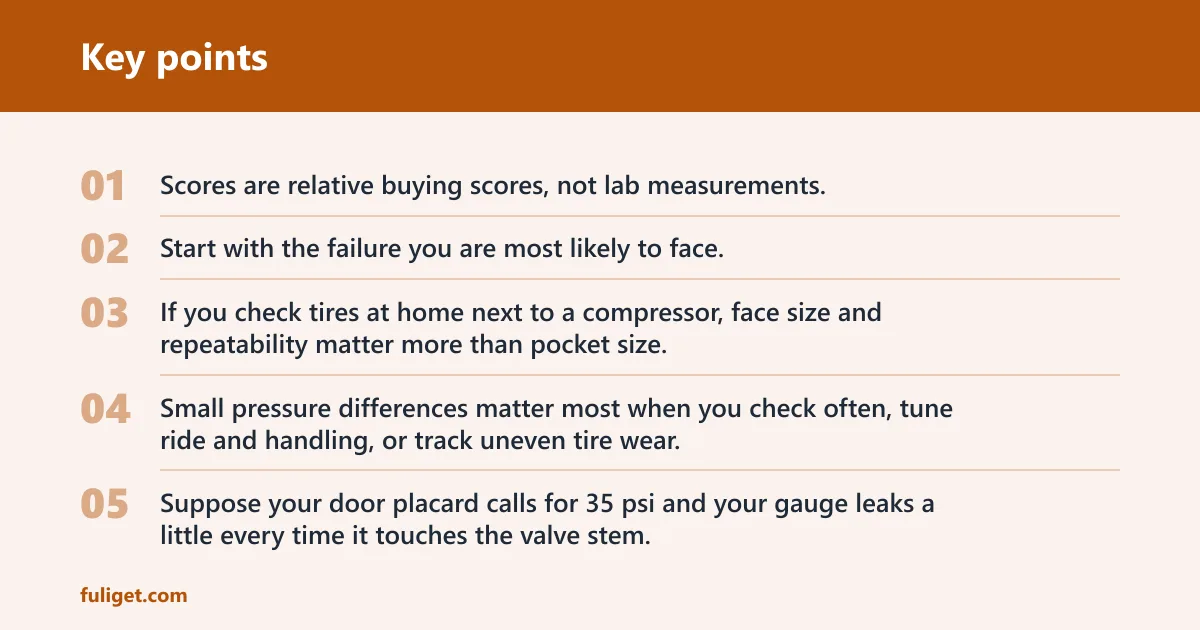
This table compares stick, dial, and digital gauges on the buying points that change real results: accuracy you can trust, readability in cold or dim conditions, drop tolerance, storage fit, and who each type suits best. Scores are relative buying scores, not lab measurements.
| Gauge type | Accuracy | Cold-weather readability | Battery dependence | Drop resistance | Glove-box friendliness | Low-light use | Price | Best-fit user scenario | Recommendation by driver type |
|---|---|---|---|---|---|---|---|---|---|
| Stick (pencil) | Fair to good; varies a lot by build and repeatability | Weak; small markings are hard to read with cold hands | None; mechanical, no battery | Usually good if simple metal body; fewer parts to crack | Excellent; slim, light, easy to stash | Poor; no lighting and tiny scale | Often less than $10 | Emergency kit, spare glove-box gauge, occasional checks in daylight | Commuter: good backup; road-tripper: backup only; enthusiast: usually no; occasional user: yes if budget and simplicity matter most |
| Dial | Good to very good; premium models can be more precise and easier to use | Good; larger face helps, though fogging or poor contrast can hurt | None; analog, no battery required | Fair to good; face and pointer can suffer from drops | Fair; bulkier than stick, better in a trunk kit or toolbox | Fair; visible under a flashlight, but not self-lit | About $25 to $100 for premium models | Frequent checks, garage use, enthusiasts, compressor-side use | Commuter: good at home; road-tripper: fine in trunk; enthusiast: best match; occasional user: only if easier analog reading matters more than size |
| Digital | Generally very accurate | Good to very good if the screen stays responsive in cold storage | Yes; battery condition is the weak point | Fair; electronics and screen are vulnerable to impacts | Good; compact, but battery access matters | Excellent; easiest to read in dim light | About $7 to $30 | Routine car checks, low-light roadside use, drivers who want fast readings | Commuter: best all-around; road-tripper: strong choice if battery is fresh; enthusiast: good secondary gauge; occasional user: good if stored indoors and checked before trips |
How to read the matrix
Start with the failure you are most likely to face. If the gauge will live in a hot or freezing glove box, battery dependence and storage damage matter more than a long feature list. If you check tires at home next to a compressor, face size and repeatability matter more than pocket size.
Where accuracy matters most
Small pressure differences matter most when you check often, tune ride and handling, or track uneven tire wear. For a driver who only wants to keep a family car near placard pressure, a gauge that is easy to read and seals cleanly is often a better buy than a fussy one with a tighter claimed tolerance.
Suppose your door placard calls for 35 psi and your gauge leaks a little every time it touches the valve stem. The reading may jump between 33 and 36 psi even if the tire started steady. That is a seal problem, not a tire problem.
Should you buy stick, dial, or digital?
Buy stick if you want the smallest gauge, need battery-free operation, or plan to leave it in a glove box full time, dial if you check pressures often at home and want an easier analog read, and digital if you want the fastest, clearest reading in normal use. The best choice depends less on the label and more on storage, lighting, and how often you check.
Stick gauge: smallest and cheapest, with readability limits
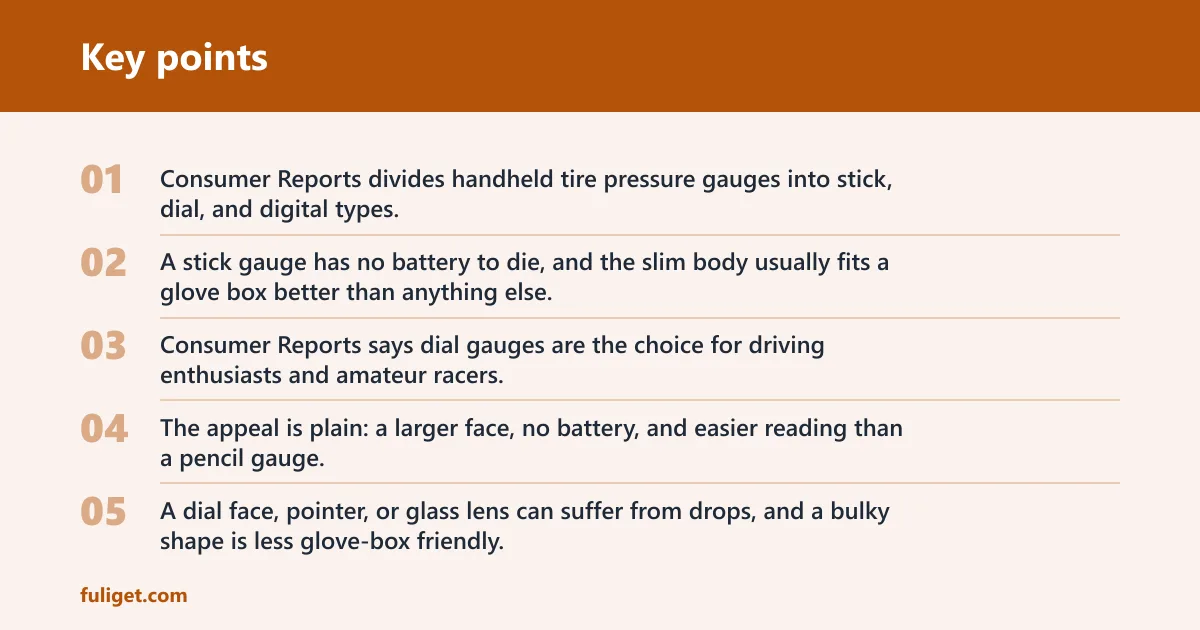
Consumer Reports divides handheld tire pressure gauges into stick, dial, and digital types. It says stick gauges can be hard to read and finicky to use, and that they are the cheapest type, often costing less than $10. That explains their role: small, mechanical, inexpensive, and easy to leave in the car.
A stick gauge has no battery to die, and the slim body usually fits a glove box better than anything else. The downside is scale spacing. On many stick gauges, a small pressure change barely moves the rule, so reading it in low light or with aging eyes can be frustrating.
Dial gauge: easier analog reading without batteries
The same source says dial gauges are the choice for driving enthusiasts and amateur racers. The appeal is plain: a larger face, no battery, and easier reading than a pencil gauge. Premium dial gauges commonly run about $25 to $100, and some justify that price with better chuck design, hose layout, and cleaner graduations.
The weak points are size and impact risk. A dial face, pointer, or glass lens can suffer from drops, and a bulky shape is less glove-box friendly. Many drivers are better off keeping a dial gauge in a garage toolbox or next to a home air compressor.
Digital gauge: fast display, battery dependence, and low-light strengths
The same source says digital gauges are generally very accurate and easy to read, with common pricing around $7 to $30. For many car owners, that is the value sweet spot. The screen gives a direct number instead of a tiny scale or needle estimate, and some screens are easier to read in dim light.
Battery dependence is the trade-off. A gauge that sits untouched through several seasons may greet you with a dead cell on a cold shoulder. Battery-door quality matters too, because a loose cover can turn a minor drop into a dead gauge.
Is a digital gauge more accurate than an analog one?
Sometimes, but not automatically. In handheld gauges, real accuracy varies more by build quality, calibration stability, storage conditions, and repeatability than by digital versus analog alone. A readable digital gauge can cut user error, yet a well-made dial gauge may stay more dependable after long storage because it has no battery.
Why accuracy varies more by build than by type
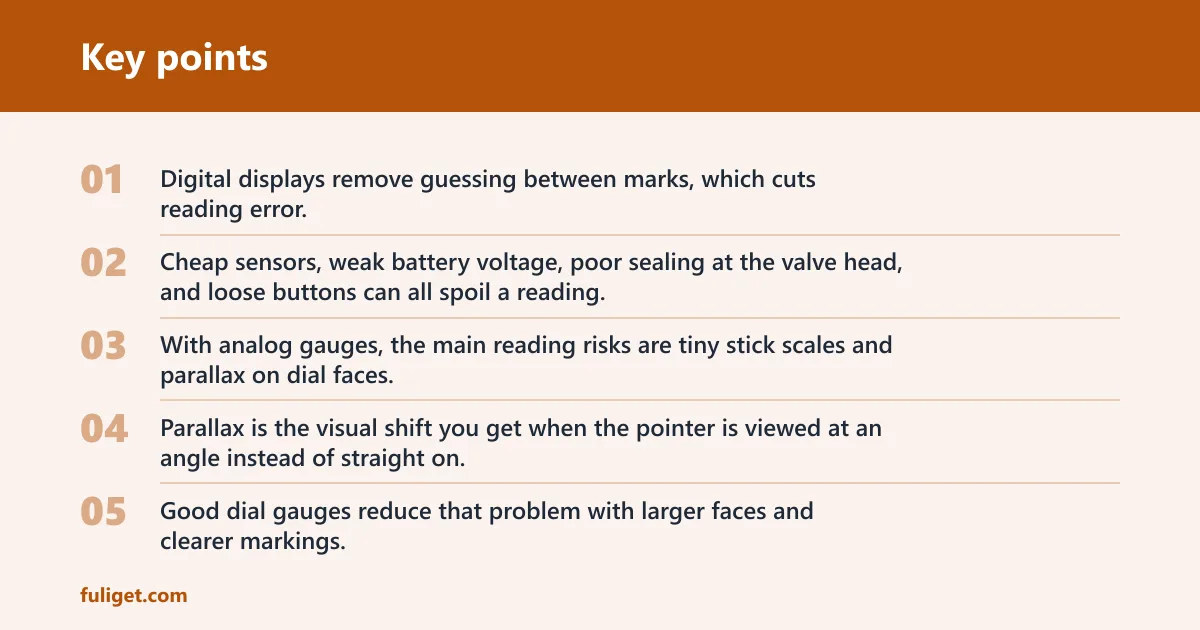
Digital displays remove guessing between marks, which cuts reading error. That does not mean every digital unit is better than every dial or stick gauge. Cheap sensors, weak battery voltage, poor sealing at the valve head, and loose buttons can all spoil a reading.
With analog gauges, the main reading risks are tiny stick scales and parallax on dial faces. Parallax is the visual shift you get when the pointer is viewed at an angle instead of straight on. Good dial gauges reduce that problem with larger faces and clearer markings.
How temperature and storage can shift readings
The same source notes that tire pressure often drops in cooler weather. That affects the tire itself, but storage conditions can also affect the gauge. A gauge left in a freezing car may be harder to read, slower to respond, or less consistent until it warms. A gauge baked in a glove box all summer may also drift or age faster.
Picture a digital gauge stored in a trunk through a cold snap. The tire pressure is lower because ambient temperature dropped, and the display may also refresh slowly with cold batteries. That combination can make a routine check feel like a bad sensor when the issue is storage and temperature.
When small PSI differences matter most
They matter more when the tire’s target pressure is narrow, when the driver checks often, or when uneven wear is already showing. They also matter more in lower-pressure applications because wide scale spacing is easier to read there than compressed markings on a gauge built mainly around higher passenger-car ranges.
Check the gauge’s pressure range before buying. For most cars, a gauge rated to around 60 psi makes sense because the useful part of the scale stays focused on normal road-car pressures. If the gauge tries to cover a much wider range, the fine spacing around everyday car pressures can get harder to read.
Which gauge is easiest to read and seal correctly?
Digital gauges are often easiest to read, especially in dim light, while dial gauges are a common battery-free option for seeing a clear value. But readability is only half the job. A gauge must also seal squarely on the Schrader valve, or hissing air and a stiff chuck will spoil the result.
Scale size, parallax, and backlighting
Stick gauges ask the most from you. The same source says they can be hard to read, and the reason is simple: the scale is small, and the reading can disappear in glare or shadow. Dial gauges improve visibility with a larger face, but you still need to look straight at the needle.
Digital gauges usually win in low light because the number is direct, and some screens are lit. That matters on a pre-dawn commute or when checking a spare on the roadside. It matters less in a bright garage beside a compressor.
Cold-weather and low-light usability
Cold hands make a tiny stick gauge harder to align and read. Dial gauges avoid battery worries in winter, but the face still needs enough contrast. Digital screens are often the easiest to see in dim conditions, yet they depend on batteries that may perform worse after long cold storage.
Valve stem fit, chuck design, and avoiding air loss
The chuck is where many cheap gauges disappoint. A good chuck seats squarely on the Schrader valve, seals fast, and releases cleanly. A bad one hisses, needs awkward pressure to hold, and gives inconsistent numbers because some air escapes during the reading.
Inspect the head shape before buying if possible. A larger head you can grip easily is often easier to square up on recessed stems, but a compact straight head may fit tighter wheel openings better. Neither is right for every wheel, because wheel design changes the answer.
A common first-timer mistake is blaming the gauge type when the real issue is valve-head fit. If the gauge gives one number, then another 2 psi lower on the same cold tire, and each attempt includes a brief hiss, the seal is poor. Replace the gauge or change technique before adjusting pressure.
Will it survive glove-box storage and drops?
Stick gauges usually tolerate glove-box life best because they are simple and battery-free. Dial gauges handle long storage well but can suffer impact damage. Digital gauges are convenient in daily use, yet their weak points are dead batteries, cracked screens, and battery-door failures after months of heat, cold, and bouncing around.
Heat, cold, and long-term in-car storage
In-car storage is harsh. Temperatures swing, small tools roll around, and pressure checks may happen only occasionally. That environment favors mechanical simplicity. A stick gauge can sit for months and still work, provided the scale stays legible and the chuck still seals.
Digital gauges are better if you will maintain them: check battery condition before trips, keep the contacts clean, and avoid leaving them loose under heavy items. For many drivers, the best compromise is a digital gauge in the house and a stick gauge in the car as backup.
Drop resistance and what usually fails first
With stick gauges, drops usually matter less unless the body bends or the sliding rule sticks. With dial gauges, the face, needle, or lens is the concern. With digital gauges, impact can crack the housing, shift the battery, or damage the sensor electronics.
Cheap gauges of any type can also lose accuracy over time. That is why repeatability matters so much. A gauge that reads the same tire nearly the same way on repeated checks is usually more useful than one with a great printed claim but erratic real use.
When battery dependence becomes the weak point
Battery dependence matters most for occasional users and emergency kits. A commuter who checks monthly may notice a weak digital gauge before it fully fails. A roadside kit that sits untouched for a year may not get that warning. If the gauge will mostly wait in the trunk, mechanical designs deserve extra credit.
How much should you spend on a good tire pressure gauge?
Spend according to reading difficulty and failure risk, not status. Under $10 buys compact, battery-free simplicity but usually gives up readability. The $7 to $30 digital band is often the value leader for everyday car owners. The $25 to $100 dial band makes sense when you check often and want better control without batteries.
Under $10: what you gain and give up
This range usually means stick gauges. You gain small size, mechanical operation, and low replacement cost. You give up a lot in visibility and ease of sealing, and Consumer Reports notes that stick gauges can be finicky to use.
$7 to $30 digital range: where value is strongest
The same source puts digital gauges in the $7 to $30 range, and that span covers many sensible everyday buys. If you check pressure monthly, want a direct display, and sometimes work in dim light, this is often the smartest place to start. Battery access and chuck quality matter more than extras.
$25 to $100 dial range: when paying more makes sense
The same source says premium dial gauges can cost $25 to $100 and are favored by enthusiasts and amateur racers. That extra cost can buy a bigger, cleaner face, better chuck feel, hose flexibility, and more consistent repeat readings. It makes less sense for a driver who only checks pressures a few times a year.
How to get an accurate tire pressure reading
An accurate reading starts with a cold tire, a straight seal on the valve stem, and a single, clean press until the hiss stops. Those small details matter because even a slightly crooked gauge or a delayed reading can throw off your PSI and lead to poor handling, uneven wear, or wasted fuel. The gauge setup guide breaks down the simple steps for checking pressure at home or at a gas station, including when to check, how to seat the gauge, and how to read the number correctly.
It also covers common mistakes, like checking warm tires or adding air too quickly, so you can make faster, more reliable pressure checks before long trips and as part of a monthly routine.
How do you know the reading is right?
Use the tire pressure listed on the driver’s doorjamb placard, measure only when tires are cold, and compare your gauge against a known reference when possible. The right reading is more than a number on the display. It is a repeatable number taken at the right time and matched to the correct target.
Use the door placard, not the tire sidewall
The same source recommends using the pressure listed on the placard on the driver’s doorjamb, not the maximum-pressure figure molded into the tire sidewall. The sidewall shows the tire’s maximum pressure, not the normal operating target for your vehicle. The placard is usually on the driver’s doorjamb.
Check pressure when tires are cold
The same source says to check after tires have cooled, typically after sitting parked 3 hours or more. Driving raises pressure temporarily, so checking right after a trip can make a healthy tire look overinflated. Cold pressure means the tire is at ambient temperature, not warmed by recent driving.
Compare against a reference and look for repeatability
- Find the correct target. Read the pressure on the driver’s doorjamb placard before touching the gauge. This prevents the common mistake of inflating to the tire sidewall number instead of the vehicle setting.
- Let the tires cool. Check after the car has sat parked 3 hours or more. Cold readings are more useful because recent driving raises pressure for a while.
- Take two readings. Press the gauge straight onto the Schrader valve, then repeat once on the same tire. If the numbers differ by more than a small amount, suspect technique or a poor chuck seal before adjusting air.
- Compare with a reference. When possible, compare your gauge against a known reference gauge or calibrated air source. The goal is not perfection; it is knowing whether your gauge reads consistently close and repeats well.
- Watch for patterns. If every tire reads oddly high or low compared with the reference, the gauge may be off. If only one tire changes between repeated checks, inspect the valve stem connection and your alignment on the valve.
Choose stick if… / Choose dial if… / Choose digital if…
Choose stick if…
- You want a battery-free gauge that can live in a glove box year-round.
- You need the smallest, cheapest option and accept harder reading.
- You want a backup gauge in an emergency kit.
- You usually check pressure in daylight and do not care about quick low-light use.
Choose dial if…
- You check pressures often and want easier reading without batteries.
- You keep the gauge in a garage, trunk kit, or with a home compressor rather than loose in a glove box.
- You care about small pressure changes and want cleaner analog graduations.
- You are an enthusiast or frequent DIY driver who values repeatability and chuck feel.
Choose digital if…
- You want the fastest, clearest reading for routine monthly checks.
- You often check pressure in low light or before early drives.
- You want strong value in the usual $7 to $30 range.
- You are willing to manage the battery and avoid long neglect in an emergency-only kit.
Say your car is used for a long highway commute and pressure checks happen in the driveway before sunrise. A digital gauge fits that use because the direct display is easier to read quickly, and the cost is modest. Keep a cheap stick gauge in the glove box as backup if dead-battery risk worries you.
Picture a weekend driver with a compressor in the garage who checks pressures before every long trip and after seasonal weather swings. A dial gauge is usually the better fit because it avoids battery dependence, offers an easier analog read than a stick gauge, and is less likely to be forgotten in a hot car.
Frequently asked questions
Which tire pressure gauge is best for my car?
For most cars, a digital gauge rated to 60 psi with claimed accuracy of ±1 psi or better is the easiest all-around choice. If the gauge will live in the car full time, a stick gauge is a better backup. If you check often at home, a dial gauge is the best battery-free upgrade.
Is a digital tire pressure gauge more accurate than an analog one?
Often, but not by rule. The same source says digital gauges are generally very accurate and easy to read, yet real-world results still depend on build quality, battery condition, valve-head sealing, and repeatability. A well-made dial gauge can beat a cheap digital one if it seals better and stays consistent.
Should I buy a stick, dial, or digital tire pressure gauge?
Buy by failure mode. Choose stick for glove-box durability and price, dial for frequent home checks and clearer battery-free reading, and digital for quick, low-light use. Consumer Reports divides handheld gauges into those three types, but matching storage and use matters more than buying by type name alone.
Do tire pressure gauges need batteries?
No. Stick and dial gauges are mechanical and do not need batteries. Digital gauges do, and that is their main weakness in emergency kits or long glove-box storage. If low-light readability matters but battery failure worries you, keep a digital gauge at home and a simple stick gauge in the car.
Can I use the tire sidewall pressure as my target?
No. Use the driver’s doorjamb placard. The same source says to use the car door placard, not the tire sidewall, for correct pressure. The sidewall lists the tire’s maximum pressure, which is not the normal setting for your vehicle’s ride, handling, and tire wear.