
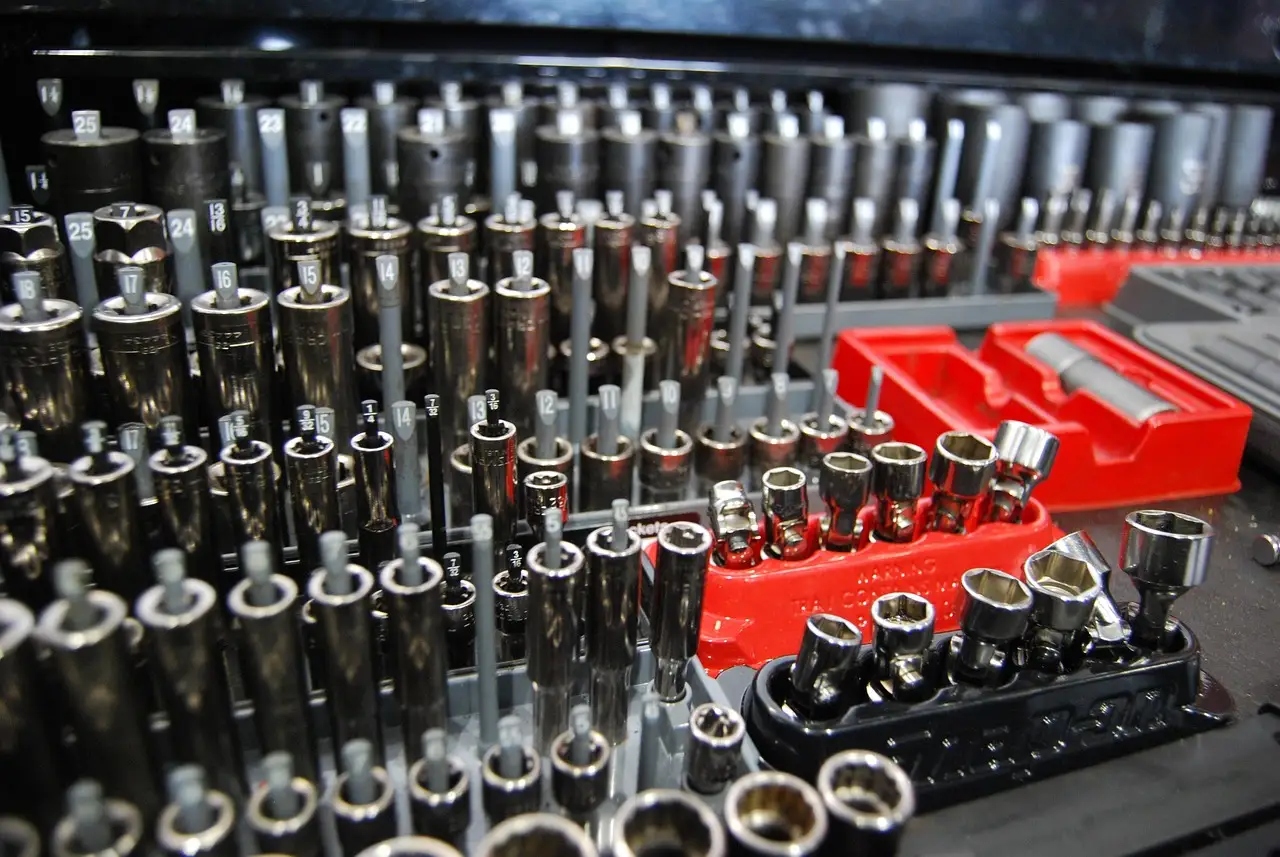
SAE vs Metric Socket Set: Which Does Your Car Need?

Many cars use metric sockets only. Buy SAE only if your vehicle has older American hardware, aftermarket parts, or inch-size fasteners marked in fractions. Pick wrong and you waste money, strip bolts with the wrong fit, or get stuck mid-repair. This guide shows how to identify the fasteners you will touch first and choose the smallest starter socket set that covers them.
| Decision factor | SAE | metric socket set | Winner |
|---|---|---|---|
| Fit on most modern cars | Usually wrong for late-model vehicle fasteners | Standard on nearly all modern vehicles | metric socket set |
| Fit on older American cars | Often the correct system on pre-2000s GM, Ford, and Chrysler vehicles | May appear on mixed repairs, but is not the first guess | SAE |
| Common sizes you will actually reach first | 1/4 inch to 3/4 inch, with 3/8 inch especially common on older US equipment | 8mm to 19mm, with 10mm and 13mm especially common | metric socket set |
| Chance of confusion with nearby sizes | Close to metric sizes like 10 mm and 13 mm, which invites mistakes | Close to SAE sizes like 3/8 inch and 1/2 inch, which also invites mistakes | tie |
| Best first buy for an uncertain garage | Useful, but too narrow if the car is modern and metric-heavy | Better starter choice for most DIY car owners | metric socket set |
Metric vs SAE at a glance
SAE sockets use inch fractions. Metric sockets use millimeters. That single difference drives most buying choices, because the wrong socket can feel close enough to start on a bolt head and still damage it.
What SAE means on a socket rail
SAE sizing uses inch fractions such as 1/4 inch, 3/8 inch, 1/2 inch, and 3/4 inch. On older American vehicles and many hardware items, that is the system to look for first.
What metric means on a socket rail
Metric sizing uses millimeters such as 8 mm, 10 mm, 13 mm, 17 mm, and 19 mm. Metric sockets are standard on nearly all modern vehicles, and the 10 mm socket is one of the most-used sizes on many cars.
Why close sizes matter
A 1/2 inch socket equals 12.7 mm across the same measurement, so it can seem close to 13 mm. A 3/8 inch socket is 9.53 mm, which is close to 10 mm. Close is not enough. A socket should seat with almost no play; wobble means the fit is wrong and can round the fastener.
Which socket system does your car use?
Most modern cars use metric fasteners, so metric is the default for late-model passenger vehicles. Older American cars may still use SAE, especially on some pre-1980s to pre-2000s GM, Ford, and Chrysler models. Some modern American trucks can still involve both systems on the same repair, especially when replacement parts or accessories are involved.
Modern cars and why metric is the default
If you drive a late-model sedan, crossover, or compact SUV, start with metric. Common automotive sizes run from 8 mm to 19 mm, and under-hood work often starts with 10 mm, 13 mm, and 17 mm.
Older American cars and why SAE still matters
If you work on a pre-2000s domestic car, SAE is a real possibility. Many of those vehicles can still have inch-based fasteners, though mixed hardware still shows up depending on the part, repair, or previous owner changes. In those cases, the inch sizes deserve a real place in the drawer.
When modern American trucks need both
Some repairs on modern American trucks can involve both metric and SAE fasteners. That is the kind of platform where both systems can appear on the same repair, especially with body, brake, hitch, or accessory work. Jeep, Chevy, and Ram models can do the same.
Car check socket table
Check the first fasteners you are likely to remove, not the sizes you think the car should have. That keeps you from overbuying a full set before you know what the vehicle actually uses.
| Vehicle type | Likely socket system | First 5 fastener sizes to verify on the car | When to buy a second set |
|---|---|---|---|
| Late-model car or crossover | Metric | Battery clamp, bracket, trim, drain plug, lug nut | Buy SAE only if a service part or accessory uses inch sizes |
| Older American car | SAE-heavy | Battery clamp, bracket, carburetor or intake hardware, suspension bolt, lug nut | Buy metric if replacement parts or prior repairs introduce millimeter fasteners |
| Modern American truck | Mixed metric and SAE | Battery terminal, body bracket, lug nut, hitch hardware, suspension bolt | Buy the second set once two or more repair points call for the other system |
| Trailer, hitch, or accessory-equipped vehicle | Often mixed | Mounting bolts, bracket hardware, light kit fasteners, lug nut, accessory clamp | Buy both if the trailer or accessory uses inch hardware on a metric vehicle |
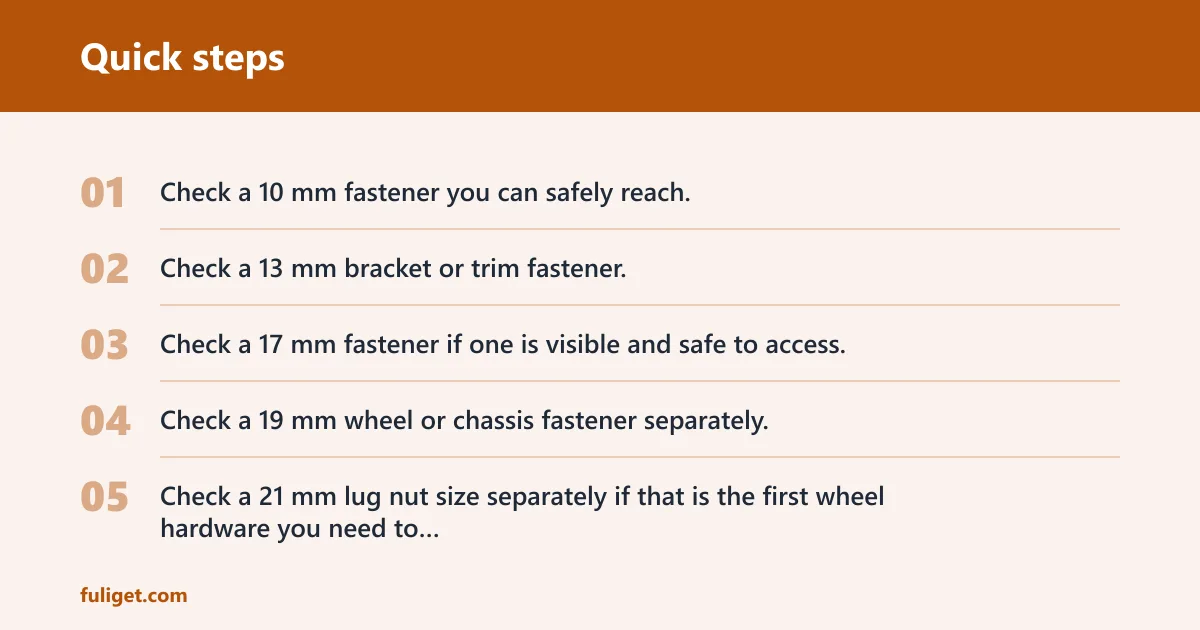
- Check a 10 mm fastener you can safely reach.
- Check a 13 mm bracket or trim fastener.
- Check a 17 mm fastener if one is visible and safe to access.
- Check a 19 mm wheel or chassis fastener separately.
- Check a 21 mm lug nut size separately if that is the first wheel hardware you need to verify.
Can you mix close sizes without damage?
No. Close sizes are where people round bolts. A 13 mm socket on a 1/2 inch fastener can be loose enough to slip under load, and a 1/2 inch socket can feel deceptively close to 13 mm. The same warning applies to 3/8 inch and 10 mm.
10 mm vs 3/8 inch
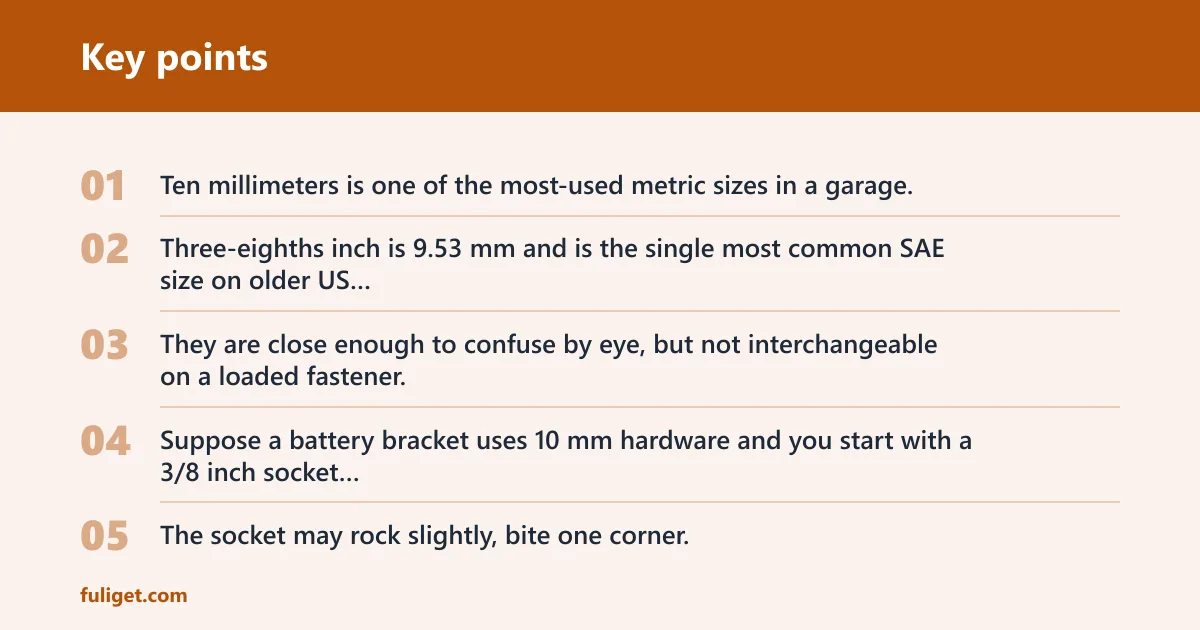
Ten millimeters is one of the most-used metric sizes in a garage. Three-eighths inch is 9.53 mm and is the single most common SAE size on older US equipment. They are close enough to confuse by eye, but not interchangeable on a loaded fastener.
Suppose a battery bracket uses 10 mm hardware and you start with a 3/8 inch socket because it almost fits. The socket may rock slightly, bite one corner, and leave the bolt head scarred before the fastener loosens. That is the wrong kind of near match.
13 mm vs 1/2 inch
Thirteen millimeters is common on general chassis hardware. A 1/2 inch socket equals 12.7 mm, so it can seem like a safe substitute. It is not. That small gap is enough to slip under torque and round the head.
A common first-timer mistake is reaching for the closest socket on a suspension bracket because the sizes sound nearly identical. If the socket rocks, stop and switch to the exact size. The right one should seat with almost no play.
How wobble leads to rounded fasteners
Wobble is the test that matters. If the socket can tilt on the fastener, the walls are not fully supporting the head, and torque will concentrate on the edges. Once those edges deform, later removal becomes slower and more expensive.
Choose SAE if… / Choose metric socket set if…
Choose the system that matches the first fasteners you plan to remove, then buy the smallest set that covers those exact sizes. For most DIY car owners, that means metric first. SAE becomes the right pick when the vehicle, trailer, or accessory hardware is inch-based.
Choose SAE if…
Choose SAE if you work mainly on older American cars. Choose SAE if the service information calls out inch fractions, or if your first checks reveal 3/8 inch, 1/2 inch, or 3/4 inch fasteners. Choose SAE first for legacy equipment and many trailer parts.
Choose metric socket set if…
Choose metric socket set if you own a late-model car, crossover, or most imported vehicles. Choose metric if your first checks show 10 mm, 13 mm, 17 mm, or 19 mm hardware. Choose metric first if you want the smallest starter set that covers the most likely car repairs.
What sizes should a starter set include?
Start with the sizes that handle the fasteners you will actually remove, not a giant range you may never touch. For metric, that usually means 8 mm through 19 mm, with extra attention to 10 mm and 13 mm. For SAE, a common starter range is about 1/4 inch through 3/4 inch.
Core metric sizes for routine car work
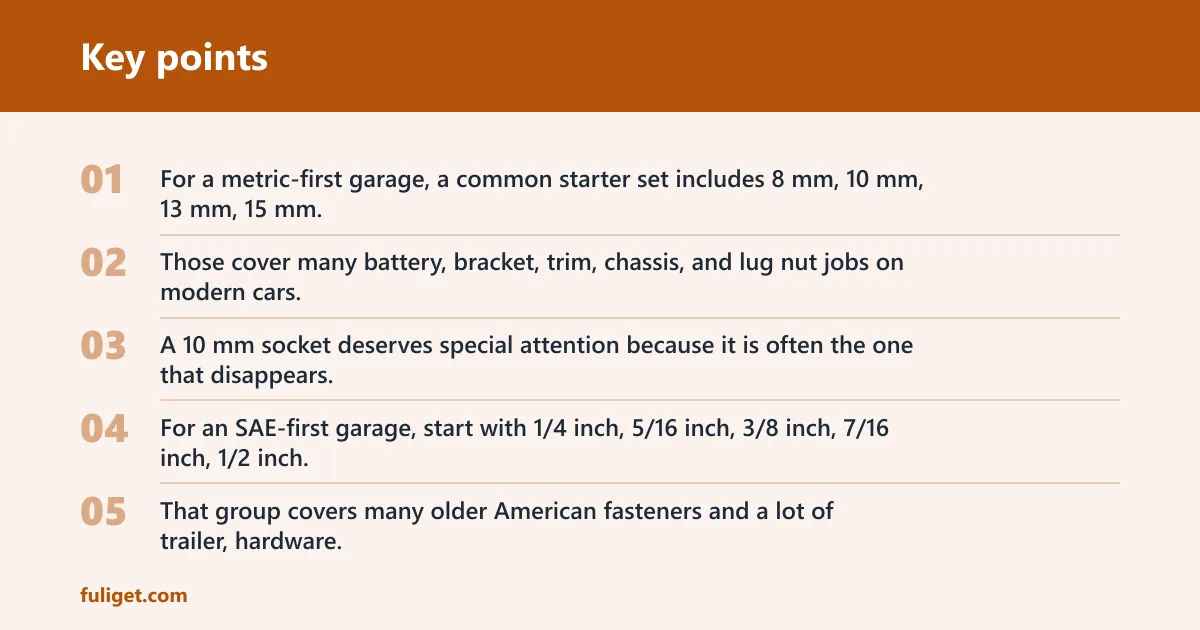
For a metric-first garage, a common starter set includes 8 mm, 10 mm, 13 mm, 15 mm, 17 mm, and 19 mm. Those cover many battery, bracket, trim, chassis, and lug nut jobs on modern cars. A 10 mm socket deserves special attention because it is often the one that disappears.
Core SAE sizes for legacy and accessory work
For an SAE-first garage, start with 1/4 inch, 5/16 inch, 3/8 inch, 7/16 inch, 1/2 inch, 9/16 inch, and 3/4 inch. That group covers many older American fasteners and a lot of trailer, hardware, and accessory work. The 3/8 inch size matters especially on older US equipment.
Why 3/8-inch drive is the best first buy
For most DIY work, a 3/8-inch drive socket set is the best first purchase because it balances reach, strength, and everyday usefulness. It is the most practical size for general car maintenance, even if you later add 1/4-inch or 1/2-inch drive tools for small trim work or high-torque fasteners.
What the service manual tells you
The service manual or manufacturer service information is the best reference for exact fastener sizes. If the car’s hardware is mixed, modified, or repaired with aftermarket parts, that source beats assumptions every time.
Owner’s manual versus service information
The owner’s manual may help with wheel and fluid basics, but service information is where fastener sizes are usually confirmed. Use it when you need a size for a bracket, drain plug, suspension bolt, or special hardware location. That is especially useful on transition-era vehicles.
How to confirm lug nut and bracket sizes
Lug nuts are a special case. Many vehicles use 17 mm, 19 mm, or 21 mm, depending on make and model, and those sizes should be checked separately from smaller under-hood fasteners. Do not assume the wheel hardware matches the battery bracket or trim bolts.
Frequently asked questions
Do I need metric or SAE sockets for my car?
Most cars need metric sockets only, especially late-model vehicles. Buy SAE only if your car has older American hardware, inch-marked fasteners, or accessories and repairs that clearly use inch fractions. If you are unsure, check the first fasteners you plan to remove and confirm in the service manual.
What cars use metric sockets only?
Most modern cars use metric fasteners, including many imports and late-model domestic vehicles. If your car is new enough that the common sizes are 8 mm to 19 mm, metric is usually the correct starting point.
What cars still need SAE sockets?
Older American cars still need SAE sockets, especially pre-1980s to pre-2000s GM, Ford, and Chrysler models. Those vehicles often use inch fractions such as 3/8 inch and 1/2 inch. Mixed hardware can still appear, so check the exact fastener before buying only one system.
Can I use a 13mm socket on a 1/2-inch bolt?
Do not treat 13 mm and 1/2 inch as interchangeable. A 1/2 inch socket equals 12.7 mm across the same measurement, and a 13 mm bolt on a 1/2 inch socket can be loose enough to slip under load. That looseness can round the fastener.
Which socket size is closest to 3/8 inch?
3/8 inch is 9.53 mm, so it is closest to 10 mm. That is exactly why the two get mixed up so often on cars and older equipment. They are not interchangeable, and a snug fit matters more than the size sounding close on paper.
Which socket size is closest to 1/2 inch?
1/2 inch equals 12.7 mm, so it is closest to 13 mm. That close match still is not a safe substitute, because the small gap can cause wobble and fastener damage. If the socket rocks at all, switch to the exact size before applying torque.
