Digital vs Analog Tire Pressure Gauge: Which Is Better?

Digital tire pressure gauges are usually the better pick for most drivers because the numbers are easier to read in low light and the readings tend to be easier to compare, while an analog gauge is the safer choice if you want battery-free simplicity and long glovebox storage. A bad gauge can leave tires underinflated or overinflated, which affects handling, wear, and winter traction. This guide compares digital and analog gauges for home use, glove box storage, roadside checks, and cold-weather conditions.
| Factor | Digital | analog tire pressure gauge | Winner |
|---|---|---|---|
| Readability | Easy to read at a glance, often with a backlight | Needs you to read a needle against a dial face | Digital |
| Power | Battery-dependent | Battery-free | analog tire pressure gauge |
| Cold-weather roadside reliability | Can fail if the battery is weak or dead | Works without power in freezing conditions | analog tire pressure gauge |
| Accuracy spec to check | Often lists a published tolerance clearly | Can be accurate if well made, but still depends on the spec | Digital |
| Storage and backup use | Good for the door pocket or console if the battery is maintained | Better for long glovebox storage because there is no battery to age | analog tire pressure gauge |
Readability and reliability trade-offs
Digital usually wins for readability. Analog wins for battery-free reliability. The better choice is the one that still gives a trustworthy reading in your real conditions: cold weather, low light, glovebox storage, and repeat checks.
Readability and night use
Digital gauges are usually easiest to read at night because the number is direct and many are backlit. Analog dials can still work fine, but a dark garage or roadside shoulder makes the needle harder to read cleanly.
That said, readability is not the same thing as measurement quality. A bright display does not fix a poor seal, a drifting mechanism, or a bad battery.
Power and roadside risk
Digital gauges depend on a battery, so they can fail at the exact moment you need them most. That matters if you keep a gauge in the glovebox for emergencies or winter travel.
An analog dial gauge removes that failure mode. For drivers who want a tool that can sit unused for months and still work, battery-free design is a real advantage.
Cold-weather behavior
Cold weather punishes weak batteries. It also makes roadside checks more awkward, which is where a simple battery-free gauge has an edge.
Consumer Reports says to check tire pressure after tires have cooled for about 3 hours or more, and that timing often lines up with overnight cold conditions. In that setting, a gauge that does not depend on electronics is easier to trust.
Price and buying range
The same source says stick gauges can be found for less than $10, dial gauges range from $25 to $100, and digital gauges run from $7 to $30. Motor Advises says good digital gauges cost under $15 and good dial gauges cost about $20 to $40.
Price alone does not decide it. A low-cost digital gauge can still be the better buy than a pricier analog one if it has a clear accuracy spec and a solid seal.
📊 Consumer Reports says digital gauges run from $7 to $30. Source: Consumerreports.
Which gauge should I buy?
Choose the gauge that matches your use case, not the one with the most features. For most daily drivers, digital is the easier pick. For cold roadside use or long glovebox storage, analog tire pressure gauge is the safer default.
| Use case | Readability | Battery risk | Cold-weather reliability | Accuracy tolerance to prioritize | Best gauge type |
|---|---|---|---|---|---|
| Daily driver | High priority, especially in garages and parking lots | Moderate concern | Usually manageable | Published tolerance near ±1 psi or a similar clear spec | Digital |
| Winter/roadside | Useful, but power matters more | High priority | Highest priority | Consistent repeat readings matter more than extra decimals | analog tire pressure gauge |
| Enthusiast/precision | Important for quick repeat checks | Moderate concern | Important if you check early or in a cold garage | Strong published tolerance and repeatability | Digital |
| Backup glovebox | Nice to have | Low risk only if you change batteries on schedule | Very important | Simple, dependable repeatability | analog tire pressure gauge |
Daily driver
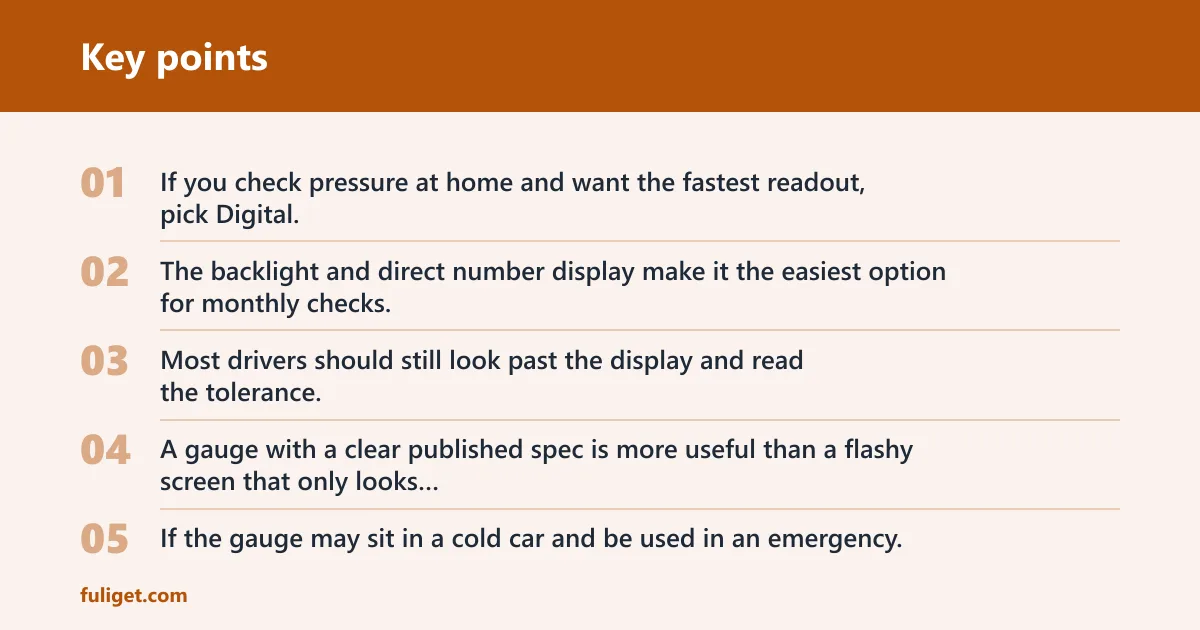
If you check pressure at home and want the fastest readout, pick Digital. The backlight and direct number display make it the easiest option for monthly checks, especially if you inspect tires in dim light or on a busy driveway.
Most drivers should still look past the display and read the tolerance. A gauge with a clear published spec is more useful than a flashy screen that only looks precise.
Winter and roadside
If the gauge may sit in a cold car and be used in an emergency, choose analog tire pressure gauge. Battery-free operation matters more when temperature and storage time can work against electronics.
Suppose a tire looks soft at dawn in a 20°F parking lot. A dead battery turns a digital gauge into dead weight, while an analog dial gauge still gives you a usable reading.
Enthusiast and precision checks
If you want repeatable cold-pressure checks at home, Digital is usually the better fit because it is easier to read quickly and compare against a target. That helps when you are making small adjustments and want less reading error from the person holding the tool.
Just do not confuse resolution with true accuracy. A screen that shows 0.1 psi steps is not automatically more trustworthy than a gauge that shows whole numbers.
Backup glovebox
For a spare that may sit untouched for months, analog tire pressure gauge is the safer option. It avoids battery dependence and is easier to trust after long storage.
A pencil or stick gauge can also work here. The same source says stick gauges can be found for less than $10, and Motor Advises says cheap pencil gauges are the least precise, so keep this choice for backup use rather than fine tuning.
Digital tire pressure gauge
Digital gauges fit the driver who wants quick readability and a clear screen. They are often backlit, which makes them easier to use at night or in a dark garage.
LCD readability and backlight advantages
Digital displays reduce reading guesswork. That helps when you are comparing a tire to the door-jamb placard and want a clean number without squinting at a needle.
Consumer Reports tested 17 stick, dial, and digital tire pressure gauges at room temperature and hot and cold extremes, so display type alone did not settle the question. The better digital units still had to perform under changing conditions. (Consumerreports)
Battery dependence and roadside risk
The main weakness is simple: the battery can fail. That risk matters more if the gauge lives in the glovebox than if it sits on a workbench at home.
If you buy digital, check the battery before long trips and keep a spare if the model uses a common replaceable cell. For roadside readiness, that routine matters as much as the display itself.
Where digital tends to fit best
Digital is the strongest choice for home checks, night use, and drivers who want easy reading without learning a dial face. It is also a good pick when you want a quick double-check after inflating a tire.
The same source says monthly pressure checks are a good habit, and digital makes that routine less annoying. Easy reading often decides whether the check gets done at all.
Analog dial tire pressure gauge
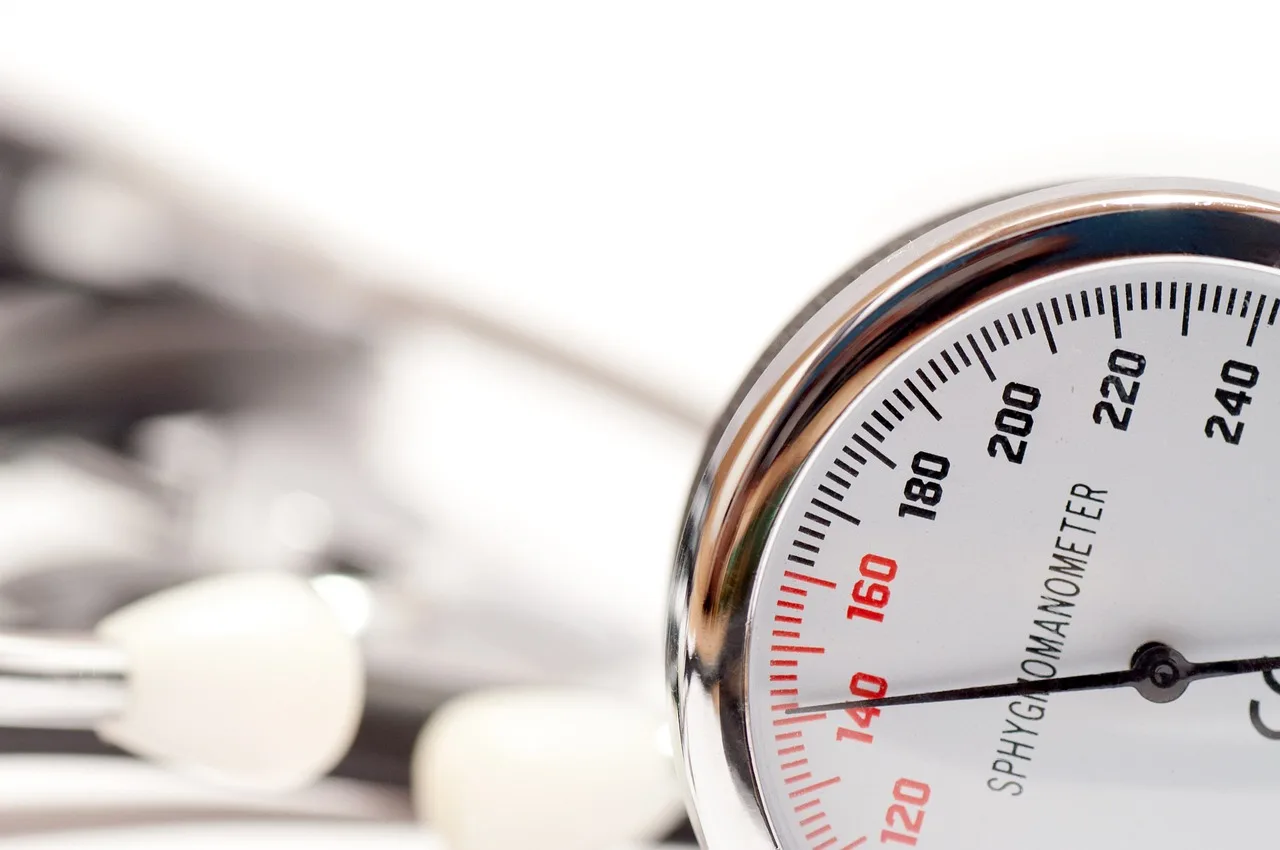
An analog dial gauge uses a needle-and-dial mechanism instead of a screen. Its biggest advantage is that it does not need batteries, which makes it appealing for glovebox storage and cold-weather roadside use.
Battery-free operation
Battery-free design is the strongest reason to buy analog tire pressure gauge. If the tool may sit unused for a long stretch, you do not have to wonder whether the battery is still alive.
That makes it a strong backup tool. It also makes sense for drivers who want a simple device that still works after long storage.
Parallax error and needle drift
Analog gauges can be affected by parallax error if you do not read the needle straight on. They can also drift mechanically over time if the movement gets damaged or worn.
That does not make them bad. It means the seal, the pointer, and the repeat reading matter more than the dial face alone.
Durability, hose fittings, and bleed valves
Some dial gauges include a hose and bleed valve, which can make seating easier and pressure adjustment more controlled. Those features can be useful, but only if the chuck seals well on the valve stem.
Durability still depends on the whole tool, not the style. A rugged-looking dial that leaks at the chuck is still a weak gauge.
Does accuracy depend on the gauge type?
Not by itself. Published accuracy tolerance matters more than whether the gauge is digital or analog, and many consumer gauges of either type can be accurate enough for normal tire checks.
Published tolerance vs display resolution
Accuracy tolerance is the spec to read first. The same source says both types can be accurate to about 1 psi, which is a much more useful buying threshold than a screen that simply shows smaller decimal steps.
Display resolution is only the number the screen can show. A digital gauge that displays 0.1 psi still may not measure that finely in practice.
Why 0.1 psi on a screen can still mislead
A screen can show tiny increments while the sensor, seal, or internal logic is less exact. That means the final number may look precise without being truly better.
For drivers, that difference matters because tire inflation changes in small steps. A gauge that repeats the same cold-tire reading consistently is usually more useful than one that flashes extra decimals.
Typical tolerance targets to look
For everyday use, a clear published tolerance around ±1 psi or a similar spec is a sensible target. If a maker does not state the tolerance, it is harder to judge the gauge against another one.
For home checks, repeatability often matters as much as the printed number. A gauge that reads nearly the same on the same cold tire, time after time, is the one you can trust.
How to know if my tire gauge is reading true
Start with the seal, then repeat the reading, then compare it against another known-good gauge. If the numbers wander or jump after a drop, the gauge should be treated as suspect.
Check the valve-stem seal and square seating
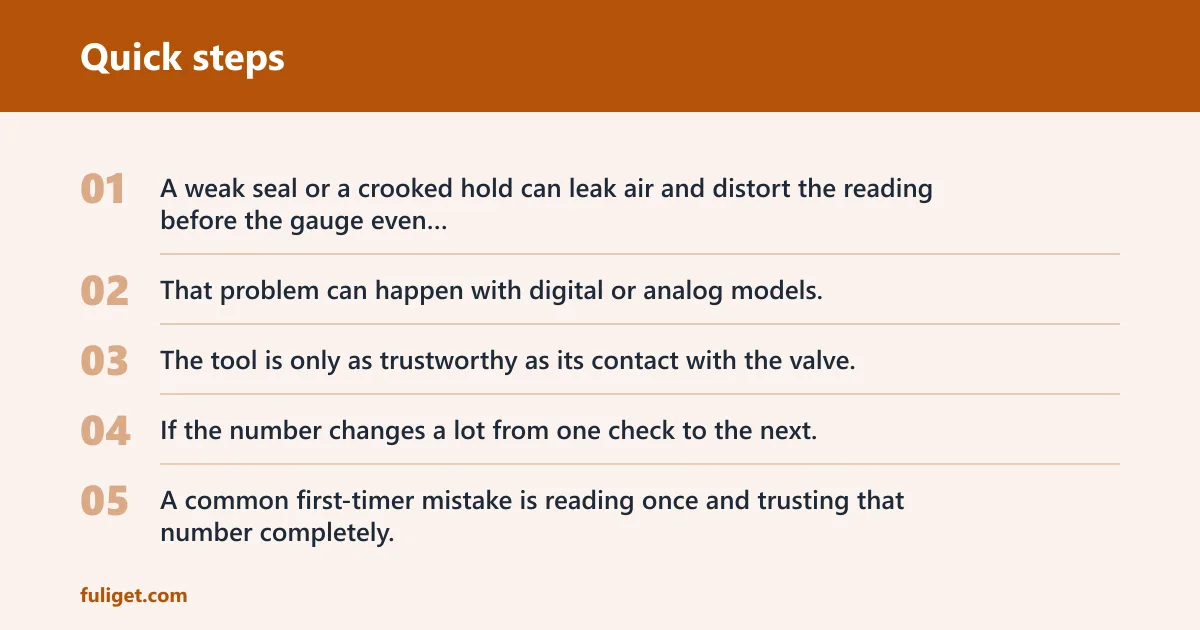
Seat the chuck squarely on the valve stem. A weak seal or a crooked hold can leak air and distort the reading before the gauge even settles.
That problem can happen with digital or analog models. The tool is only as trustworthy as its contact with the valve.
Repeat readings on the same cold tire
Take several readings on the same cold tire. If the number changes a lot from one check to the next, the gauge may be inconsistent or the seal may be poor.
A common first-timer mistake is reading once and trusting that number completely. A second and third reading often tell you more.
Compare against a second good gauge
Use a second gauge that already reads consistently on the same cold tire. If both tools agree closely, confidence goes up; if they disagree, the one that drifts or feels sticky is the one to doubt.
Consumer Reports also assessed durability after a fall from a tabletop, which matters because dropped gauges are more likely to drift or break. If a gauge has been hit hard, compare it before trusting it again.
Replace gauges that were dropped or drift over time
Do not keep using a gauge that gives inconsistent numbers after a drop. Mechanical damage and internal drift can show up as repeat errors long before the tool stops working completely.
That rule applies to cheap and expensive gauges alike. If the reading cannot be repeated, the tool is not doing its job.
Use the gauge on cold tires, read the driver-side door-jamb placard, and ignore the tire sidewall maximum as a target. TPMS is helpful, but it is only a warning system and does not replace manual checks.
- Park the vehicle and let the tires cool for about 3 hours or more.
- Find the tire pressure placard on the driver-side door jamb.
- Compare your reading to that placard, not to the sidewall maximum.
- Press the chuck squarely onto the valve stem.
- Take a second reading if the number seems off.
Cold tires and the placard
Cold tire pressure is the pressure you read after the tires have sat long enough to cool, usually about 3 hours or more. That is the condition the manufacturer uses when setting the recommended PSI on the placard.
The tire sidewall maximum is not the target pressure. The door-jamb placard is the number that matters for your vehicle.
TPMS is a warning system only
TPMS can tell you when pressure drops enough to trigger a warning, but it does not replace monthly manual checks. The same source recommends checking tire pressure once a month.
That manual check is where your gauge choice matters. A readable, repeatable tool is the one you will actually use.
Verdict: Digital or analog tire pressure gauge?
Choose Digital if you want the easiest option for daily driver home checks, especially when you inspect tires in dim light or want a quick readout at night with a backlight.
Choose analog tire pressure gauge if you need a gauge for winter roadside use or backup glovebox storage, because battery-free operation is safer when the tool may sit unused for months in cold conditions.
Frequently asked questions
Are digital or analog tire pressure gauges better?
Digital is better for most drivers because it is easier to read, especially in low light, and often faster for routine checks. analog tire pressure gauge is better when battery-free storage, roadside readiness, or winter use matters more than screen readability.
Which is more accurate, analog or digital tire gauge?
Neither type wins by default. A well-made digital gauge and a well-made analog gauge can both be accurate enough for normal use, so the published tolerance, seal quality, and repeatability matter more than the display style.
Are digital tire pressure gauges more accurate?
Not automatically. A digital display can show smaller decimals, but display resolution is not the same as true accuracy, and a poor seal or weak battery can still spoil the reading.
Should I buy a digital or analog tire pressure gauge?
Buy Digital if you want the easiest reading for home checks, especially at night. Buy analog tire pressure gauge if you want a battery-free tool for glovebox storage, winter travel, or roadside backup.
Do tire pressure gauges lose accuracy over time?
Yes, they can. Dropping a gauge, wearing out the chuck, or letting the mechanism drift can change repeat readings, so compare it against a second good gauge if the numbers start to look inconsistent.
What matters more than gauge type for accuracy?
Published accuracy tolerance matters more than digital versus analog. Seal quality, square seating on the valve stem, and repeat readings on the same cold tire matter too, because a bad seal can distort any gauge type.