
Tool Roll Bag vs Tool Roll Up Pouch: What Is the Difference?

A tool roll bag is usually larger, with more pockets and room for bulkier hand tools; a roll-up pouch is smaller, tighter, and better for compact kits. Pick the wrong format and tools waste space, shift in transit, or become hard to find fast. This guide compares size, layout, closure style, and the best use cases for each.
| Factor | Tool roll bag | tool roll up pouch | Winner |
|---|---|---|---|
| Tool length | Better for longer hand tools, such as wrenches and compact ratchets, because the flatter layout can handle more span. | Better for short tools, bits, and small accessories that do not need much run length. | Tool roll bag |
| Capacity | Usually offers more room for mixed hand tools and a broader pocket layout. | Usually holds fewer items and keeps the kit tightly contained. | Tool roll bag |
| Opening speed | Good, but often slower because a wider layout takes more time to unfold and sort. | Faster for grab-and-go use because the smaller format opens and closes with less handling. | tool roll up pouch |
| Vehicle fit | Better for trunk, cargo area, and truck bed storage where a compact footprint still needs organized carry. | Fits well in a glove box, seat-back pocket, or small cubby, but holds less gear. | Tool roll bag |
| Pocket visibility | Usually clearer when the tools are laid out flat, so each slot is easier to scan. | Can be easier to overpack, which makes the contents harder to read at a glance. | Tool roll bag |
| Common failure mode | Becomes bulky if you pack too many heavy tools or choose a layout that is too short. | Runs out of room fast, and overstuffing can block quick access. | Tool roll bag |
How to tell them apart in listings
The core difference is that a tool roll bag is built for organized carry of more tools, while a tool roll up pouch is built for compact storage of smaller kits. In practice, the bag format gives you more layout room, while the pouch format favors speed and a smaller footprint.
When the names overlap
Tool roll is the umbrella term for rollable tool storage, so brands and marketplaces may use it for bags, pouches, or wraps. That is why two listings can look similar but behave differently once opened. Check the dimensions, pocket layout, and packed thickness instead of trusting the label alone.
How to read product listings
A listing that calls itself a tool roll bag often points to a softer carrier with more structure, more pockets, or a wider layout for hand tools. A tool roll up pouch often signals a smaller carrier meant for compact kits and quicker closure. If the copy mentions vehicle storage, trunk carry, or a flat tool layout, it usually leans toward the bag side.
📊 This Old House’s tool bag review covers multiple models. Source: Thisoldhouse.
Tool roll decision chart
Use this chart to match the format to the job, not the marketing name. The right pick comes down to tool length, how much you need to carry, and how fast you need to open it.
| Scenario | Tool roll bag | tool roll up pouch | Winner |
|---|---|---|---|
| Car kit | Fits better when you want a compact footprint with room for pliers, wrenches, tape, and a small socket set. | Works only if the kit is very small and mostly made of short accessories. | Tool roll bag |
| Home hand-tool kit | Better for a broader mix of hand tools, especially when pocket count matters. | Best when you only need a few items and want fast grab-and-go storage. | Tool roll bag |
| Roadside emergency kit | Better if you want organized storage for a flashlight, gloves, pliers, and basic repair tools. | Better if the kit stays small and speed matters more than tool variety. | tool roll up pouch |
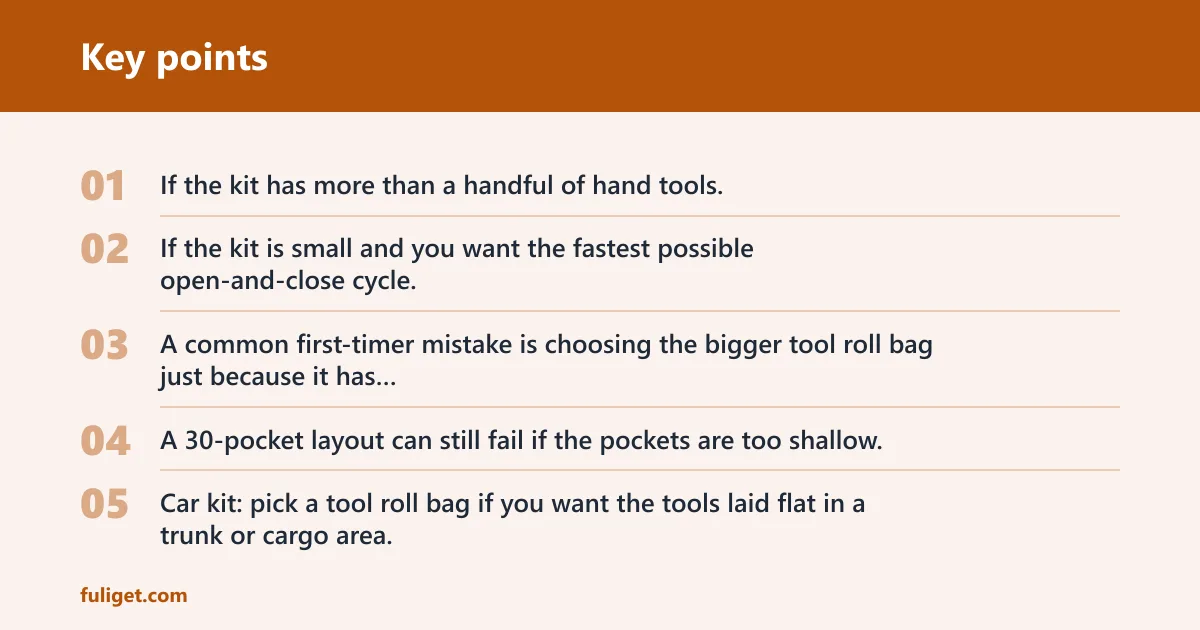
Reading the chart is straightforward. If the kit has more than a handful of hand tools, the bag format usually gives you cleaner organization and less crowding. If the kit is small and you want the fastest possible open-and-close cycle, the pouch format starts to make more sense.
A common first-timer mistake is choosing the bigger tool roll bag just because it has more slots, even when the smaller tool roll up pouch would fit the basic kit better. A 30-pocket layout can still fail if the pockets are too shallow, the roll is too short for your wrench lengths, or the packed bundle becomes too thick for the space where you store it.
Three scenario recommendations
Car kit: pick a tool roll bag if you want the tools laid flat in a trunk or cargo area. It handles a few repair items plus small accessories better, and it keeps the load easier to sort after the vehicle moves around.
Home hand-tool kit: pick a tool roll bag if the set includes multiple wrench sizes, pliers, screwdrivers, and a socket rail. The broader layout makes it easier to keep each tool in a fixed place.
Roadside emergency kit: pick a tool roll up pouch if the kit stays light and you want the shortest path from storage to use. The smaller format is easier to pull from a compartment and close again in a hurry.
Which tools fit each format?
Tool length is the first filter. Tool roll bag works better when your tools need more span or when you want flatter storage for a set of mixed hand tools. Tool roll up pouch is better when the tools are short, narrow, and easy to bundle together.
Wrench sets and long hand tools
Wrench sets usually fit the bag format better because the layout can stay flatter and broader. If the storage is too short, longer wrenches can poke out, twist inside the roll, or force the closure to sit under strain. That is where a bag style is safer and easier to sort.
Sockets, bits, and small accessories
Sockets, driver bits, small adapters, and spare fasteners often fit a pouch well because they do not need much length. A pouch can keep those items together without wasting space. The trade-off is that tiny parts can disappear into a crowded pocket if you overfill it.
Packed thickness and tool length limits
Two dimensions matter: how long the tool is and how thick the roll becomes when closed. A tool roll bag can handle more mixed thickness, but there is still a limit. Tool roll up pouch is more sensitive to both, so even a modest pile of tools can make it bulky fast.
How do opening speed and pocket visibility compare?
Tool roll up pouch usually wins on opening speed, while tool roll bag usually wins on layout clarity. The smaller format opens fast because there is less fabric to manage, but the larger format often lays tools out more cleanly, so you can see what is missing at a glance.
Quick access versus compact containment
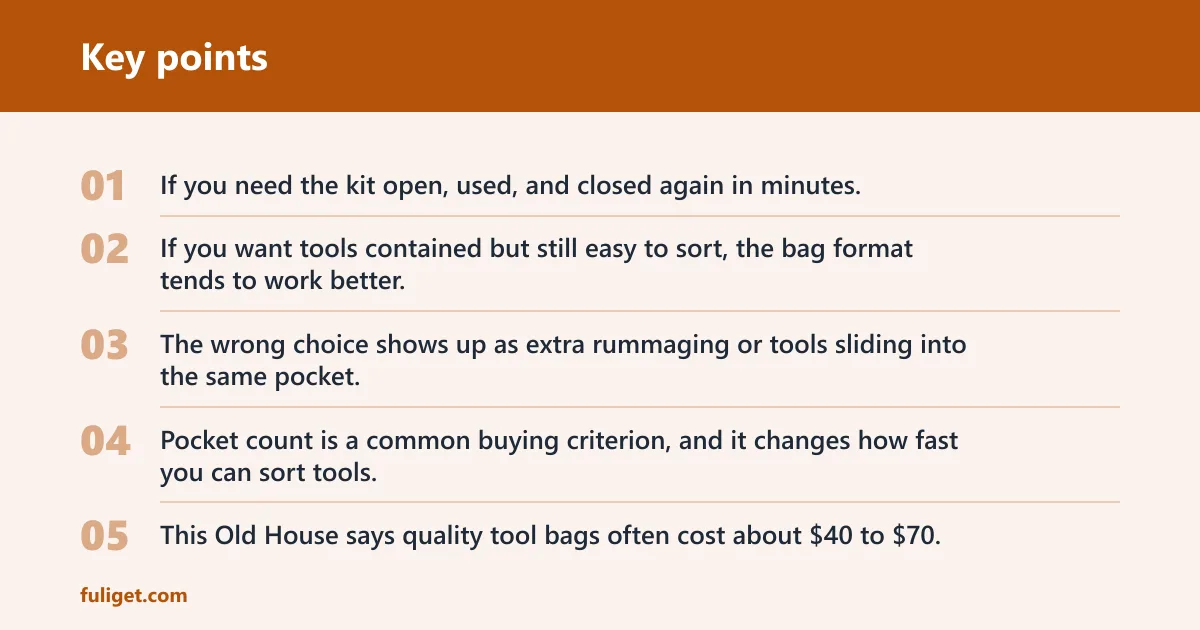
If you need the kit open, used, and closed again in minutes, the pouch format is appealing. If you want tools contained but still easy to sort, the bag format tends to work better. The wrong choice shows up as extra rummaging or tools sliding into the same pocket.
Pocket count and sorting
Pocket count is a common buying criterion, and it changes how fast you can sort tools. This Old House says quality tool bags often cost about $40 to $70, and the reviewed bags had a wide pocket range. One best overall pick has 33 pockets, while a backpack in the same review uses 39 multi-sized pockets.
That range matters because a higher pocket count does not automatically mean better access. A crowded layout can slow you down if the pockets are too close together or the roll is packed beyond its intended load. A well-spaced layout is easier to scan than a dense one.
Common access failure modes
The main failures are overstuffing, hidden pockets, and closures that fight the load. If tools sit too deep or overlap each other, you lose the speed benefit of a roll altogether. A pouch can also become hard to read when small parts pile up on top of one another.
Say your kit has six screwdrivers, a pair of pliers, and a socket rail. In a tool roll bag, those pieces can sit in separate slots and stay visible. In a tool roll up pouch, the same load can become dense enough that you spend extra time checking each pocket.
Is a tool roll bag better for vehicle storage?
For many vehicle storage jobs, a tool roll bag is the better fit because it balances a compact footprint with better organization in a trunk, cargo area, or truck bed. A tool roll up pouch is often the better choice for glove boxes, seat-back pockets, and small cubbies, where the smaller footprint matters more than layout depth.
Trunk, cargo area, and truck bed fit
Vehicle storage rewards shapes that sit flat and do not roll around loose. A tool roll bag is often labeled for this use because it can keep a set together without taking as much room as a hard case. A compact pouch fits too, but it gives up space for the sake of size.
One vehicle-storage pick is specifically labeled as a tool roll bag, which is a useful sign that this format is often aimed at compact transport. That same idea shows up in wider tool bag buying guides too. Tool bags can be compact at 12 inches or larger at 20 inches, so the word alone does not tell you the whole story.
Grab-and-go organization
For a car kit, the best roll is the one you can pull out, open, and sort without dumping the whole load. A flatter tool layout helps here. A pouch may be quicker to open, but the contents can become harder to separate if you store too many items in one place.
Weather and abrasion concerns
Material matters as much as layout. Polyester is common, canvas and waxed canvas are often chosen for abrasion resistance, and ballistic weave is used where wear resistance matters. Some bags also add base protection or reinforcement.
That does not make one fabric automatically better. It means you should match the material to the setting. A truck bed or cargo area can put more wear on the bottom panel than a dry closet shelf, so a reinforced base can be worth more than extra pocket count.
Choose Tool roll bag if… / Choose tool roll up pouch if…
Choose Tool roll bag if you need broader organization, longer tool slots, or better use of trunk, cargo area, or truck bed storage. Choose tool roll up pouch if your kit is small, your tools are short, and you care most about fast opening and a compact bundle.
Best fit for a car kit
Choose Tool roll bag if the car kit includes wrenches, pliers, a few sockets, and small accessories. The layout keeps items separate, which helps when the kit needs to live in vehicle storage for long stretches.
Best fit for a home hand-tool kit
Choose Tool roll bag if you want one carrier for a wider set of hand tools. It is the safer pick when pocket count, tool length, and visibility all matter at once. If the kit is tiny, a pouch can still work, but the bag gives more room to grow.
Best fit for a roadside emergency kit
Choose tool roll up pouch if the roadside kit is lean and speed matters most. If you carry only a few tools, gloves, and small repair items, the smaller format is easier to stow and quicker to close again after use.
Frequently asked questions
What is the difference between a tool roll bag and a tool roll up pouch?
A tool roll bag usually gives you more space, more pockets, and a flatter layout for broader tool carry. A tool roll up pouch is smaller and tighter, so it works better for compact kits and quick access.
Are a tool roll and a tool roll-up pouch the same thing?
Not always. Tool roll is the umbrella term for rollable tool storage, and sellers may use it for bags, pouches, or wraps.
Which is better for wrench sets, sockets, or car tools?
Tool roll bag is usually better for wrench sets and mixed car tools because it gives more room for longer pieces and clearer sorting.
What size tool roll do I need for my tools?
Start with tool length, then check packed thickness and pocket count. Tool bags can be compact at 12 inches or larger at 20 inches, but the right size depends on whether your tools need long slots or a small bundle.
Is a tool roll bag better than a pouch for vehicle storage?
Often yes for trunks, cargo areas, and truck beds; often no for glove boxes, seat-back pockets, and small cubbies.
What features matter most in a tool roll or tool pouch?
Focus on pocket count, pocket size, material, base protection, and weather or abrasion resistance. Also check opening speed and how visible the tools stay when the carrier is open.