Socket Set Guide: How to Choose the Right Set

Choose a socket set by drive size first: 1/4-inch for small fasteners, 3/8-inch as the best first set, and 1/2-inch only for larger automotive bolts and lug nuts. Get this wrong, and you can waste money on duplicate sizes, strip fasteners, or still miss the socket a routine repair actually needs. This guide ties common home and light-auto jobs to drive sizes, depths, point styles, and accessories so you can buy one practical set.
What should a first socket set actually cover?
A first socket set should cover the fasteners that stop common jobs, not chase the biggest piece count on the shelf. For most homeowners and DIYers, that means strong metric coverage, a usable ratchet, key shallow and deep sockets, and the accessories needed to reach recessed or awkward bolts without rounding them.
Coverage matters more than the number on the box
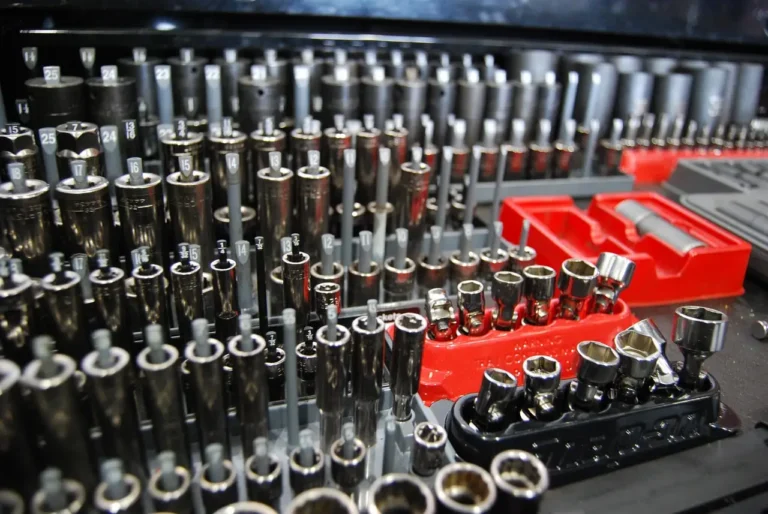
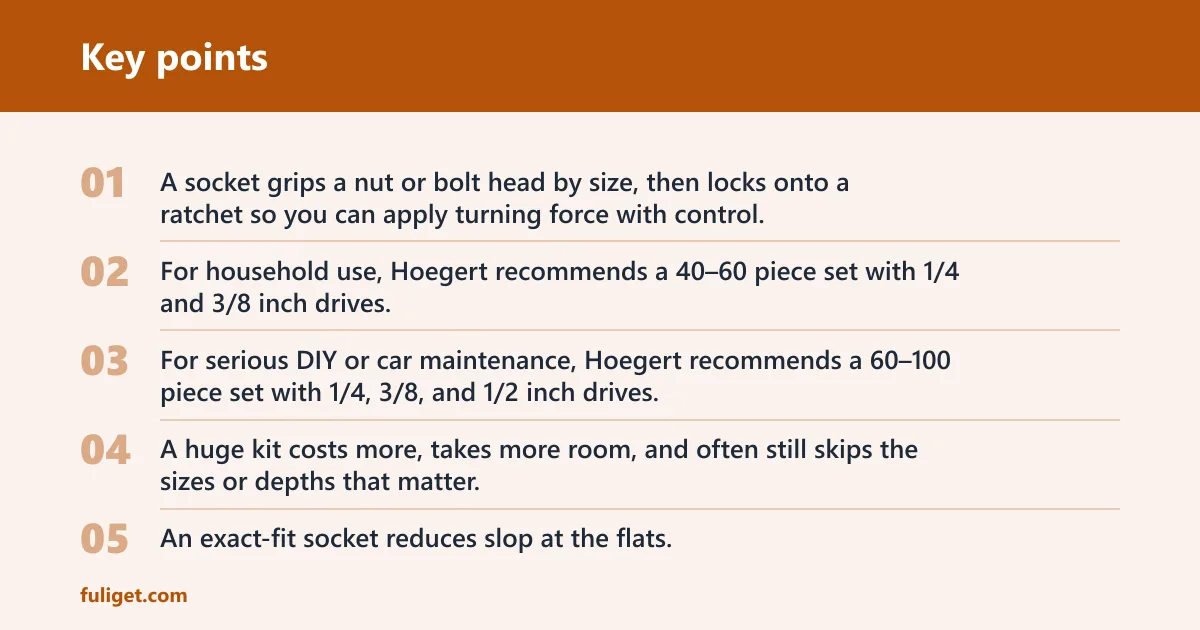
A socket grips a nut or bolt head by size, then locks onto a ratchet so you can apply turning force with control. That part is simple. Buying the right set is where people miss.
Many boxed sets pad the count with screwdriver bits, duplicate spark plug sockets, adapters, or sizes that rarely leave the tray. What matters first is coverage for the fasteners found on furniture, appliances, lawn equipment, bicycles, and routine car work.
For household use, Hoegert recommends a 40–60 piece set with 1/4 and 3/8 inch drives. For serious DIY or car maintenance, Hoegert recommends a 60–100 piece set with 1/4, 3/8, and 1/2 inch drives. Those ranges help because they tie piece count to actual coverage, not box copy.
The three failure modes to avoid
Overbuying is the obvious one. A huge kit costs more, takes more room, and often still skips the sizes or depths that matter.
Missing sizes is what stops the job. A set can have dozens of pieces and still leave out the exact socket needed for a common bracket, hose clamp, battery hold-down, or mower fastener.
Rounded fasteners are the expensive failure. An exact-fit socket reduces slop at the flats. The wrong size, a worn fastener, or forcing a shallow socket where a deep one is needed can turn a five-minute fix into extraction work.
A common first-timer mistake is buying a giant mixed kit for one car project, then finding it has plenty of bits but no deep socket for a battery clamp stud. The count looked strong. The working coverage was thin.
Do you need 1/4, 3/8, or 1/2 drive sockets?
Yes, drive size matters because it sets the torque range, the socket sizes that feel right on the ratchet, and how bulky the tool is in tight spaces. Start with 3/8 inch for general work, move to 1/4 inch for small low-torque fasteners, and add 1/2 inch for larger automotive hardware.
1/4 inch drive: low torque and tight spaces
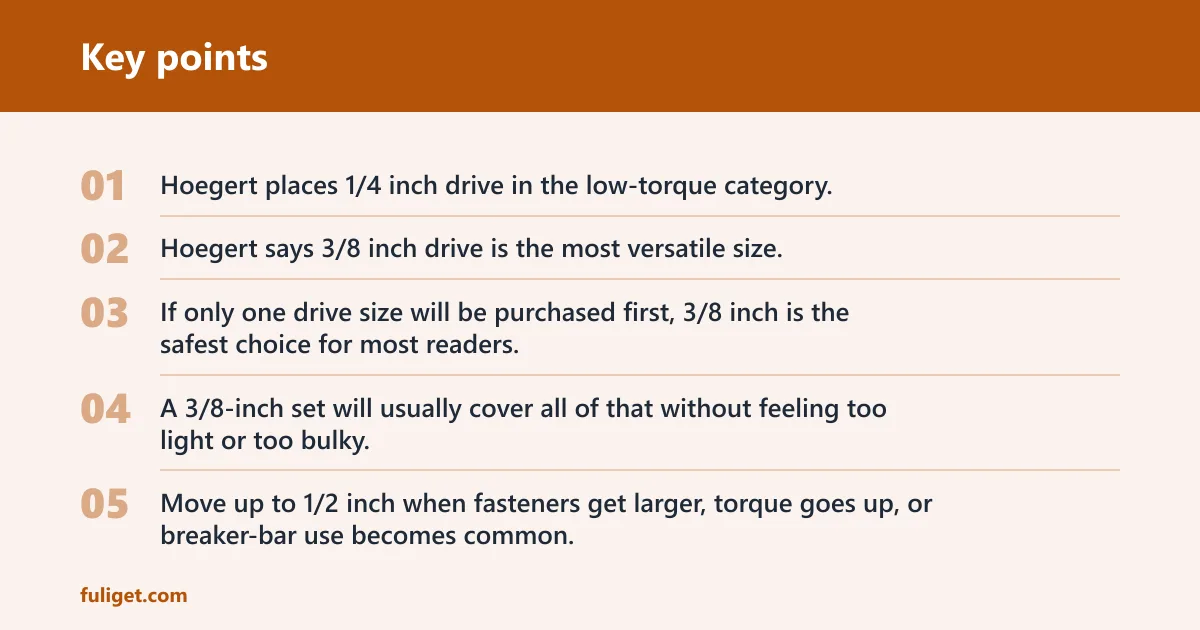
Hoegert places 1/4 inch drive in the low-torque category. This is the small, light setup for trim screws, hose clamps, interior panels, battery terminals, small brackets, and compact equipment.
Choose 1/4 inch first if the work is mostly bicycles, small engines, appliances, electronics-adjacent hardware, or household assembly where access is tight and the fasteners are small. It is less useful for stubborn automotive suspension or lug work.
3/8 inch drive: the default first buy
Hoegert says 3/8 inch drive is the most versatile size. In practice, that makes sense because it handles medium-torque work, fits a broad range of common sockets, and stays compact enough for engine bays and household repairs.
If only one drive size will be purchased first, 3/8 inch is the safest choice for most readers. It covers a broad middle range without the small-fastener limits of 1/2 inch or the torque limits of 1/4 inch.
Say your main jobs are replacing a mower blade, tightening deck hardware, changing a battery, and removing under-hood brackets. A 3/8-inch set will usually cover all of that without feeling too light or too bulky.
1/2 inch drive: larger fasteners and higher torque
Move up to 1/2 inch when fasteners get larger, torque goes up, or breaker-bar use becomes common. This is the usual choice for lug nuts, axle hardware, larger suspension bolts, and stubborn fasteners that need more force at the handle.
Do not buy 1/2 inch first unless those jobs are already routine. It is heavier, larger in confined spaces, and less pleasant on small hardware where feel matters more than force.
3/4 inch and above: niche for very high torque
The same source recommends 3/4 inch and above for very high torque work. That puts these sizes outside the needs of most home garages. Heavy trucks, agricultural equipment, and industrial service are where they start to make sense.
Should you buy metric, SAE, or both?
Buy metric first unless you have a specific reason to do otherwise. Most newer vehicles and much modern equipment use metric fasteners, while SAE still matters on older American vehicles, legacy equipment, and mixed garages where both systems show up in the same week.
Metric first for most buyers
Metric sockets are measured in millimetres and are typically listed from 4mm to 32mm in a full set. That does not mean every starter set includes every size in one drive. It means many general-use lines cover that span across several drives and depths.
For a first set, metric coverage usually gives you more useful range than SAE. Newer vehicles, imported tools, bicycles, power equipment, and household hardware often lean metric.
Where SAE still matters
SAE sockets use inch fractions. They still matter for older American vehicles, shop equipment, some lawn and garden hardware, and garages that inherit tools and machines from different eras.
That does not make near-fit sizes interchangeable in practice. Near-fit sizes are a classic way to round bolt heads.
Mixed garages should plan for both
The practical issue is not ideology. It is downtime. Mixed-use garages often outgrow single-system sets.
If the household has one newer car and one older American mower or project vehicle, start with metric in the main drive size and add SAE in the sizes that actual jobs keep demanding. That costs less than buying a huge dual-system kit all at once.
Which socket types matter in a real set?
The useful socket types are the ones tied to common failure points: shallow sockets for flush fasteners, deep sockets for studs and recesses, hex for most work, Torx where manufacturers specify it, and impact sockets for impact tools. Material matters because hand-tool sockets and impact sockets are built for different loads.
Shallow vs deep sockets
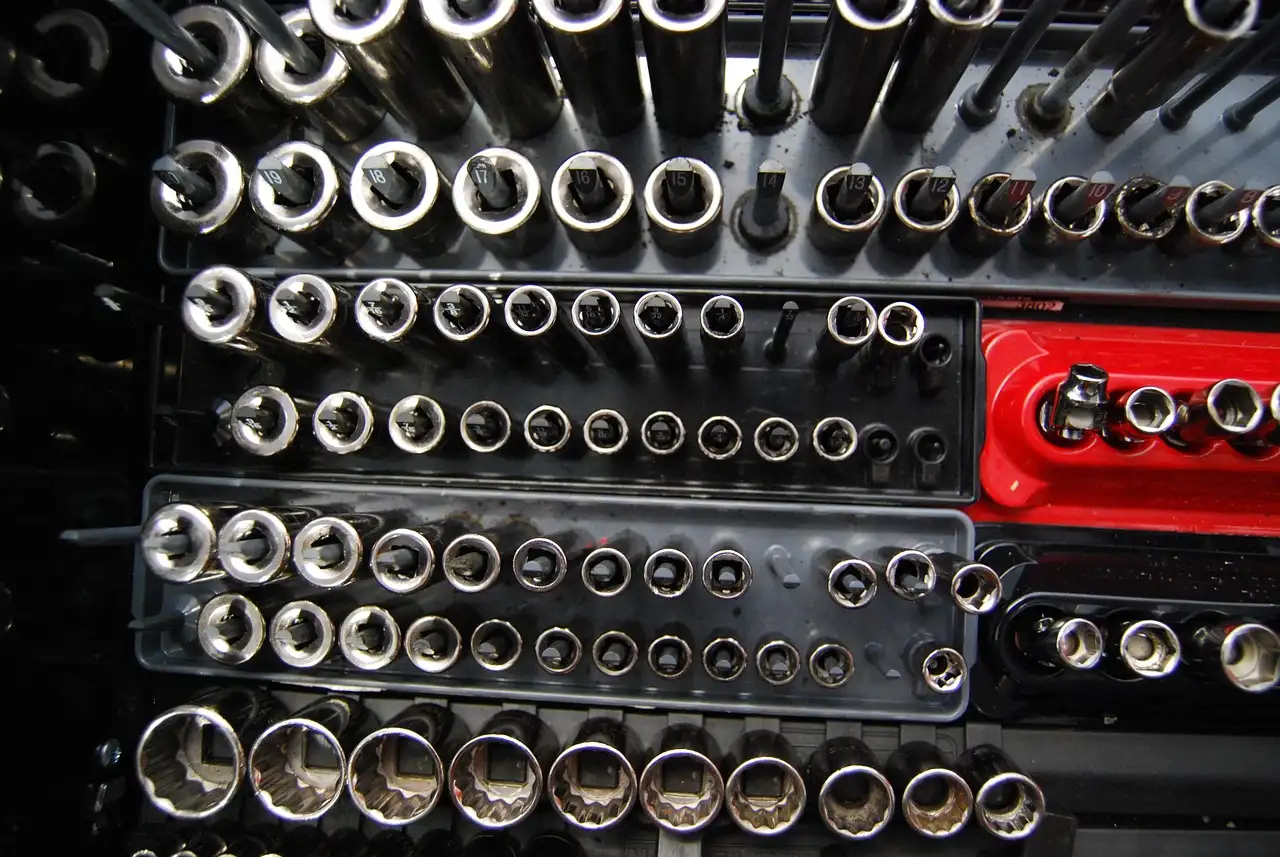
Shallow sockets are the default for bolts and nuts that sit proud and have clear side access. They are shorter, easier to fit into crowded spaces, and often better for feel on routine fasteners.
Deep sockets are for recessed fasteners and long studs. They are longer than regular sockets, which is why they clear protruding threads and reach hardware tucked below covers or brackets.
Suppose a battery hold-down nut sits on a long stud. A shallow socket bottoms out before it reaches the nut. Swap to a deep socket of the same size, and the ratchet can finally engage the flats instead of slipping on the exposed threads.
Head types that actually come up
Standard hex sockets do most of the work in a first set. That is where the budget should go first.
Deep hex sockets matter almost as much because many common home and auto jobs involve studs or recessed hardware. Torx sockets matter on cars, power tools, and appliances where star-shaped fasteners are common. Spline and other specialty sockets are worth adding only when a recurring job calls for them.
If a set advertises lots of specialty pieces but skimps on common hex sizes in both shallow and deep forms, it is the wrong priority for a first purchase.
Regular chrome vs impact sockets
Regular chrome sockets are for ratchets, breaker bars, and hand use. Impact sockets are for impact wrenches and high-torque impacts. Keep that line clear.
Impact sockets have thicker walls and tougher construction because impact sockets are built for sudden torque spikes. If an impact wrench is part of the plan, impact-rated sockets are a requirement, not an upgrade.
Materials and what they mean
Chrome vanadium sockets are described as suitable for hand tools at a lower cost. That makes them a sensible fit for a home set built around manual ratchets and extensions.
Chrome-molybdenum is presented as superior for impact tools. If the set will live beside an impact wrench, that material is the safer place to spend money.
What accessories make a set useful instead of frustrating?
The difference between a usable set and a frustrating one is often the ratchet and the small accessories around it. A fine-tooth ratchet, a 6-inch extension, a universal joint, and orderly storage solve more real problems than another handful of duplicate sockets ever will.
Ratchets and tooth count
Ratchet quality is easy to spot on paper. Ratchets with 72-tooth mechanisms allow a 5° arc swing, which means less handle movement is needed to re-engage the pawl.
That matters in engine bays, under sinks, behind guards, and anywhere the handle cannot swing far. As a buying threshold, 72-tooth or finer is a good target for a first serious set.
Extensions, universal joints, and useful extras
A 6-inch extension is one of the most useful pieces in any set. It reaches recessed hardware, clears plastic covers, and moves the ratchet handle into open space where it can swing.
Universal joints help with angled fasteners. They are not ideal for maximum torque, but they can be the difference between reaching a hidden bolt and removing half the surrounding parts first.
Spark plug sockets and a couple of adapters can be worth having, but they should not replace core socket coverage. If the set skimps on common sizes to make room for add-ons, move on.
Cases and organizers
Storage affects day-to-day use more than many buyers expect. A tray or case should keep sizes in order, hold pieces tightly enough not to spill in transport, and make missing sockets obvious at a glance.
Good organization also helps replacement buying. If one 10mm or 13mm disappears, it should be clear what is missing and where it belongs.
How do you choose the right set by job type?
Choose by the jobs that repeat, then buy the drive size and socket family that fit those fasteners. This avoids the two common mistakes: buying a giant set that still misses the key socket, or buying too small and hitting torque limits on routine car work.
A simple selection process
- List recurring jobs. Write down the work that actually comes up: furniture assembly, mower service, battery removal, brake work, lug nuts, appliance repair. The list matters because socket choice follows fastener context better than marketing labels.
- Match drive size. Put small low-torque fasteners in the 1/4-inch bucket, general repair in 3/8-inch, and larger automotive bolts in 1/2-inch. If very high torque work is rare or absent, ignore 3/4-inch and larger.
- Choose size system. Buy metric first for newer vehicles and modern equipment. Add SAE if older American vehicles, shop tools, or inherited equipment make inch-fraction sockets a real need.
- Add depth and head types. Cover common hex sizes in shallow form first, then add deep sockets for studs and recesses. Add Torx only if the target jobs use Torx heads often enough to justify it.
- Check the accessories. Look for a ratchet rated at 72-tooth or finer, a 6-inch extension, and a universal joint. Those items decide whether the set works in cramped spaces or stalls out.
- Inspect the case. Confirm the tray or case keeps sizes ordered and makes missing pieces visible. A messy case turns a decent set into a time-waster.
Socket set matrix
Decision matrix
| Job type | Fastener size range | Drive size | Socket depth | Material | Must-have accessories |
|---|---|---|---|---|---|
| Furniture, appliances, bicycles, small equipment | Small fasteners; compact hardware | 1/4 inch | Mostly shallow; a few deep sizes help on studs | Chrome vanadium for hand use | Fine-tooth ratchet, short extension, 6-inch extension |
| General home repair, lawn equipment, mixed DIY | Small to medium fasteners | 3/8 inch | Shallow plus core deep sizes | Chrome vanadium for hand use | 72-tooth ratchet or finer, 6-inch extension, universal joint |
| Battery service, under-hood brackets, starter home auto work | Medium fasteners; occasional recessed hardware | 3/8 inch | Shallow and deep | Chrome vanadium unless using an impact tool | 6-inch extension, universal joint, spark plug socket if needed |
| Brake hardware, suspension bolts, lug nuts | Medium to larger fasteners; higher torque | 1/2 inch | Mostly shallow; deep where studs require it | Chrome-molybdenum if impact use is planned | Breaker-bar compatibility, impact-rated sockets for impact wrench use |
| Heavy truck, trailer, agricultural or industrial service | Large fasteners; very high torque | 3/4 inch and above | Application-specific | Impact-oriented materials | Large-handle tools, impact compatibility, organized heavy-duty storage |
Socket set table
| Use case | Buy first | Skip first | Add later |
|---|---|---|---|
| Home use | Metric 3/8-inch set with shallow and a few deep hex sockets, 72-tooth ratchet, 6-inch extension, clear case | Large SAE spread, impact sockets, oversized 1/2-inch-heavy kit | 1/4-inch drive set, Torx sockets, selective SAE sizes |
| Auto use | Metric 3/8-inch set plus a 1/2-inch path for lug and suspension work; deep sockets included | Huge bit-heavy homeowner kit with weak 1/2-inch coverage | Impact sockets, SAE coverage for older American vehicles, spark plug sockets |
| Mixed-use garage | Metric-focused 3/8-inch set with both shallow and deep hex, plus core 1/4-inch pieces and a strong case | 3/4-inch drive gear, broad specialty spline selection, padded piece-count kits | Selective SAE set, 1/2-inch impact sockets, Torx set, adapters and extra extensions |
What size range and piece count should you expect?
A useful starter set should cover the common sizes for its drive class, include the sockets most likely to stop a job, and avoid padded totals. Expect metric to do most of the work, with piece count treated as a coverage clue rather than the reason to buy.
What socket sizes are actually in a complete set?
On store shelves, “complete” often means complete within a product line, not complete for every job. Many sets spread coverage across multiple drives, and many omit a few in-between sizes even when the package count looks large.
For most buyers, the real question is whether the set covers the common metric middle without glaring gaps, then adds deep versions where they count. Mixed-use buyers should watch for the same in SAE rather than assuming the inch sizes will be there in useful depth and spread.
What socket set size charts mean
Size charts usually combine three things: socket size, drive size, and system type. A chart may show that a set includes a given size, but it may only exist in one depth, one drive, or one socket family.
That is why charts need to be read by job context. If the repair calls for a deep 13mm on a 3/8-inch drive, a chart listing only a shallow 13mm or only a 1/4-inch version does not actually solve the problem.
How to spot padded piece counts
Look for repeated sizes across adapters, bits, and driver accessories. Those can add utility in some sets, but they should not crowd out core sockets.
A strong starter kit often beats a larger weak kit when it includes the right metric sizes, a fine-tooth ratchet, a 6-inch extension, deep sockets where they matter, and a case that keeps everything visible.
Common buying mistakes
Buying for the biggest future job
If the garage mostly sees household work and light maintenance, a 1/2-inch-dominant set is usually too much too soon. Buy for the jobs on the calendar, then move up the torque ladder only when those larger jobs become routine.
Assuming metric and SAE can substitute
Near-fit sockets feel close until they slip. That is how corners get rounded and extraction tools enter the story.
Ignoring deep sockets
Sets with only shallow sockets look fine until a long stud or recessed nut blocks the job. A first set does not need every deep size, but it does need enough to cover the common offenders.
Using chrome sockets on an impact wrench
This is a safety and durability problem, not a preference issue. If impact use is planned, buy impact-rated sockets for that tool path.
Choosing a bad case
A poor organizer causes lost pieces, mixed sizes, and duplicate replacement buys. Case quality sounds minor until the first missing socket stalls a repair.
Frequently asked questions
What size socket set should I buy?
Most first-time buyers should start with a 3/8-inch metric set because it covers the broad middle of home and light-auto work. Choose 1/4-inch first only for small low-torque jobs, and add 1/2-inch when lug nuts, suspension bolts, or other higher-torque tasks become common.
What’s the difference between shallow and deep sockets?
Shallow sockets suit flush, easy-to-reach fasteners and save space in tight areas. Deep sockets are longer and are used for recessed fasteners and long studs where a shallow socket would bottom out before reaching the nut or bolt head.
Do I need impact sockets or regular chrome sockets?
Use regular chrome sockets for hand tools and impact sockets for impact wrenches. Impact sockets have thicker walls and tougher steel for repeated high-torque hits, while chrome vanadium hand sockets are the normal choice for ratchet work where compact size and lower cost make more sense.
What is the best socket set for a homeowner?
The best homeowner set is usually a metric-focused 3/8-inch kit with strong shallow coverage, a few deep sockets, a 72-tooth or finer ratchet, a 6-inch extension, and a case that keeps sizes ordered. That covers far more real jobs than a larger padded kit with weaker core coverage.