Click vs Digital Torque Wrench: Which Is Better for DIYers?

For most DIYers, a click torque wrench is often the better choice for general 20-100 lb-ft work. A digital torque wrench is often a good choice if preset alerts, angle mode, or frequent low-torque jobs are needed. Wrong torque can strip threads, warp parts, or leave lug nuts loose. This guide compares both types by accuracy, ease of use, garage conditions, and price.
| Factor | Click | digital torque wrench | Winner |
|---|---|---|---|
| Cost | Usually cheaper and common in starter kits. | Usually costs more because of the display, electronics, and alerts. | Click |
| Feedback while tightening | Set the value, then feel or hear the click. | Shows live torque and may add beep, light, or vibration. | digital torque wrench |
| Low-torque control | Can feel abrupt on tiny fasteners and is easier to overshoot. | Shows the number as you approach target torque, which can reduce overshoot. | digital torque wrench |
| Power and readiness | No battery, so it is ready after storage if properly kept. | Needs a charged battery and can be dead when you need it. | Click |
| Range fit | Good for routine wheel work and general assembly when sized correctly. | Good for broad range work, plus units, memory, and angle features on some models. | digital torque wrench |
Click vs digital torque wrench: the trade-off
The real choice is a low-cost mechanical tool that works the same way every time, or an electronic tool that gives more feedback and more functions while adding battery and screen risk. For a garage that mostly sees wheels, brakes, and general fasteners, Click usually covers the job with fewer failure points.
Digital torque wrench models make more sense when the work is small, the target torque is close to the low end of a tool’s scale, or you want angle mode and memory. Click wrenches remain a strong default for DIY use because they are the familiar standard, but they depend on the user noticing the click and stopping immediately.
Cost and upkeep
Click wrenches are often cheaper than digital models, which matters if you only torque a few jobs per month. They also avoid battery care, but they still need proper storage and periodic calibration checks so the spring mechanism stays trustworthy.
Feedback and error control
Digital torque wrench models can show live torque, then add an audio or visual alert near target. That helps in noisy or low-light garage conditions, where a faint click can be missed or a long pull can overshoot. The trade-off is that the display can also distract you if you chase numbers instead of stopping at the target.
Torque wrench comparison table
| Use case | Click | digital torque wrench | Winner |
|---|---|---|---|
| General wheel service | Works well when sized for lug nut torque and used with a steady pull. | Useful if you want live numbers or alerts, but the extra features are optional. | Click |
| Low-torque fasteners | Can be awkward near the bottom of range, especially on tiny bolts. | Better for spark plugs, valve cover bolts, and other delicate work. | digital torque wrench |
| Angle-based fasteners | Usually needs a separate angle gauge for torque-plus-angle work. | Some models include angle mode for head bolts and some axles. | digital torque wrench |
| Battery-free readiness | No battery to die in storage or mid-job. | Needs a charged battery before use. | Click |
| Record trail | Usually has no record trail. | Can store or display more data, which helps with torque documentation. | digital torque wrench |
Are digital torque wrenches more accurate?
Sometimes on paper, but not automatically in the garage. Accuracy is usually quoted as a percent of reading, and common claims are around ±2% to ±3%, with some tools listing separate clockwise and counterclockwise ratings such as about ±2% clockwise and about ±3% counterclockwise. That spec matters only within the stated range.
What accuracy specs mean at the bench
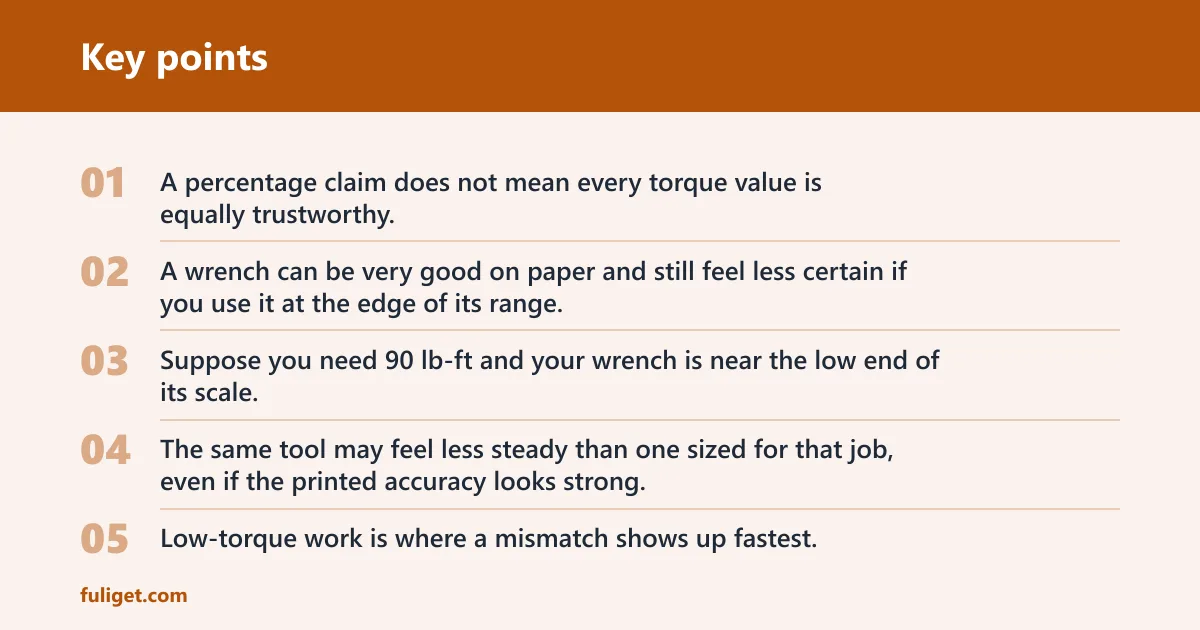
A percentage claim does not mean every torque value is equally trustworthy. It means the error band is tied to the reading, and the quoted range often runs from 20–100% of full scale. A wrench can be very good on paper and still feel less certain if you use it at the edge of its range.
Suppose you need 90 lb-ft and your wrench is near the low end of its scale. The same tool may feel less steady than one sized for that job, even if the printed accuracy looks strong. That is why the right range matters as much as the brand claim.
Where range limits matter most
Low-torque work is where a mismatch shows up fastest. A large wrench used for tiny fasteners is harder to control, and a small wrench pushed near its top end can feel strained on lug nuts or heavier assemblies. For confidence, choose a tool whose working range sits near the middle of the fastener torque you use most.
Clockwise and counterclockwise ratings
Some torque specs differ by direction, so check both directions if you work on left-hand threads or tasks that need reverse torque. That matters because the printed number on the box can hide a weaker rating in one direction. A Snap-on TechAngle electronic torque wrench lists ±2% clockwise and ±3% counterclockwise, which shows why direction is not a footnote.
Which torque wrench is easier for DIYers?
For a beginner doing ordinary garage work, Click is usually easier to learn for wheels and general assembly because the operation is simple: set the value, pull, stop at the click. Digital torque wrench models are easier for low-torque and precision work because the screen and alerts reduce guesswork as you approach target torque.
Low-torque fasteners and small parts
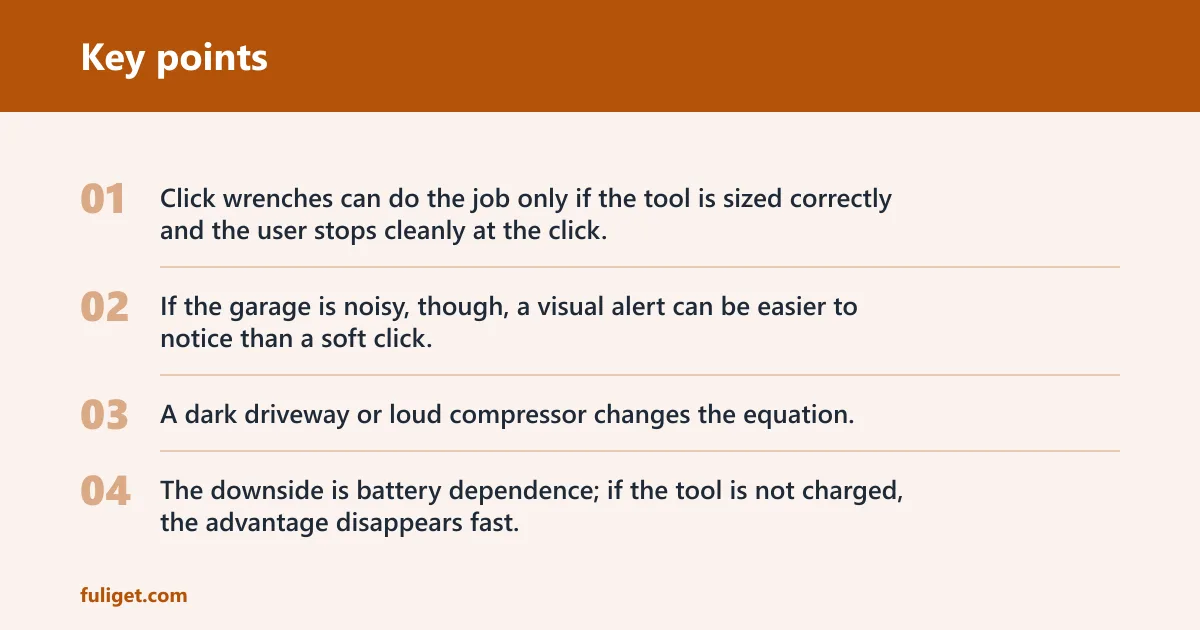
Small fasteners reward fine feedback. A digital torque wrench can show torque climbing in real time, which helps on spark plugs, valve cover bolts, and bicycle stem bolts where a tiny overshoot matters more than brute force. Click wrenches can do the job only if the tool is sized correctly and the user stops cleanly at the click.
Lug nuts and heavier assemblies
For wheels, a click wrench is often the simplest tool because the torque range is familiar and the job does not need a display. Digital torque wrench models still work, but the extra features often do not change the result enough to justify the cost for occasional wheel service. If the garage is noisy, though, a visual alert can be easier to notice than a soft click.
Noisy or low-light garage conditions
A dark driveway or loud compressor changes the equation. In those conditions, the lights, vibration, or beep on a digital torque wrench can be easier to catch than the click of a mechanical tool. The downside is battery dependence; if the tool is not charged, the advantage disappears fast.
Torque wrench decision table
| Task | Better wrench type | Ideal drive size/range | Why it wins | Main failure risk |
|---|---|---|---|---|
| Lug nuts | Click | 1/2 in drive, roughly wheel-torque range for your vehicle | Simple, fast, and good for routine wheel work without needing a screen. | Overshooting because you do not stop at the click. |
| Spark plugs | digital torque wrench | 3/8 in drive or a small low-range wrench | Clear live feedback helps avoid stripping threads on low-torque parts. | Using a large wrench near the bottom of its range. |
| Valve cover bolts | digital torque wrench | 1/4 in or 3/8 in drive, low-range model | Low torque and short fasteners benefit from easier-to-read feedback. | Over-tightening thin covers or gasket surfaces. |
| Bicycle stem bolts | digital torque wrench | Low-range 1/4 in drive | Small torque values are easier to control with live numbers. | Conversion mistakes between in-lb, ft-lb, and N·m. |
| Interior trim fasteners | Click | Low-range small drive if torque matters at all | Cheap, simple, and usually enough when the target value is modest. | Missing the click cue in a cramped cabin. |
| Small engine work | digital torque wrench | Low-range 1/4 in or 3/8 in drive | Helpful for mixed fasteners, unit changes, and angle-capable repairs. | Battery deadness before the job starts. |
For example, a valve cover bolt may call for a low torque value in N·m. A small digital wrench can show the number in the same unit, then alert you before the fastener crushes the gasket. The same task with an oversized click wrench invites overshoot.
Choose Click if… / Choose digital torque wrench if…
Choose Click if you mostly handle lug nuts, brakes, suspension hardware, and other routine automotive fasteners in a familiar range. Choose it if you want lower cost, no batteries, and a simple set-value-and-pull routine that is easy to store and keep ready.
Choose digital torque wrench if you do a lot of spark plugs, valve cover bolts, bicycle parts, or other low-torque work. Choose it if you want unit conversion, peak hold, track mode, angle mode, or a display that helps reduce overshoot in noisy or dim garage conditions.
When the extra cost is worth it depends on how often you use the added functions. If the wrench will live in a drawer until wheel season, the premium features may be wasted. If you regularly work across ft-lb, in-lb, and N·m, a digital model earns its keep faster.
Do digital torque wrenches need calibration too?
Yes. Both types need periodic verification, and both lose trust if they are stored badly or handled roughly. A digital torque wrench adds battery care to the list, but the calibration question is the same: if the tool is off, the display does not fix that by itself.
Storage and battery checks
Keep a digital torque wrench stored with the battery in good condition, and check that it powers on before a job. If the screen is dim, the battery indicator is low, or the tool has been unused for a long stretch, test it before tightening anything critical. Click wrenches also benefit from relaxed storage and a reset to the lowest setting after use.
- Store it at low setting. Return a click wrench to its lowest marked setting after use, then keep both types in a dry case. That reduces spring stress and helps the tool stay trustworthy.
- Check power first. For a digital torque wrench, confirm the battery is charged and the display wakes normally before starting. A dead battery in the middle of a wheel job wastes time and can leave a fastener unfinished.
- Verify before critical work. Recheck calibration periodically, especially after drops, long storage, or rough handling. If a fastener is safety-critical, do not rely on a tool that has not been verified in a long time.
Verification intervals
There is no single universal interval that fits every garage, but periodic verification is the safe rule for both tools. More frequent use, frequent transport, or a drop should shorten the interval. If the wrench has drifted, the best display or click cue still gives the wrong result.
Unit selection and conversion mistakes
Some digital models can switch between ft-lb, in-lb, and N·m, which helps when service data changes units. That convenience still creates room for mistakes if you pick the wrong unit or convert in your head under pressure. Set the unit before tightening, then confirm the target value from the service spec.
Frequently asked questions
Are digital torque wrenches worth the extra money?
They are worth it when you use low-torque fasteners often, need angle mode, or want live feedback that helps avoid overshoot. For occasional wheel work, the extra cost can be hard to justify because Click already handles the common job well.
Do I need a digital torque wrench for lug nuts?
No. A Click wrench is usually the practical choice for lug nuts because the job is common, the torque range is familiar, and you do not need a screen to tighten wheel hardware correctly. Choose digital only if you want alerts or use the tool for many other precision jobs.
Can a click torque wrench handle low-torque jobs like spark plugs?
Yes, if it is sized for the low range and you are careful, but it is less comfortable there than a digital model. Near the bottom of the scale, the click can feel abrupt and overshoot is easier, so low-torque work is where digital tends to be calmer.
What features matter most in a digital torque wrench?
Live torque display, peak hold, track mode, unit conversion, and angle mode matter most for DIY use. Memory and data output matter more if you need a record trail, while beep, light, or vibration are useful when the garage is noisy or dim.
Why do digital torque wrenches feel worse on wheels?
They can feel like extra tool for a simple job. Wheel work usually needs a clear target and a steady pull, which a click wrench already provides. The screen, alerts, and battery make sense only if you also use the wrench for small fasteners or angle-based work.
Which torque wrench is better in a noisy or low-light garage?
Digital torque wrench models usually have the edge because lights, vibration, or a beep are easier to notice than a click in poor conditions. That said, the benefit depends on the battery being charged and the display being readable before you start.