

Car Ramps vs Floor Jack: Which Is Better for Home Maintenance?

For home maintenance, use ramps for fast front-end jobs like oil changes, and use a floor jack with stands for wheel-off work, uneven lift points, or broader service tasks. The wrong choice can leave you stuck, slow the job, or create a stability risk if the vehicle moves. This guide compares both setups by job type, space, cost, and safety, so you can pick the right lift gear.
| Factor | Car ramps | floor jack | Winner |
|---|---|---|---|
| Quick front-end access | Drive on and get under the nose fast. | Slower, since you must lift one end and usually add stands. | Car ramps |
| Wheel removal | Not possible by themselves. | Works well for brake, tire, and suspension access. | floor jack |
| Low-car fit | Depends on approach angle and front lip clearance. | Depends on minimum height clearance and saddle reach. | tie |
| Working underneath | Useful for basic under-car access, but fixed height limits reach. | Needs jack stands before you work under the vehicle. | floor jack |
| Job flexibility | Best for front or rear drive-on access. | Works for many lift points and mixed service jobs. | floor jack |
| Setup speed | Usually faster. | Slower because lifting and supporting are separate steps. | Car ramps |
How ramps and jacks differ in use
Car ramps are drive-on support tools with a fixed height. A floor jack is a hydraulic lifting tool that raises the vehicle at a point, and jack stands are usually used before anyone works underneath. For simple front-end maintenance, ramps are usually quicker. For wheel-off service, the floor jack setup wins.
Drive-on support vs hydraulic lift
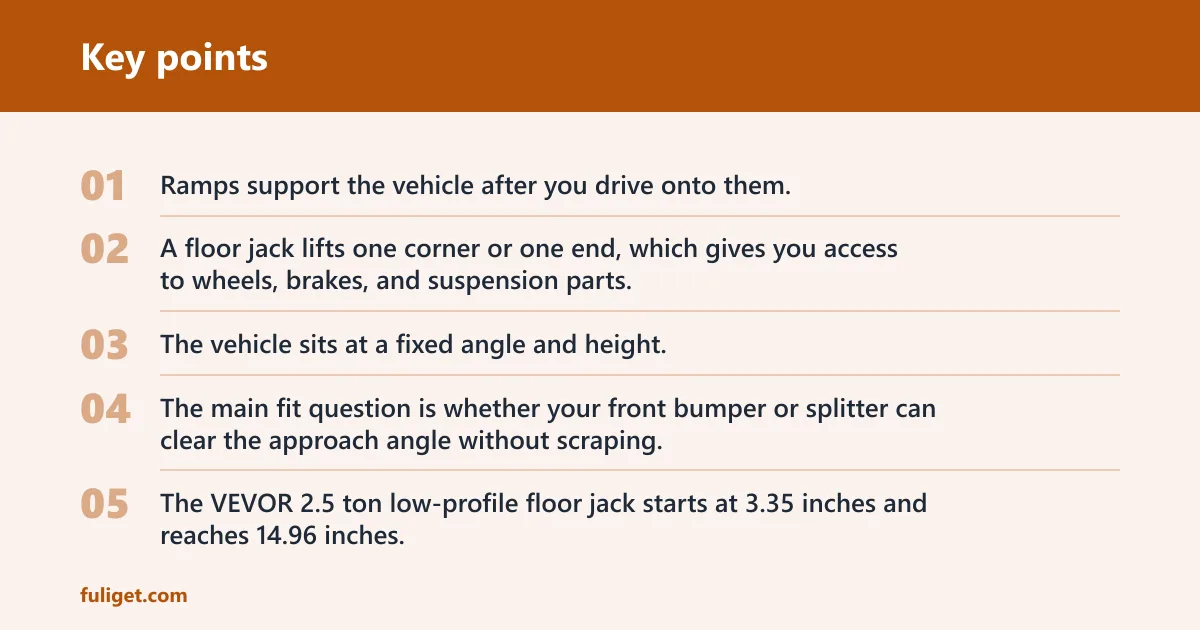
Ramps support the vehicle after you drive onto them. That makes them a strong fit for oil changes and fluid checks where you want under-car access without removing a wheel. A floor jack lifts one corner or one end, which gives you access to wheels, brakes, and suspension parts.
That difference matters because ramps do not change ride height after placement. The vehicle sits at a fixed angle and height. A floor jack gives you more control over where and how high you lift, which matters when lift points are uneven or tucked behind aero panels.
Fixed height, minimum height, and lift height
Ramps are simple, but the height is fixed. The main fit question is whether your front bumper or splitter can clear the approach angle without scraping. A floor jack has its own fit limit: the jack must slide under the car, and its maximum lift height must be enough for the job.
Examples make that clear. The VEVOR 2.5 ton low-profile floor jack starts at 3.35 inches and reaches 14.96 inches. The ARCAN A20019 starts at 3.75 inches and reaches 18 inches. On the ramp side, RhinoRamps MAX have a 17° incline, and MaxxHaul 50709 is described as having a low incline for lowered vehicles.
Where jack stands enter the setup
Jack stands are the secondary support device. They are used with a floor jack when wheels must come off or when you will work underneath the car. The jack raises the car; the stand holds it mechanically after that, which is why the safest floor-jack setup includes both tools.
A floor jack alone is not the end state for under-car work. If you need to remove a wheel, inspect suspension parts, or work near the brake caliper, place jack stands at the correct support points after lifting. Do not rely on the hydraulic jack by itself.
Which works better for low cars?
Low cars usually favor the tool with the gentler entry path, but that can be either ramps or a low-profile floor jack depending on the front end. Ramps work well when the bumper, splitter, or body kit can clear the approach angle. A floor jack works better when the car is too low to climb a ramp but still gives enough clearance for the jack saddle.
Approach angle and scraping risk
Approach angle is the first thing to check with ramps. A steeper ramp can catch a lowered car, especially one with a deep front lip or aero kit. Longer ramps usually reduce scraping risk because the rise is spread over more length.
That is why low-angle ramp designs matter. MaxxHaul 50709 is described as having a low incline for lowered vehicles. For a very low front end, that can matter more than the rated capacity printed on the box.
Low-profile ramps and low-clearance jacks
Some cars sit low enough that even a ramp’s entry lip is a problem. In that case, a low-profile floor jack may be the better first step, especially if the job requires wheel removal anyway. The jack’s minimum height must fit under the pinch weld or approved lift point without forcing the car upward first.
Say your car has a front splitter and only a small gap at the nose. A ramp with a steeper approach can scrape before the front tires even start climbing. A low-profile jack with a 2.8-inch starting height, such as the Naipo 3-ton low-profile floor jack listed by Walmart, gives you another path if the lift point clears.
Body kits and front lips
Body kits make this choice less forgiving. Ramps can still work, but only if the front lip clears the first contact point and the tires do not bottom out before they are centered. A floor jack can avoid the front lip entirely by entering from the side, as long as the jack body itself fits under the car.
A common first-timer mistake is assuming any low-profile tool will fit every lowered car. The real issue is geometry, not just height. The bumper shape, wheelbase, and entrance angle all matter.
Car ramps vs floor jack matrix
This matrix maps the tool to the job, because that is where the answer changes. For some tasks, ramps are the better first choice. For others, a floor jack with stands is the only practical setup.
| Home maintenance job | Wheel removal | Undercar access | Low-car fit | Setup time | Best safety setup |
|---|---|---|---|---|---|
| Oil change | No | Yes | Ramps if approach angle fits | Fast on ramps | Car ramps |
| Fluid check and top-off | No | Yes | Ramps if ground clearance allows | Fast on ramps | Car ramps |
| Front brake pad replacement | Yes | Yes | Depends on jack minimum height | Moderate | floor jack + jack stands |
| Tire rotation | Yes | No | Usually manageable with a jack | Moderate | floor jack + jack stands |
| Exhaust inspection | No | Yes | Ramps if the rear fits | Fast on ramps | Car ramps |
| Suspension check | Usually yes | Sometimes | Depends on lift point access | Moderate | floor jack + jack stands |
| Wheel bearing diagnosis | Yes | Yes | Good with a low-profile jack | Moderate | floor jack + jack stands |
| Undertray removal | No | Yes | Ramps if fast access is enough | Fast on ramps | Car ramps |
| Transmission service access | Sometimes | Yes | Often easier with a jack | Moderate | floor jack + jack stands |
| Mixed garage service on one low car and one SUV | Sometimes | Yes | Ramps for the SUV, jack for the low car | Mixed | Both tools, chosen by vehicle |
Oil changes and fluid checks
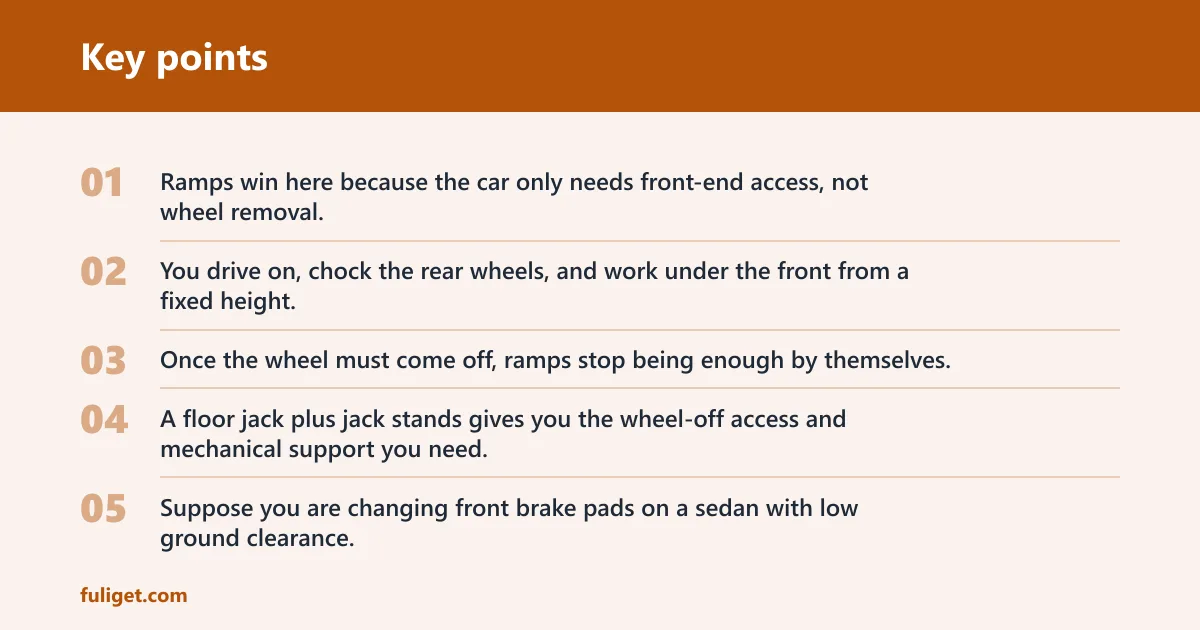
Ramps win here because the car only needs front-end access, not wheel removal. You drive on, chock the rear wheels, and work under the front from a fixed height. That is why ramps are the simplest answer for many front-end maintenance jobs.
Brake work and wheel removal
Brake work changes the answer immediately. Once the wheel must come off, ramps stop being enough by themselves. A floor jack plus jack stands gives you the wheel-off access and mechanical support you need.
Suppose you are changing front brake pads on a sedan with low ground clearance. Ramps might get the front end high enough to look underneath, but they do not let you remove the wheel. The floor jack plus stands setup solves both problems.
Exhaust, inspection, and undercar access
For exhaust checks, undertray removal, or a quick inspection under the nose, ramps often save time. They are best when you want access without rearranging the wheels or searching for a lifting point. If the access point is far back or the car needs a side-specific lift, the floor jack becomes more practical.
SUV and truck maintenance
SUVs and trucks often fit ramps more easily because of greater ground clearance. That makes them a good match for quick oil service or underside checks. A floor jack still matters for wheel removal, but the vehicle’s height and mass may push you toward a jack with a higher maximum lift and stands with enough reach.
Can you use a floor jack instead of ramps?
Yes, you can use a floor jack instead of ramps for many home-maintenance jobs, but only if you pair it with jack stands before working underneath. The jack is the lifting tool; the stands are the support. That setup wins for wheel-off work, uneven lift points, and any job that needs the wheel removed.
When the jack plus stands setup wins
Use a floor jack plus stands when the task involves brakes, tires, suspension parts, or anything that needs the wheel off. It also works better when the lift points are not centered, when one side must come up higher, or when the car’s front shape makes ramp entry difficult.
-
Find the approved lift points.
Check the owner’s manual for the pinch welds, subframe pads, or reinforced points. That matters because a jack saddle placed in the wrong spot can slip or damage the underbody. -
Raise the vehicle slowly.
Pump the jack until the tire clears the ground or until you reach the height needed for the job. Stop if the jack body reaches its limit before the wheel comes free. -
Set the stands and lower onto them.
Place jack stands under approved support points, then lower the car onto the stands. The stands, not the jack, should carry the load during the work period.
When ramps are faster and simpler
Ramps are faster for jobs where wheel removal is not needed. That includes oil changes, fluid checks, and many undertray or exhaust inspections. If the vehicle can climb them cleanly, the workflow is shorter and the setup is simpler.
Use ramps when the task is front-end maintenance and the car’s clearance works in your favor. Use the jack setup when the job changes the wheel or suspension. That split keeps the decision tied to the job instead of to a generic “safer” label.
Common fit and setup failures
Overshooting ramps is a real failure case. If the tire climbs past the ramp’s cradle or stops off-center, the car may not sit correctly on the platform. The other common miss is saddle height mismatch, where the jack cannot get under the car or cannot lift high enough to create useful working room.
Ramps have one more hard limit: they do not allow wheel removal by themselves. That is not a minor inconvenience. It is the reason they lose to a floor jack for brake, tire, and suspension work.
Choose car ramps if… / Choose floor jack if…
Choose Car ramps if you want quick front-end access, you are doing oil changes or fluid checks, your vehicle clears the approach angle, or you want the simplest setup for routine underside work. Choose floor jack if you need wheel-off service, you have uneven lift points, or the car sits too low for a ramp entry but still clears a low-profile jack.
For mixed garages, the better choice can change by vehicle. A lowered car often pushes you toward a floor jack with stands, while an SUV or truck often makes ramps the faster pick for routine maintenance. If you only want one setup for broad service work, the floor jack plus stands is the more versatile path.
Capacity, clearance, and fit
Capacity matters, but not in the same way for every tool. With ramps, you are looking at a pair rating or sometimes a per-ramp rating. With a floor jack, capacity is usually listed in tons. In both cases, the vehicle’s curb weight and the lift geometry determine whether the tool fits the job.
Vehicle curb weight and per-side load
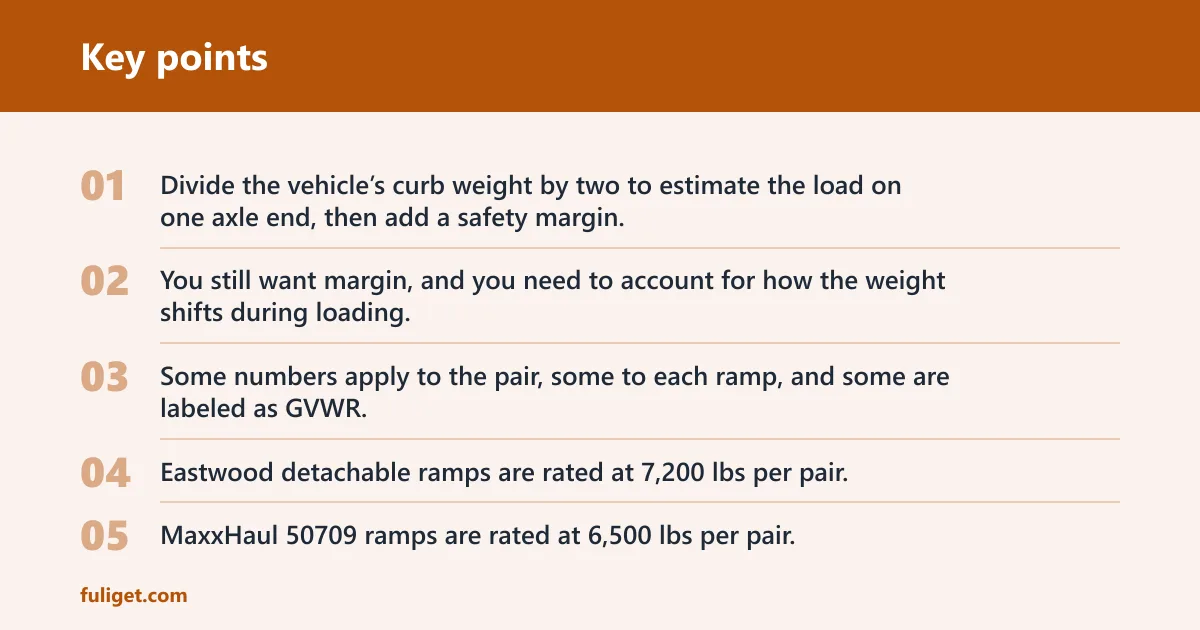
Use curb weight to estimate support needs. Divide the vehicle’s curb weight by two to estimate the load on one axle end, then add a safety margin. That simple split helps you compare the load against a pair of ramps or against the jack and stand ratings you plan to use.
For example, a car with a curb weight of about 3,600 pounds puts about 1,800 pounds on one end in a front or rear lift scenario. That does not mean any 2,000-pound support is enough by itself. You still want margin, and you need to account for how the weight shifts during loading.
Pair ratings, per-ramp ratings, and ton ratings
Ramp packaging can be confusing. Some numbers apply to the pair, some to each ramp, and some are labeled as GVWR. Eastwood detachable ramps are rated at 7,200 lbs per pair. MaxxHaul 50709 ramps are rated at 6,500 lbs per pair. RhinoGear RhinoRamps MAX are rated at 16,000 lbs GVWR. Race Ramps RR-56 are rated at 3,000 lbs per pair. Black Widow plastic ramps are rated at 10,000 lbs per pair.
The safe move is to read the exact label on the product and treat the printed number as the minimum, not the target. For a floor jack, the key number is the ton rating, but the real fit question is whether the minimum height clears the car and whether the maximum lift height is enough for the task. That is why a jack can be “strong enough” on paper and still be the wrong tool.
Ground clearance and saddle height
Vehicle ground clearance affects both tools. A low bumper or splitter can block ramp entry, while low ground clearance can also keep a jack from sliding under the car. That is why low-profile ramps and low-profile jacks exist, and why low cars often need a narrower buying decision than taller vehicles.
For a household with one lowered car and one SUV, ramps may be best for the SUV and a low-profile floor jack plus stands may be best for the lowered car. That split is often cheaper than forcing one tool to do everything badly. It also reduces setup failures from a bad fit.
Frequently asked questions
Are car ramps safer than a floor jack for oil changes?
For oil changes, ramps are often the simpler and steadier setup because the car drives onto a fixed platform and stays there. That said, “safer” still depends on fit, level ground, and correct wheel chocking. If the car cannot climb the ramp cleanly, a floor jack plus stands may be the safer practical choice.
Can you use a floor jack instead of car ramps for home maintenance?
Yes, but the floor jack should be paired with jack stands before you work underneath the vehicle. It is the better choice when you need wheel removal, uneven lift points, or more lift flexibility. For quick front-end access without wheel removal, ramps are usually faster.
Do I need jack stands if I use a floor jack?
Yes. Jack stands are the mechanical support that should hold the car while you work under it or remove a wheel. A floor jack is for lifting and positioning, not for leaving the vehicle suspended on its own. That rule matters even for short tasks.
Which is better for low cars: ramps or a floor jack?
It depends on geometry. Low cars often need low-angle ramps or a low-profile jack, but the better option is the one that clears the front end first. If the bumper lip or splitter cannot clear the ramp approach angle, a low-profile floor jack is usually the better starting point.
Can car ramps be used on SUVs and trucks?
Yes, provided the ramp rating matches the vehicle and the approach angle is not too aggressive for the front end. SUVs and trucks often have enough clearance to make ramp use easy. Always check the pair rating or GVWR marking and confirm that the tires and wheelbase fit the ramp width and length.
What capacity floor jack do I need for my car?
Pick a jack with a rated capacity that comfortably exceeds the load it will carry, and check both minimum height and maximum lift height. A common rule is to estimate half the curb weight for one end of the car, then add margin. The jack still must fit under the vehicle and lift high enough for the task.
What maintenance tasks are better on ramps than on a jack?
Ramps are better for oil changes, fluid checks, undertray removal, and many quick exhaust inspections. Those jobs need under-car access but usually do not require wheel removal. Once the wheel has to come off, the floor jack plus stands setup takes over.
What is the safest way to lift a car at home?
The safest setup depends on the task, but the general rule is level ground, wheel chocks, the correct lift points, and a support device that matches the job. Use ramps for drive-on front-end access. Use a floor jack with jack stands for wheel-off work and any time you will work underneath the vehicle.