
Small Mechanic Tool Kit vs Full-Size Set: Which Is Better?

Choose the smallest mechanic tool kit that covers your most common jobs, and move to a full-size set only when buying the missing sizes or drive types one at a time would cost more than three separate purchases. Buy too small, and you stop mid-repair or pay twice for duplicate sockets and ratchets. This guide compares compact and full-size sets, shows the jobs each can handle, and gives a break-even rule for upgrading.
| Factor | Small mechanic tool kit | full-size set | Winner |
|---|---|---|---|
| Portability and storage | Compact case, easier to carry, easier to fit in an apartment closet or under a workbench | Larger case or drawer footprint, better for a dedicated garage | Small mechanic tool kit |
| Fastener coverage | Usually covers common metric fasteners, but may miss deep sockets, extra drive sizes, and specialty bits | Usually includes broader metric and SAE coverage, more depths, and more bit sizes | full-size set |
| Repair range | Best for battery service, oil changes, filters, trim, and light maintenance | Better for brakes, suspension, stubborn fasteners, and mixed vehicle work | full-size set |
| Upgrade cost risk | Cheaper up front, but missing sockets, bits, and a torque wrench can add up fast | Higher upfront cost, fewer separate purchases later | full-size set |
| Organization | Quick to see missing pieces if the case is molded and labeled | Better long-term sorting with drawers, trays, and duplicate sizes | full-size set |
Tool coverage and storage trade-offs
A small mechanic tool kit is the better starting point if you want to handle common maintenance without giving up closet space. A full-size set makes more sense when your repairs go beyond basic work and missing sockets, bits, and torque tools would cost more to add one by one than to buy at once.
Tool count and duplicate sizes
Small kits usually trim duplicate sockets, skip some deep lengths, and leave out less common metric and SAE sizes. That keeps weight down and removes deadweight tools, but it also means one missing size can stop a repair. Full-size sets often add duplicates in shallow and deep sockets, plus more specialty bits and adapters.
Portability and storage footprint
A compact case is easier to store in an apartment, trunk, or small garage shelf. A full-size set usually fits better in a drawer cabinet or tool chest, where missing pieces are obvious at a glance. If storage is tight, the smaller footprint is part of the decision, not an afterthought.
Socket, wrench, and bit coverage
Most modern cars lean metric, so a small kit should still include the common sizes, but full-size sets usually cover more of the awkward edges: deep sockets, extra Torx, and more hex bits. That matters on newer cars that use bit fasteners in covers, brackets, and interior trim.
What tools do I actually need in a full-size mechanic set?
A full-size set should cover the common socket sizes, all three common ratchet drive sizes, a useful wrench range, extensions, adapters, bit sockets, pliers, cutters, and at least one torque wrench. The goal is broad coverage for the repairs most DIY owners run into, not every tool made.
Metric and SAE sockets
For cars, metric sockets are the priority. Common metric sizes often include 8 mm through 19 mm, while SAE sizes still matter on older vehicles, truck hardware, and some mixed garages. Shallow sockets fit where clearance is tight; deep sockets reach nuts on studs, battery terminals, and some suspension links.
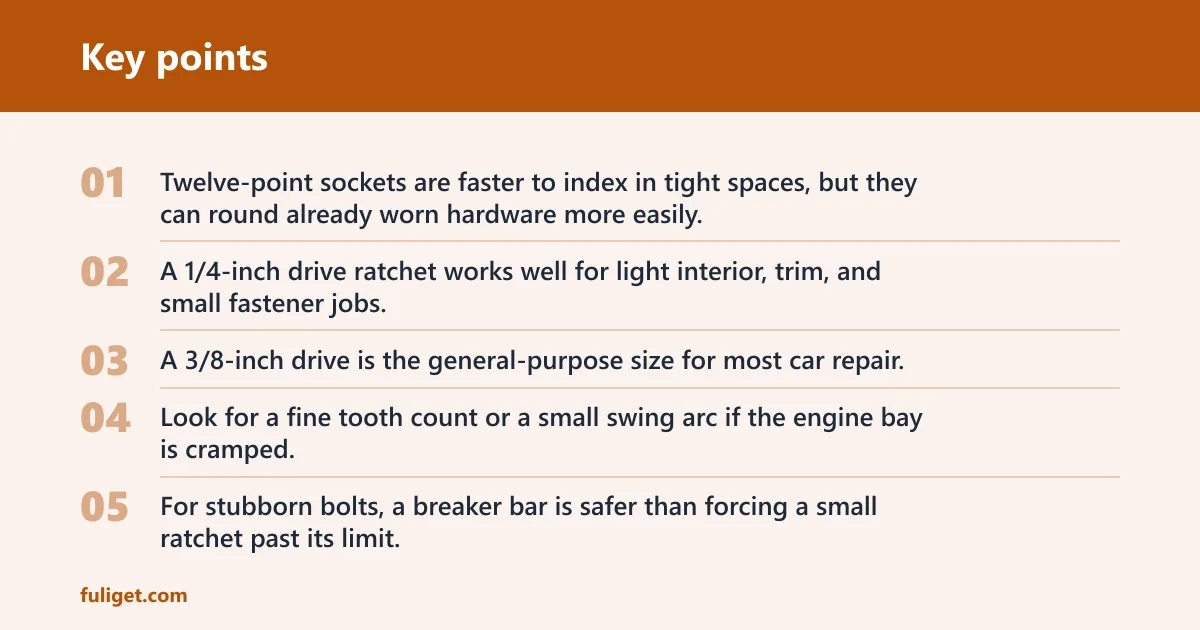
Six-point sockets grip the flats better on stubborn fasteners and are usually the safer choice for high-torque automotive work. Twelve-point sockets are faster to index in tight spaces, but they can round already worn hardware more easily.
Ratchets and drive sizes
A 1/4-inch drive ratchet works well for light interior, trim, and small fastener jobs. A 3/8-inch drive is the general-purpose size for most car repair. A 1/2-inch drive is better for higher torque fasteners, large suspension hardware, and situations where a small ratchet would be overstressed.
Look for a fine tooth count or a small swing arc if the engine bay is cramped. More teeth can help when you only have a few degrees of movement, but the ratchet body and the fastener load still matter. For stubborn bolts, a breaker bar is safer than forcing a small ratchet past its limit.
Combination wrenches
Combination wrenches matter when a socket will not fit around a bolt head or when the fastener sits between hoses and brackets. A practical set usually starts in the same metric range as the sockets, with SAE added for older or mixed vehicles. Offset wrenches help clear obstacles in tight engine-bay spaces.
Extensions, adapters, and universal joints
Extensions are the difference between reaching a recessed fastener and leaving it alone. Short, medium, and long extensions all have a place. Adapters let you move between drive sizes, while a universal joint helps angle into brackets, intake bolts, and other awkward spots where a straight socket cannot line up.
Hex and Torx bits
Newer cars use more hex and Torx fasteners than many beginners expect. Common automotive hex sizes often include 4 mm through 8 mm, and Torx often runs from T20 to T50 for interior panels, sensors, calipers, and accessory components. Bit sockets are better than loose bits because they stay engaged under torque.
Pliers, cutters, and a torque wrench
Needle-nose pliers help with clips and reach. Slip-joint pliers handle odd shapes, and locking pliers can hold stubborn hardware or crushed hose clamps. Wire cutters matter for zip ties and light electrical work. A torque wrench is essential for wheel lugs, brake parts, and other critical fasteners that need a known tightening range.
Choose a torque wrench with the right range for the job. Inch-pound torque wrenches suit small fasteners, while foot-pound models suit wheels, suspension, and many engine-bay bolts. Most manufacturers recommend calibration checks over time, especially if the wrench sees regular use or lives in a crowded drawer.
What a small kit misses first
A small kit usually falls short first on depth, holding power, and specialty bits. If your repairs stay light, that may never matter. Once you reach brake work, suspension hardware, or older rusted fasteners, the missing pieces appear fast and often at the worst possible moment.
Deep sockets and uncommon sizes
Deep sockets are often the first omission that slows a repair. Battery terminals, spark plug tubes, and some studs need the extra reach. Small kits may also skip odd metric sizes or SAE sizes that appear on mixed vehicles, trailer hardware, or older engine-bay parts.
Stubborn fasteners and leverage limits
Small ratchets break sooner when a bolt is seized or overtightened. That is not a quality failure by itself; it is a size limit. A 3/8-inch drive can handle a lot, but suspension bolts, caliper bracket bolts, and rusted exhaust hardware often call for a 1/2-inch drive or a breaker bar.
Missing specialty bits and long reach tools
Compact kits often leave out the extra Torx, hex, and extension combinations that modern cars require. They may also skip universal joints, which are useful when a bolt hides behind a bracket or intake runner. Those gaps do not matter on every job, but they matter on enough jobs to change the buying decision.
Tool kit decision matrix
This matrix maps common DIY jobs to the tool types they usually require, the likely missing pieces in a small kit, and the add-on cost range you may face if you buy gaps separately. The price ranges are broad on purpose because quality and brand vary widely.
| DIY auto job | Required tool types | Small kit or full-size set? | Likely missing tools from a small kit | Estimated add-on cost range |
|---|---|---|---|---|
| Battery service and terminals | 10 mm metric socket, 3/8-inch ratchet, extension, pliers | Both | Deep 10 mm socket, battery clamp wrench, terminal brush | $10-$30 |
| Oil change and filter access | Drain plug socket, oil filter socket or wrench, 3/8-inch ratchet, catch-pan clearance tools | Both | Oil filter cup, larger drain plug size, deep socket | $15-$40 |
| Brake pad and rotor work | 3/8-inch and 1/2-inch sockets, Torx or hex bits, locking pliers, torque wrench | full-size set | Caliper bracket socket, T-handle bits, 1/2-inch drive torque wrench | $40-$120 |
| Spark plug replacement | Deep spark plug socket, extensions, wobble or universal joint, inch-pound torque wrench | full-size set | Deep plug socket, long extension, torque wrench | $35-$100 |
| Air filter and intake work | Socket set, Torx bits, screwdriver-style bit holder, pliers | Both | T15-T30 Torx, long extension, clip tool | $10-$35 |
| Accessory belt jobs | 3/8-inch or 1/2-inch drive, long wrench, extensions, breaker bar | full-size set | Long breaker bar, pulley tool, 1/2-inch drive sockets | $25-$80 |
| Cabin filter replacement | Trim tools, small Torx or hex bits, needle-nose pliers | Both | Trim tool, T20-T25 Torx, small extension | $10-$25 |
| Suspension bolts and sway bar links | 1/2-inch drive sockets, long breaker bar, torque wrench, penetrating-oil-friendly wrench sizes | full-size set | Deep sockets, 1/2-inch ratchet, breaker bar, torque wrench | $50-$150 |
| Interior trim and clips | Trim tools, small sockets, pliers, Torx bits | Both | Plastic trim tools, T15-T20 bits | $10-$30 |
| Basic hose and clamp repairs | Needle-nose pliers, slip-joint pliers, cutters, small sockets | Both | Hose-clamp pliers, long needle-nose, deep socket | $10-$35 |
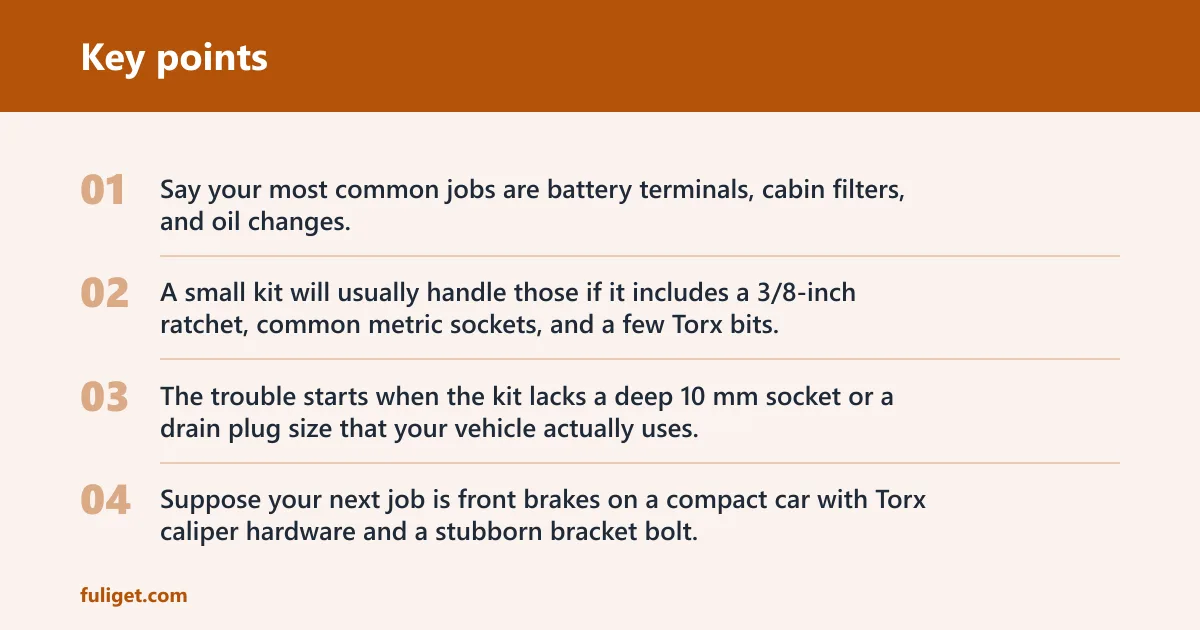
Say your most common jobs are battery terminals, cabin filters, and oil changes. A small kit will usually handle those if it includes a 3/8-inch ratchet, common metric sockets, and a few Torx bits. The trouble starts when the kit lacks a deep 10 mm socket or a drain plug size that your vehicle actually uses.
Suppose your next job is front brakes on a compact car with Torx caliper hardware and a stubborn bracket bolt. A small kit may cover the easy pieces, then stop on the bolt that needs a 1/2-inch drive, a longer bar, or a deeper socket selection. That is the point where the upgrade cost turns from optional to practical.
Choose Small mechanic tool kit if… / Choose full-size set if…
Choose Small mechanic tool kit if you have limited storage, plan basic maintenance, and want the lightest set that can still handle common metric fasteners. Choose full-size set if you expect brake jobs, suspension work, mixed metric-and-SAE vehicles, or repeated repairs that need deep sockets, more Torx and hex sizes, and a 1/2-inch drive.
- Choose Small mechanic tool kit if… you mainly do battery service, oil changes, filters, trim, and hose work.
- Choose Small mechanic tool kit if… you store tools in an apartment, closet, or small cabinet and need a compact case.
- Choose Small mechanic tool kit if… you want to avoid paying for duplicate pieces you may never use.
- Choose full-size set if… you service brakes, spark plugs, or suspension hardware on a regular basis.
- Choose full-size set if… you work on older vehicles, trucks, or a mixed garage where SAE still appears often.
- Choose full-size set if… you would otherwise buy several missing sockets, bits, and a torque wrench one by one.
How many pieces should a beginner mechanic tool set have?
There is no magic piece count, but a beginner set should cover the common fasteners, not simply pad the box. A compact set can work with fewer pieces if it includes the right drive sizes, common metric sockets, a few deep sockets, and a torque wrench. A larger count helps only when it adds real coverage.
For many DIY car owners, the better question is whether the set includes the sizes needed for the car in the driveway. A 120-piece kit can still miss deep sockets or a useful Torx range, while a smaller, well-chosen kit can cover routine work more efficiently.
What sockets and ratchet sizes matter most for cars?
For most cars, start with metric shallow sockets in 8 mm through 19 mm, then add deep sockets for battery, spark plug, and recessed fasteners. A 3/8-inch drive ratchet is the main workhorse, a 1/4-inch drive helps with light fasteners, and a 1/2-inch drive is the safer choice for bigger torque jobs.
Six-point sockets are better for stubborn bolts, while 12-point sockets can speed up access in tight spots with clean fasteners. If space is limited, a fine-tooth ratchet with a smaller swing arc is more useful than a bulky head that cannot move between obstructions.
Is a full-size mechanic set worth the extra money and storage?
A full-size set is worth the extra money when it replaces several separate purchases and reduces the chance of stopping mid-job. If you already know you need deep sockets, Torx bits, long extensions, and a 1/2-inch drive for repeated repairs, the larger set usually costs less than filling those gaps piecemeal.
It also makes sense when the garage has room for drawer storage. That storage pays off by making missing tools obvious and keeping duplicate sockets organized instead of scattered across small cases.
What is the best tool kit size for apartment or garage use?
Apartment users usually benefit most from a compact set because storage and transport matter as much as tool coverage. A small garage can go either way: if you only do maintenance, compact is enough; if you want to handle brakes or suspension, a full-size set with drawer storage is easier to live with.
Think about where the tools will sit between jobs. A molded case is easier to stash. A drawer setup is better once the count grows, because missing pieces show up immediately and the extra room keeps ratchets, sockets, and bits from mixing together.
Can a small mechanic tool kit handle brake, battery, and oil jobs?
A small mechanic tool kit can usually handle battery and oil work, and it may handle simple brake jobs if the vehicle uses common sizes and the kit includes the right bits and extensions. It becomes unreliable when the brake hardware needs a 1/2-inch drive, deep sockets, or a torque wrench that the compact case leaves out.
Battery and oil service are the easiest dividing line. If the kit has a 3/8-inch ratchet, common metric sockets, and a few extensions, those jobs are realistic. Brake work is where the missing pieces show up faster, especially on cars with Torx calipers, rusted fasteners, or tight wheel-well access.
Should I buy a small set now and add tools later?
Buy small first if you are sure your jobs are limited and storage is tight. Add tools later only when a specific repair exposes a repeated gap, such as a missing deep socket or Torx bit. That path works best when you know the car and can predict the next task.
If you already expect brakes, spark plugs, or suspension work, the add-later strategy can cost more. In that case, the full-size set is usually the cleaner buy because it avoids duplicate ratchets, duplicate sockets, and several separate accessory purchases.